
An architect proposes relying only on EBS snapshots to claim multi-AZ high availability for a running EC2 database volume. What is the correct distinction?
Select an answer to reveal the explanation.
Short Explanation
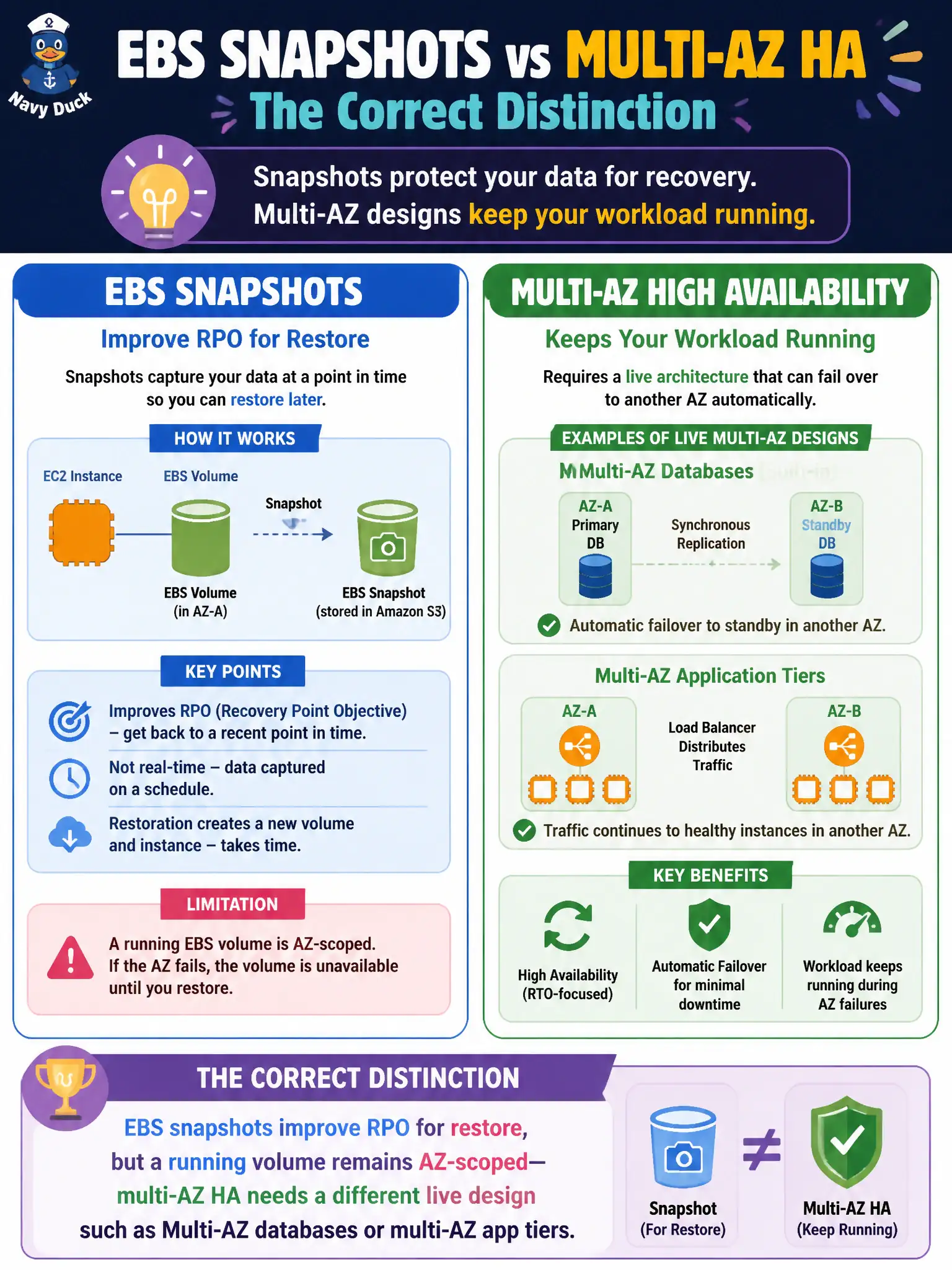
Snapshots are great seatbelts for restore—they don’t make one AZ volume magically run in three AZs at once. Live HA and backup RPO are different tools.
Full Explanation
EBS snapshots improve RPO for restore, but a running EBS volume remains AZ-scoped—so claiming multi-AZ high availability for a live EC2 database volume from snapshots alone is incorrect. The distinction works as teaching content because durability of backup copies in Amazon S3 (via snapshots) is not the same as continuous availability of an attached volume across Availability Zones. If the AZ hosting the instance and volume fails, the live volume is unavailable until you restore or attach elsewhere; that restore path has nonzero RTO and is not automatic multi-AZ failover of the original volume. Live multi-AZ HA requires designs such as Multi-AZ RDS/Aurora or multi-AZ application tiers with replicated or shared-nothing data strategies—not snapshot rhetoric.
The claim that EBS snapshots make a single volume simultaneously online in every AZ without restore fails by concept because snapshots are restore points, not multi-attach live presentation of one volume in all AZs for arbitrary database use. Asserting that snapshots replace Multi-AZ RDS because restore is instantaneous with zero RTO fails because restore and volume warm-up are not zero-RTO automatic failover comparable to Multi-AZ database standby promotion. Asserting that any snapshot automatically fails over the live volume when its AZ fails fails because snapshots do not perform live failover of the attached volume; operators (or automation) must create volumes and remount/reconfigure.
Exam caveat: some architectures use multi-attach io2 for clustered software, but that is a specialized pattern—not “snapshots equal multi-AZ HA.” Operational check: separate backup RPO metrics (snapshot age/success) from availability metrics (Multi-AZ failover drills), and refuse architecture reviews that cite only snapshot schedules as AZ HA evidence for EC2 databases.