
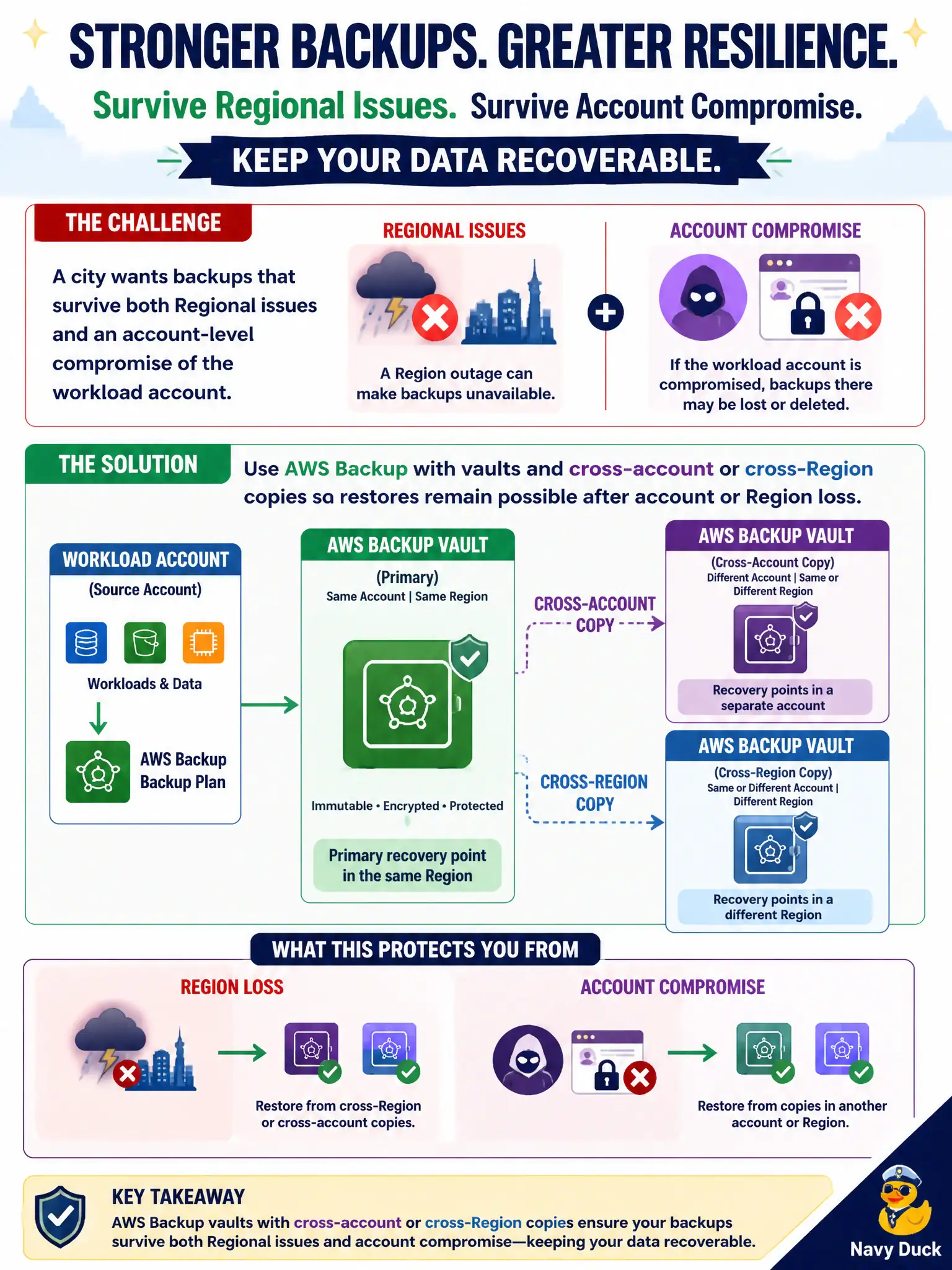
A city wants backups that survive both Regional issues and an account-level compromise of the workload account. Which approach strengthens resilience?
Select an answer to reveal the explanation.
Short Explanation
Backups that live only in the burning building don’t help—copy vaults across accounts or Regions so restore keys aren’t trapped with the outage.
Full Explanation
Using AWS Backup with vaults and cross-account or cross-Region copies strengthens resilience when a city needs restores after Regional issues or an account-level compromise of the workload account. The approach works because recovery points that live only inside the affected account and Region can be encrypted, deleted, or stranded with the same blast radius as the outage. Copying backups to a separate account vault and/or another Region keeps restore keys and data outside that blast radius, which is a core civic continuity control for ransomware and account-compromise scenarios. AWS Backup plans automate frequency, retention, and copy rules so protection is not an ad-hoc snapshot habit.
Keeping a single backup vault only in the compromised account with no external copies fails by concept because account-level loss can include the vault itself. Storing all backups exclusively on the same EBS volume as the production database fails because the backup shares fate with the primary volume and AZ. Disabling backups once Multi-AZ RDS is enabled fails because Multi-AZ provides AZ HA for live failover—it is not an offsite or cross-account backup substitute for logical corruption, ransomware, or Regional loss.
Exam caveat: cross-account copies need KMS and IAM design; a copy you cannot decrypt is not a restore. Operational check: implement a Backup plan with vault lock where appropriate, copy critical municipal recovery points to a hardened backup account and second Region, and perform a restore test from the copy—not from the production vault alone.