
A county’s DR runbook scales out EC2 and load balancers in a standby Region on failover day. What must be true beforehand so scale-out is not throttled?
Select an answer to reveal the explanation.
Short Explanation
Quota day is before disaster day—ask for the headroom in the standby Region while everyone is calm, not while the sirens are already on.
Full Explanation
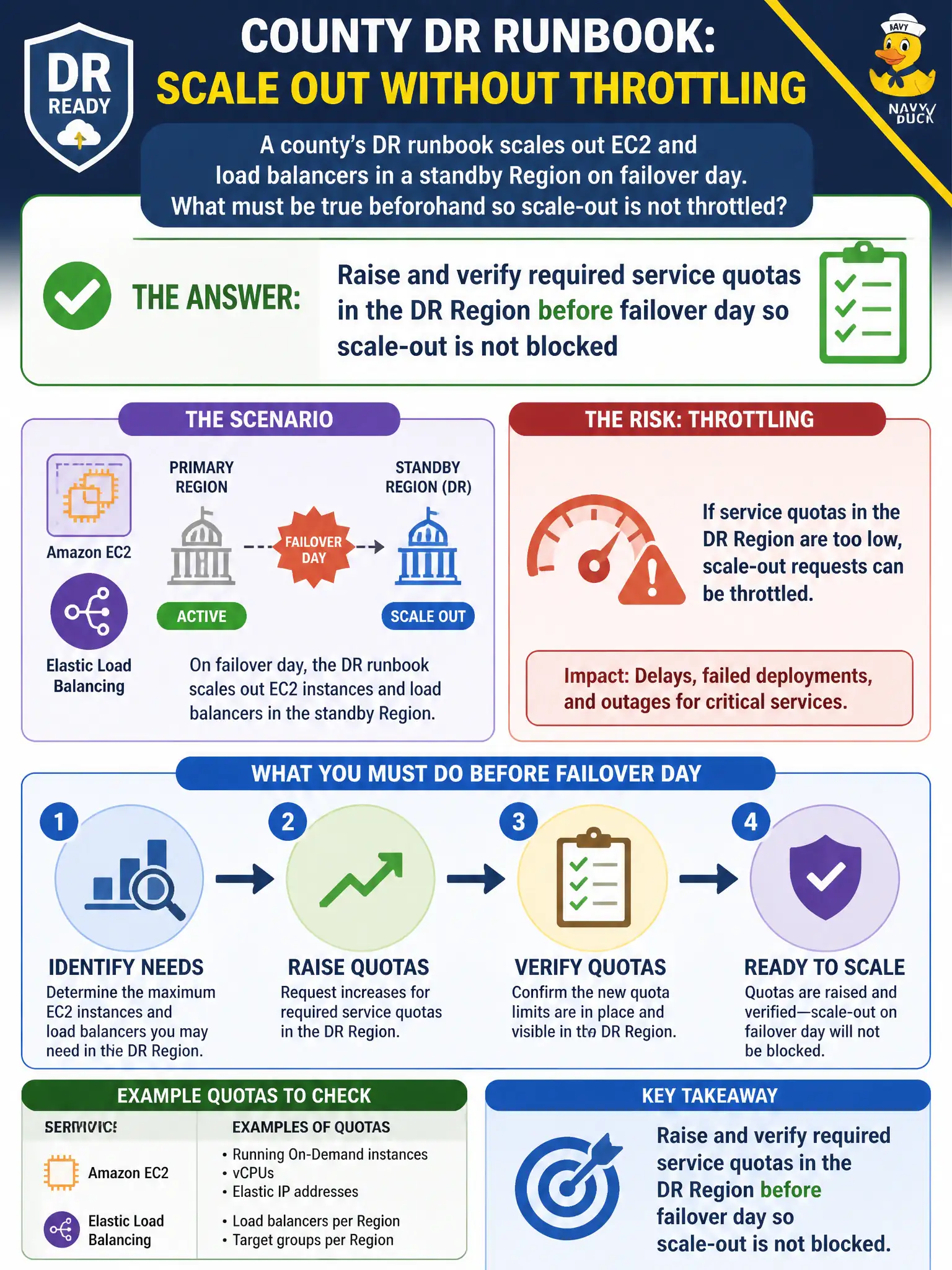
Raising and verifying required service quotas in the DR Region before failover day is what must be true so a county ERP or civic app runbook can scale out EC2 and load balancers without being throttled. The practice works because AWS accounts have per-Region service quotas for instances, ELBs, network interfaces, and related resources; a standby Region that looks empty in peacetime may still reject a sudden surge to production scale on disaster day. Pre-approved quota increases turn DR scale-out into an engineering exercise rather than a support-ticket race while citizens wait. Verification matters: a requested increase is not useful until the console/API shows the new limit and a capacity test can launch representative resources.
Ignoring service quotas because DR Regions automatically inherit unlimited capacity on disaster declaration fails by concept—AWS does not lift quotas automatically when you declare a municipal emergency. Relying only on soft-limit emails after the outage has already started fails because quota tickets and approval latency collide with RTO; waiting until sirens are on is too late. Deleting IAM roles in the DR Region to free quota for more EC2 instances fails because IAM role counts are not a substitute currency for EC2 or ELB quotas; destroying identity posture does not grant compute headroom.
Exam caveat: quotas are necessary but not sufficient—instance type availability and reserved planning still matter during Regional stress. Operational check: inventory peak DR launch counts for EC2, ALB/NLB, EBS, and elastic IPs; submit quota increases in the standby Region; and run a scheduled scale-out drill that proves the new limits before annual tabletop exercises.