
A municipal web tier must survive loss of an Availability Zone without manual redeploy. Which HA design should the architect use?
Select an answer to reveal the explanation.
Short Explanation
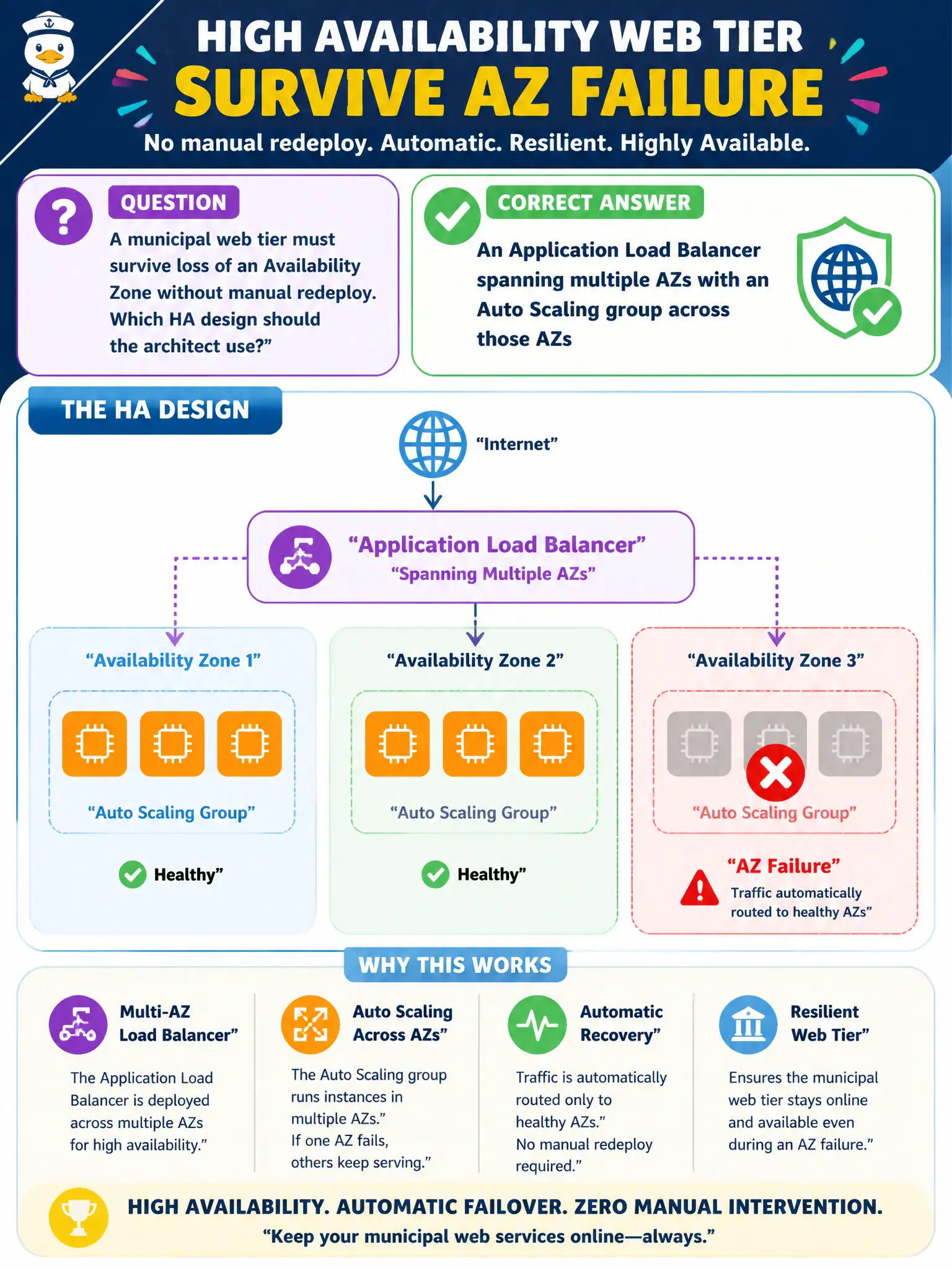
Spread the front door and the workers across AZs—ALB plus multi-AZ Auto Scaling keeps the website up when one AZ naps.
Full Explanation
An Application Load Balancer spanning multiple Availability Zones with an Auto Scaling group across those AZs is the municipal web-tier design that survives loss of an AZ without manual redeploy. The pattern works because the ALB continues distributing citizen traffic to healthy targets in surviving AZs while Auto Scaling replaces capacity lost in the failed AZ according to desired count and health checks. Multi-AZ subnet placement for both the load balancer and the ASG removes the classic single-AZ SPOF that takes down city websites when one data-center facility fails. No manual redeploy is required for the basic AZ-loss case if capacity and health checks are already correct.
One EC2 instance in a single AZ behind no load balancer fails by concept because any instance, AZ, or process failure ends service with no automatic replacement path. An ALB in one AZ only with Auto Scaling max size of one fails because max=1 prevents horizontal recovery and single-AZ ALB placement retains an AZ concentration risk for the entry point. Route 53 weighted records pointing at instance public IPs with no health checks fails because unmanaged public IPs and unmonitored weights neither detect unhealthy targets nor provide AZ-aware load balancing comparable to an ALB plus multi-AZ ASG.
Exam caveat: multi-AZ ASGs still need adequate desired capacity and correct target-group health checks; empty spare AZs without registered targets do not help. Operational check: place ASG subnets in at least two AZs, enable ALB multi-AZ, terminate instances in one AZ during a drill, and confirm the ALB serves only healthy remaining targets while ASG restores count.