
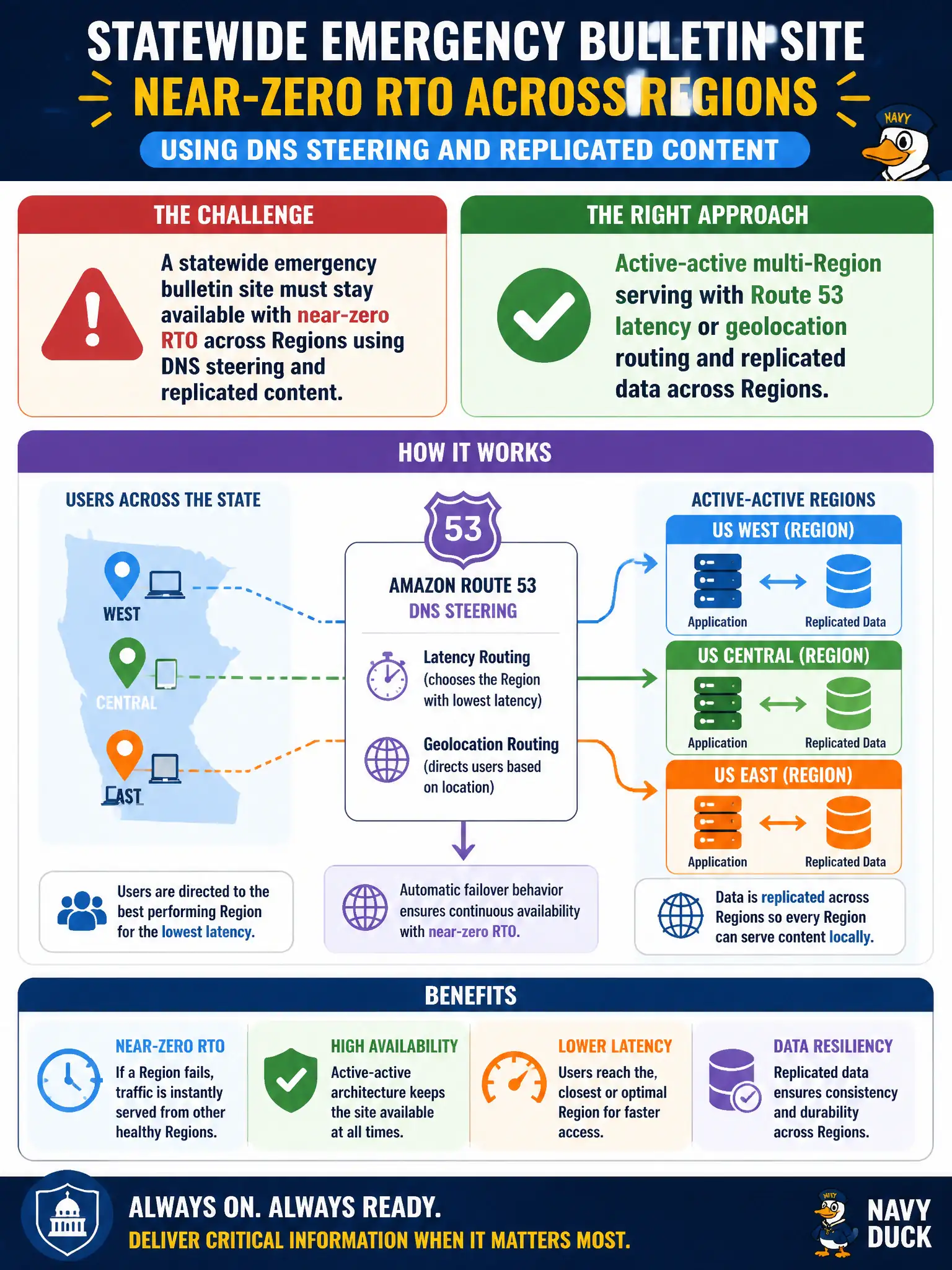
A statewide emergency bulletin site must stay available with near-zero RTO across Regions using DNS steering and replicated content. Which approach fits?
Select an answer to reveal the explanation.
Short Explanation
Emergency bulletins need both cities’ billboards lit—active-active with Route 53 pointing people to healthy Regions and data already copied over.
Full Explanation
Active-active multi-Region serving with Amazon Route 53 latency or geolocation routing and replicated content fits a statewide emergency bulletin site that must stay available with near-zero RTO across Regions. The design works because healthy Regional origins continue answering citizen requests without waiting for a cold recovery, while Route 53 health checks and routing policies steer users toward the best or geographically appropriate Region. Replicated static or near-static bulletin content—often on S3/CloudFront or multi-Region datastores—ensures each Region can answer independently when another Region degrades. For emergency communications, that continuous multi-Region posture is the availability pattern that matches near-zero RTO language.
Single-Region ALB only, relying on AZ diversity inside one Region, fails by concept because multi-AZ HA is not multi-Region HA; a Regional event can still take the bulletin offline statewide. Pilot light with manual DNS edits after a multi-day recovery workshop fails because manual, workshop-paced cutover cannot deliver near-zero RTO for emergency bulletins. A single NAT gateway in one AZ advertised as the global bulletin origin fails because a NAT is an egress construct for private subnets, not a global content origin, and concentrating on one AZ creates an obvious SPOF unrelated to active-active serving.
Exam caveat: active-active needs conflict/replication rules for any writable bulletin workflows; read-mostly emergency pages are simpler than dual-write transactional systems. Operational check: configure Route 53 health checks against each Regional endpoint, validate latency/geolocation policies, and rehearse withdrawing one Region while confirming citizens still receive current bulletins from the remaining Region.