
A 911 CAD reporting database must survive an Availability Zone outage with automatic failover and minimal operator heroics. Which database HA design should the city choose?
Select an answer to reveal the explanation.
Short Explanation
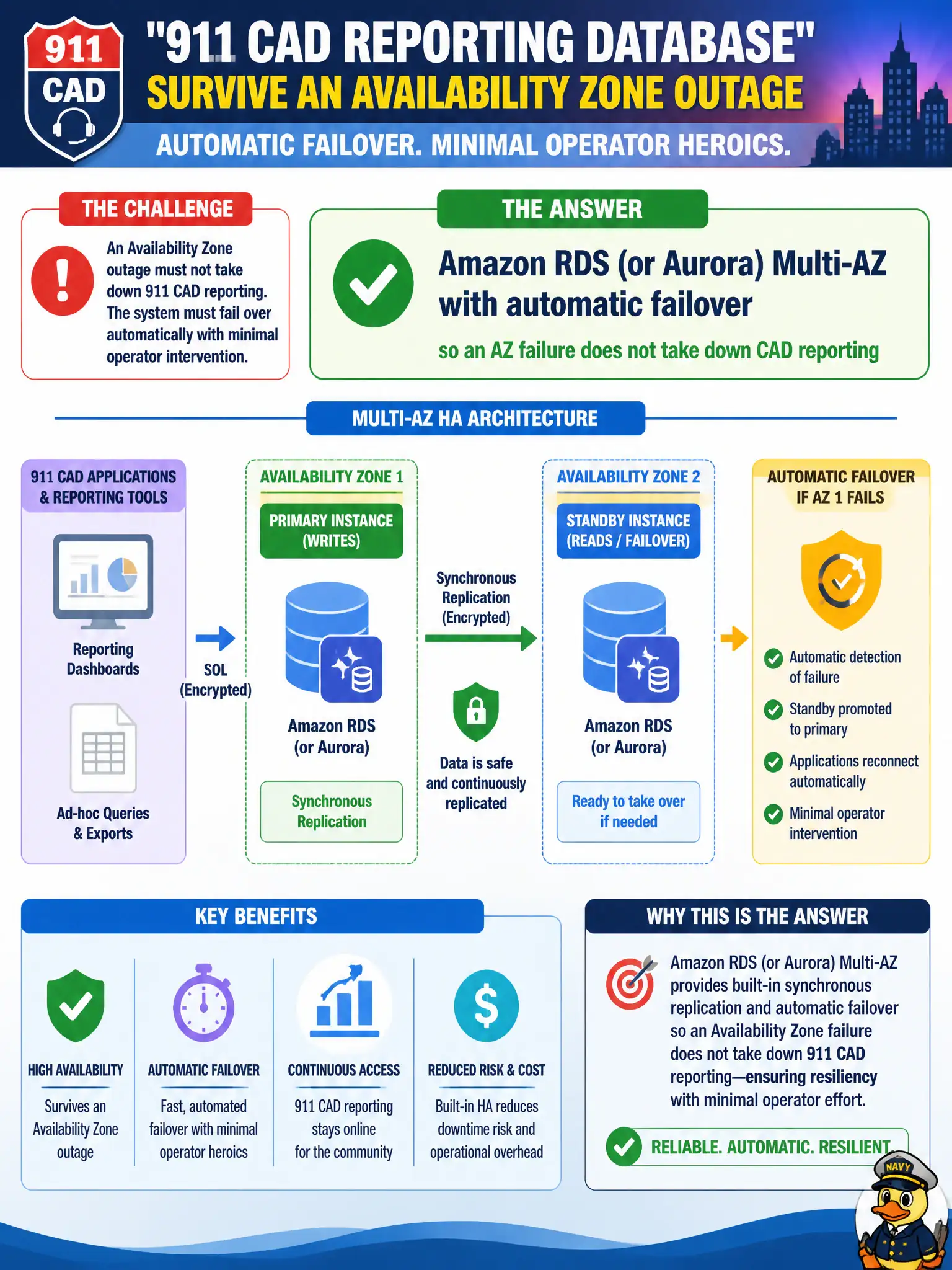
911 reporting can’t wait for someone to rebuild a disk from a snapshot after an AZ blinks. Multi-AZ RDS keeps a standby ready and fails over for you.
Full Explanation
Amazon RDS or Aurora Multi-AZ with automatic failover is the right high-availability design for a 911 CAD reporting database that must survive an Availability Zone outage with minimal operator heroics. Multi-AZ works because the service maintains a synchronous standby in another AZ and can promote that standby automatically when the primary AZ fails, preserving a single endpoint for applications and shortening recovery compared with manual rebuilds. For public-safety reporting, that managed AZ-level HA aligns with the need for continuity without waiting on night-shift runbooks. The city’s operational burden drops because failover is a platform feature rather than an ad-hoc restore exercise.
A single-AZ RDS instance with nightly EBS snapshots only and manual restore during outages fails by concept because snapshots aid RPO for restore but do not keep a live standby ready; RTO depends on operator action and rebuild time during a crisis. An EC2-hosted MySQL on one instance with no standby and SSH-based rebuild runbooks fails because a lone AZ-scoped host is a classic SPOF and human rebuilds are too slow and error-prone for 911-adjacent reporting. DynamoDB global tables in one AZ only with eventual consistency disabled fails on multiple counts: global tables are a multi-Region concept, DynamoDB already replicates within a Region across AZs by design, and “eventual consistency disabled” misstates how you configure DynamoDB consistency—none of that substitutes for stating Multi-AZ RDS/Aurora correctly.
Exam caveat: Multi-AZ failover still incurs brief interruption; applications should use reconnect/backoff and not assume zero dropped connections. Operational check: confirm Multi-AZ is enabled on the CAD reporting instance/cluster, test failover in a maintenance window, and verify reporting clients reconnect to the same endpoint without manual DNS or IP edits.