
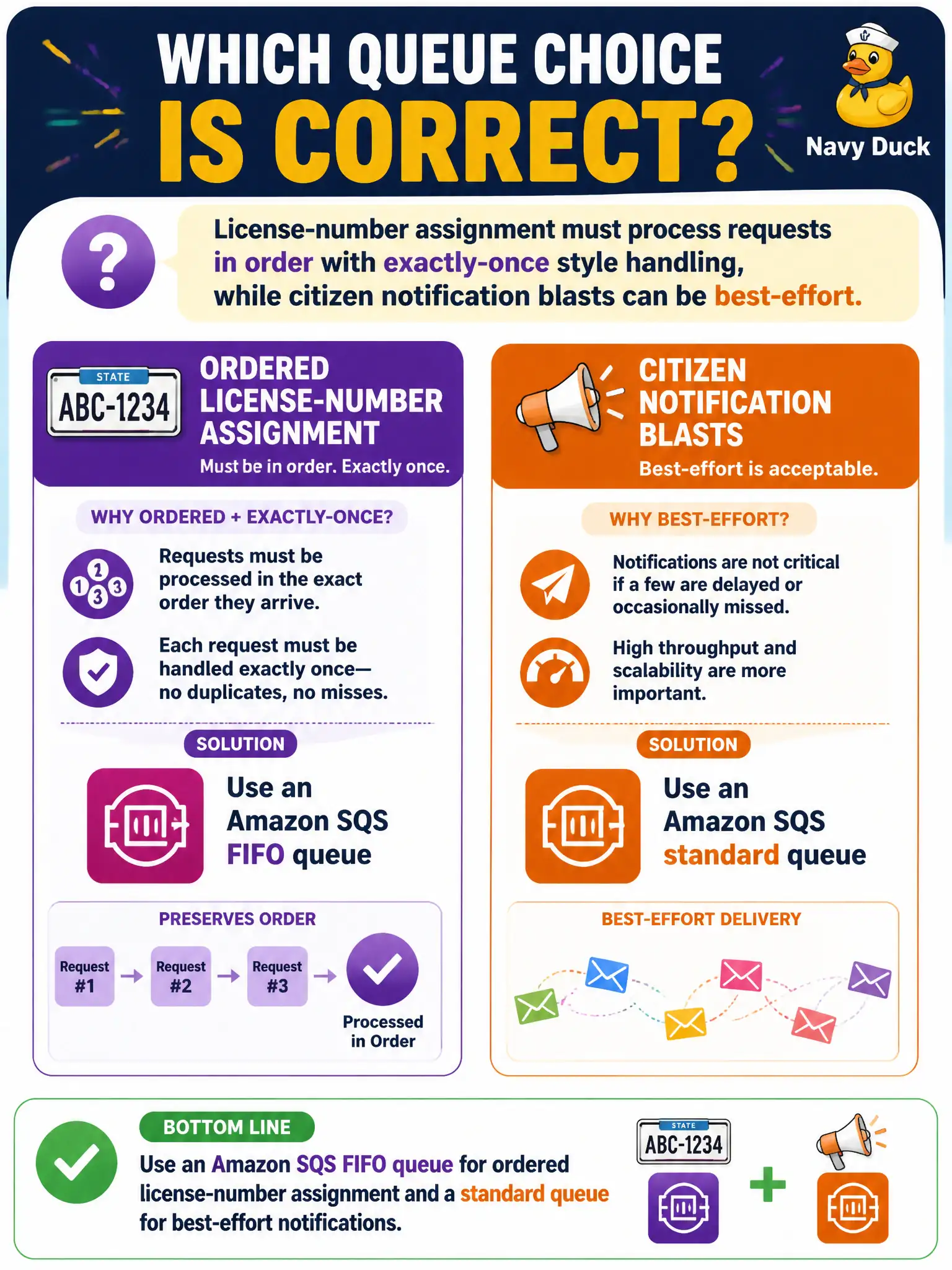
License-number assignment must process requests in order with exactly-once style handling, while citizen notification blasts can be best-effort. Which queue choice is correct?
Select an answer to reveal the explanation.
Short Explanation
FIFO is the numbered deli ticket for license IDs; standard queues are the flyer drop for “we’ll get to you.” Don’t flip those—or hope S3 overwrites and email somehow serialize IDs.
Full Explanation
License-number assignment needs ordering and exactly-once-style processing, so an Amazon SQS FIFO queue is the correct choice for that path; citizen notification blasts that can be best-effort fit a standard SQS queue with higher throughput. FIFO provides per-message-group ordering and deduplication semantics suited to sequential ID assignment, while standard queues favor scale for non-critical fan-out notices.
Using a standard queue for license-number assignment and a FIFO queue only for unimportant logs fails by concept because it inverts the ordering requirement—assignment is what needs FIFO, not low-value logs. Avoiding queues and writing license numbers with concurrent unsynchronized PutObject calls to the same S3 key fails because S3 overwrites do not provide coordinated exactly-once allocation. Using Amazon SNS raw email for license-number allocation because “email guarantees global ordering” fails: email does not provide distributed exactly-once ID assignment semantics.
Exam caveat: Ordered / exactly-once-style work → SQS FIFO; high-throughput best-effort → standard SQS. Do not assign FIFO to trivia and standard queues to serialization-critical work.
Operational check: Confirm license assignment uses FIFO with a sensible MessageGroupId, content-based or explicit deduplication is configured, notification traffic uses standard queues, and consumers are idempotent where required. If two workers can mint the same license number from a standard queue, the ordering design is wrong.