
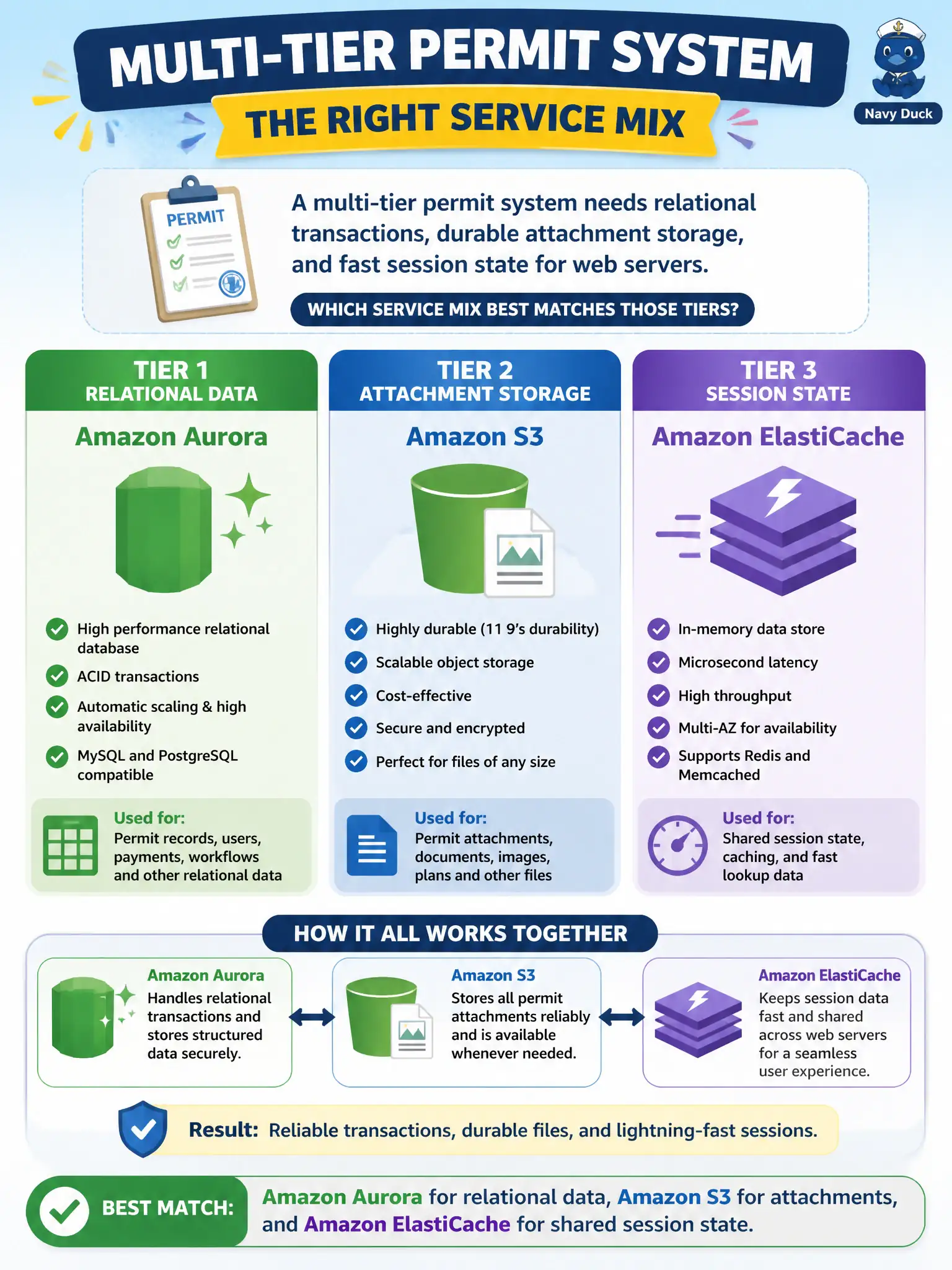
A multi-tier permit system needs relational transactions, durable attachment storage, and fast session state for web servers. Which service mix best matches those tiers?
Select an answer to reveal the explanation.
Short Explanation
Give each floor the right furniture: Aurora for the permit ledger, S3 for the attachment attic, ElastiCache for quick session sticky-notes the web desks share. Using S3 as your OLTP database is the wrong floor plan.
Full Explanation
A multi-tier permit system should use Amazon Aurora for relational transactions, Amazon S3 for durable attachment storage, and Amazon ElastiCache for fast shared session state across web servers. Aurora (MySQL/PostgreSQL-compatible) handles OLTP transactions; S3 stores citizen attachment objects durably and cheaply; ElastiCache gives low-latency session data that Auto Scaling web nodes can share. That mix matches each tier’s access pattern.
Using S3 for the relational OLTP database, RDS for binary attachments, and instance store alone for sessions across an Auto Scaling group fails by concept: S3 is not a relational transaction engine, RDS is awkward as a bulk binary attachment store versus S3, and instance store sessions break when instances replace. ElastiCache as the system of record for permits, EBS snapshots as the only citizen attachment store, and SNS for session cookies misuses a cache as SOR, snapshots as live attachment storage, and a pub/sub service for HTTP sessions. DynamoDB Streams only for relational joins, local desktop disks for attachments, and Amazon MQ for HTTP sessions fails similarly by wrong-tooling each tier.
Exam caveat: Relational OLTP → Aurora/RDS; large binary attachments → S3; shared ephemeral session state → ElastiCache. Exam distractors swap these roles deliberately.
Operational check: Confirm permit writes commit in Aurora, attachments are S3 object keys referenced from the DB, sessions live in ElastiCache with appropriate TTLs, and web ASG instances remain interchangeable. If sessions sit on instance store or attachments live only on desktop disks, the tier mix is wrong.