
A city media desk runs containerized image-resizers that sit idle most nights and must not pay for idle capacity. Which approach best meets scale-to-zero for intermittent work?
Select an answer to reveal the explanation.
Short Explanation
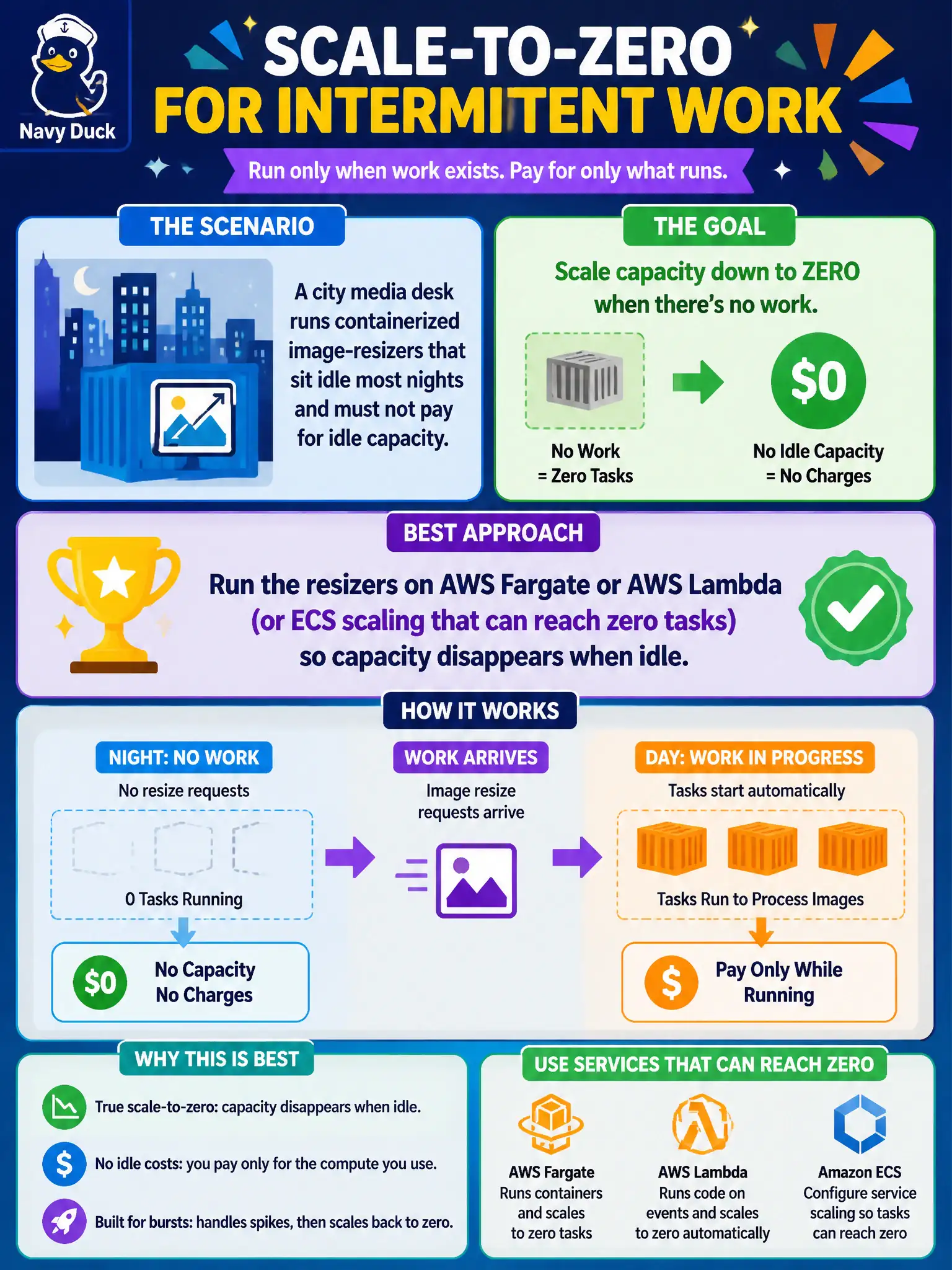
Nighttime resizers should clock out like seasonal park staff—Fargate or Lambda (and ECS patterns that scale to zero) only work when there’s a queue. Ten always-on boxes or a forever Reserved Instance leave the lights on for nobody.
Full Explanation
Intermittent city media desk image-resizers should run on AWS Fargate or AWS Lambda (or ECS services that can scale to zero tasks) so capacity disappears when the nightly queue is empty. Scale-to-zero means the municipality does not pay for idle parade-day fleets at 3 a.m.; workers appear when jobs arrive and vanish when idle. That is the correct economic pattern for bursty, non-continuous batch work.
Keeping a minimum of ten always-on EC2 workers sized for the busiest parade day fails by concept because it forces continuous spend for mostly idle capacity. Running resizers only on Reserved Instances that cannot stop when the queue is empty fails because reservations optimize steady-state commitment—they do not create scale-to-zero behavior for intermittent queues. Pinning one oversized bare-metal host in a single AZ as a permanent resize appliance fails as both a cost and resilience anti-pattern: always-on, single-AZ, and sized for peak forever.
Exam caveat: Scale-to-zero / intermittent batch → Lambda, Fargate, or ECS desired count that can reach zero. Always-on EC2 floors, inflexible RIs for idle work, and single bare-metal appliances contradict the idle-cost requirement.
Operational check: Verify the service or function scales from zero on queue depth or events, CloudWatch shows zero running tasks during idle nights, and cost reports reflect no large idle EC2 baseline for the resizer fleet. If ten workers sit warm all night with empty queues, scale-to-zero is not achieved.