
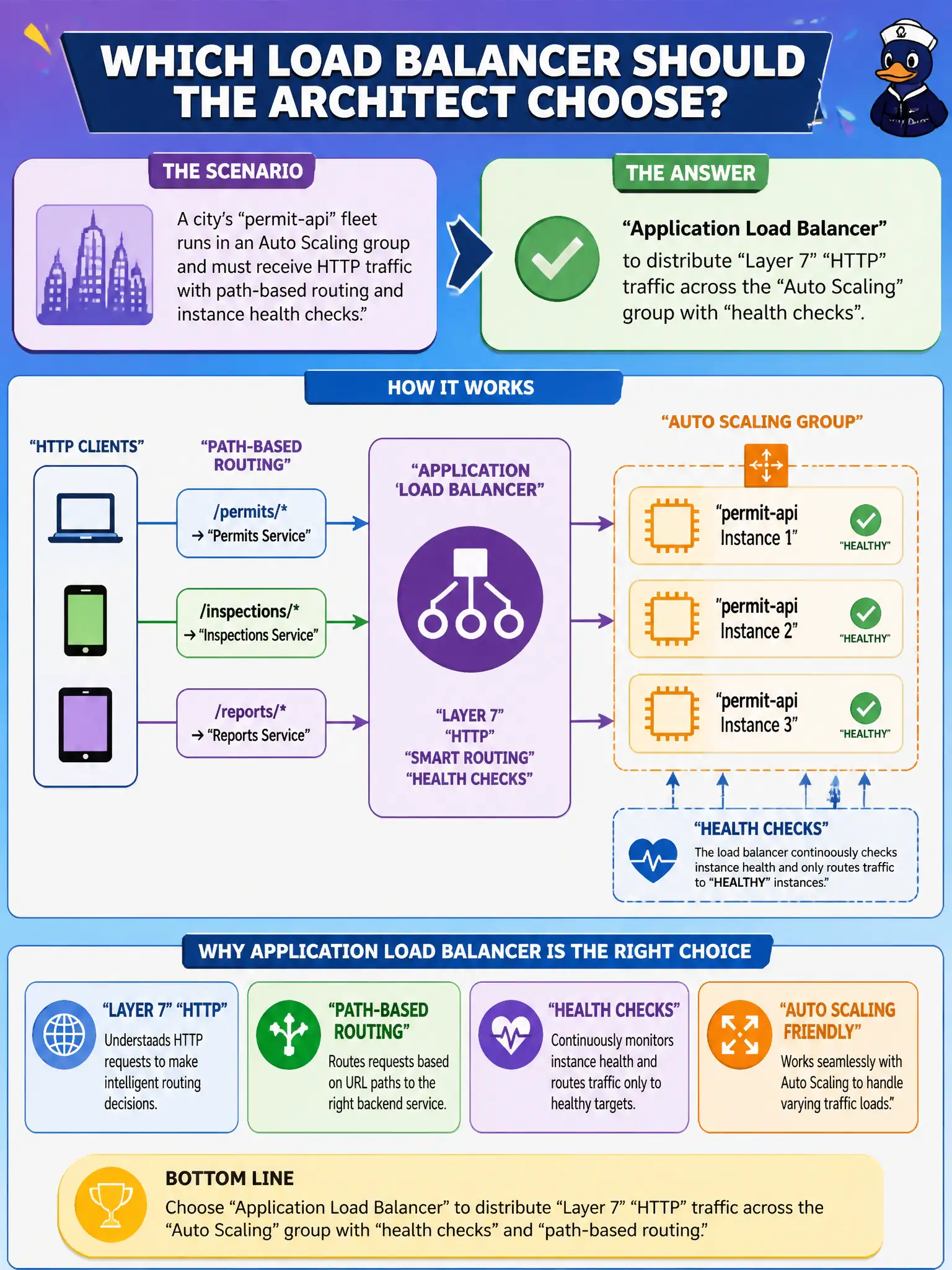
A city’s permit-api fleet runs in an Auto Scaling group and must receive HTTP traffic with path-based routing and instance health checks. Which load balancer should the architect choose?
Select an answer to reveal the explanation.
Short Explanation
An ALB is the traffic cop that understands HTTP paths and can pull unhealthy permit-api cars out of the lane. NLBs are great for raw TCP, Gateway Load Balancer is for appliances, and raw Route 53 to instance IPs skips real L7 health and scaling hygiene.
Full Explanation
An Application Load Balancer is the right front door for the city’s permit-api Auto Scaling group when traffic is HTTP with path-based routing and instance health checks. ALBs operate at Layer 7, understand host and path rules, integrate natively with Auto Scaling target groups, and perform HTTP(S) health checks so unhealthy instances leave the rotation without manual intervention. That matches civic API fleets that need content-aware routing rather than raw TCP pass-through.
A Network Load Balancer configured only for TCP pass-through without HTTP health checks fails by concept for this stem: NLB shines at ultra-low-latency Layer 4 forwarding, but it does not provide the path-based HTTP routing the architect needs. A Gateway Load Balancer in front of each EC2 instance to terminate TLS for browsers fails because GWLB is for inserting third-party network appliances (firewalls, IDS) into the path—not for terminating citizen browser TLS or distributing application HTTP. Amazon Route 53 weighted records pointing at individual instance public IPs with no load balancer fails because DNS alone does not give true L7 health-checked load distribution, connection draining, or clean Auto Scaling integration for a dynamic fleet.
Exam caveat: Match load balancer type to traffic layer and features. HTTP path/host routing and HTTP health checks → ALB. Extreme TCP/UDP performance or static IPs → NLB. Inline security appliances → GWLB. Pure DNS is not a substitute for an application load balancer.
Operational check: Verify target groups use HTTP health checks on a meaningful path, listener rules route permit-api paths correctly, Auto Scaling registers and deregisters instances automatically, and access logs show balanced distribution. If operators still point Route 53 at individual instance IPs, the L7 load-balancing design is not in place.