
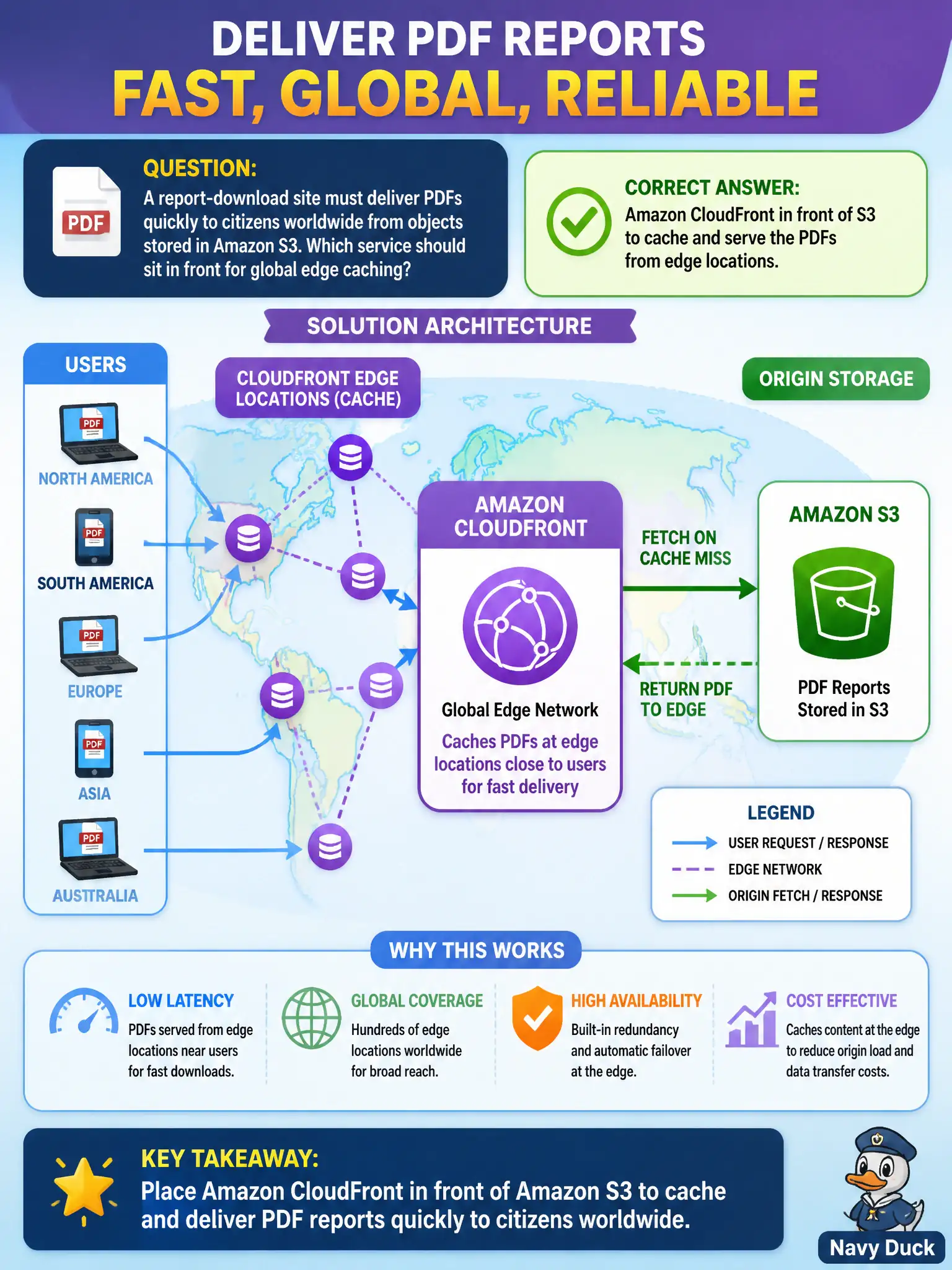
A report-download site must deliver PDFs quickly to citizens worldwide from objects stored in Amazon S3. Which service should sit in front for global edge caching?
Select an answer to reveal the explanation.
Short Explanation
World-wide PDF grabs want a CDN porch light—CloudFront caches from S3 at the edge. DataSync, MQ, and Direct Connect solve other problems; they are not citizen download CDNs.
Full Explanation
A report-download site that must deliver S3-stored PDFs quickly to citizens worldwide needs a content delivery network at the edge. Amazon CloudFront in front of S3 caches objects at edge locations, reducing latency and origin load for global readers. Pairing CloudFront with an S3 origin (often via origin access control) is the standard architecture for municipal public document distribution, allowing the bucket to stay private while the CDN serves cached PDFs. Regional S3 alone forces distant citizens to pull every byte from one Region’s origin on cache misses.
AWS DataSync moves data between storage locations and on-premises systems; it is not a public download CDN and does not terminate citizen HTTPS at global PoPs. Amazon MQ is a message broker for application messaging, not an edge cache for static PDFs. AWS Direct Connect provides private connectivity from a datacenter to AWS, which helps hybrid networks but is not a substitute for a global CDN serving citizens on the public internet.
Exam caveat: CloudFront is the CDN answer for global static acceleration from S3; do not confuse it with S3 Transfer Acceleration (optimized uploads) or DataSync (migration/replication). Operational check: create a CloudFront distribution with the reports bucket as origin, restrict direct public bucket access, test download latency from multiple Regions, set appropriate TTLs for PDF versions, and invalidate paths when a report is corrected.