
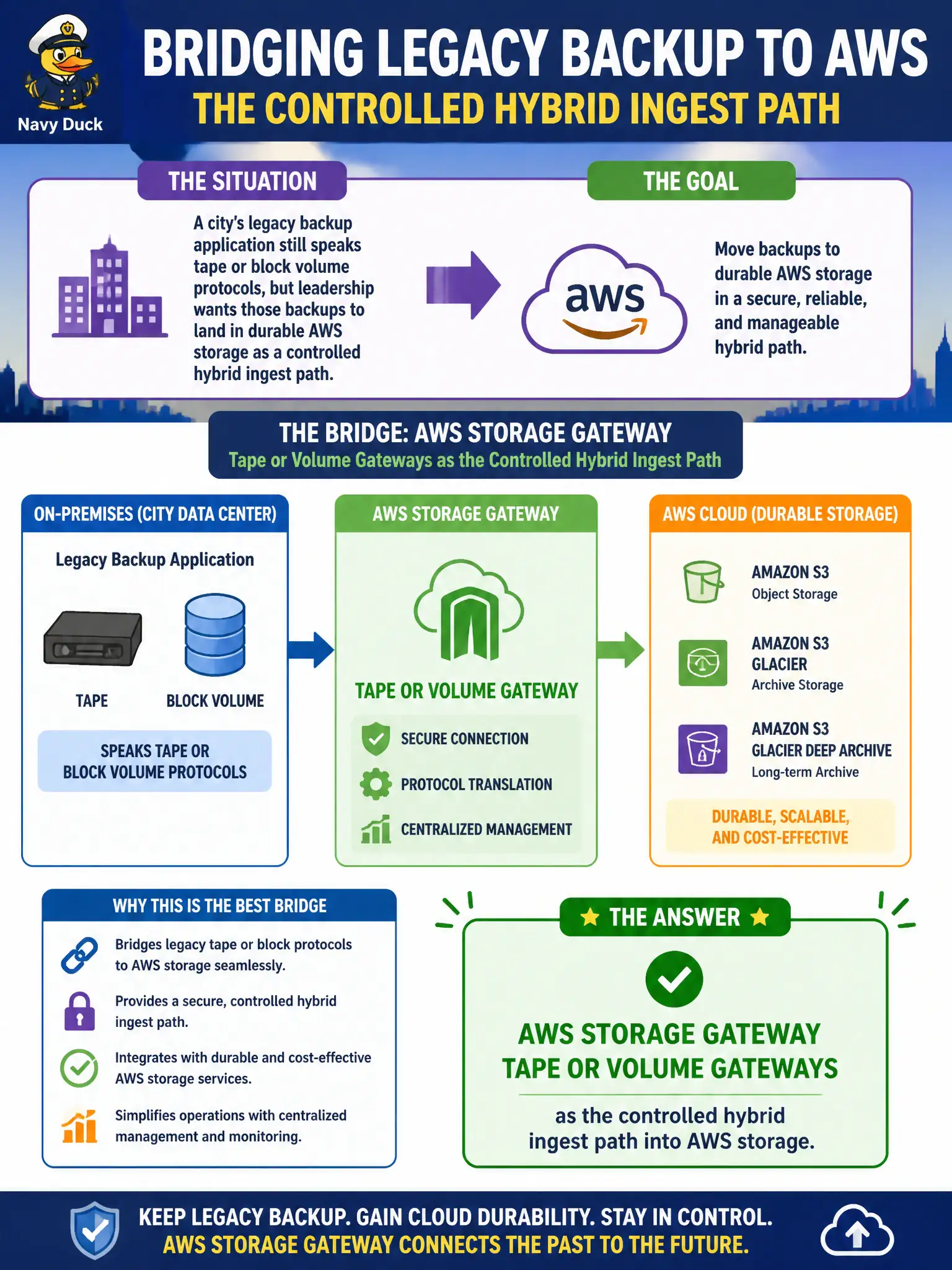
A city’s legacy backup application still speaks tape or block volume protocols, but leadership wants those backups to land in durable AWS storage as a controlled hybrid ingest path. Which service best bridges that legacy path?
Select an answer to reveal the explanation.
Short Explanation
Legacy backup apps often still think in tapes and volumes—not REST. Storage Gateway presents those familiar interfaces while sliding the bytes into AWS storage behind the scenes. CloudFront, Cognito, and Polly solve CDN, identity, and speech—not hybrid backup ingest.
Full Explanation
AWS Storage Gateway tape or volume gateways best bridge a legacy backup application that still speaks tape or block volume protocols into durable AWS storage. The gateway presents familiar virtual tape library or volume interfaces on-premises while persisting data into AWS-backed storage behind the scenes, giving the city a controlled hybrid ingest path without an immediate rewrite of the backup software. Amazon CloudFront origin failover to empty S3 buckets is a CDN high-availability pattern, not a backup ingest bridge. Amazon Cognito user pools authenticate end users for apps; they do not translate tape/block backup protocols into AWS storage. Amazon Polly narrating backup job logs into MP3 files on EBS confuses text-to-speech with backup data movement and stores audio on block volumes rather than solving hybrid backup durability. Exam caveat: choose tape gateway versus volume gateway based on whether the app expects VTL/tape workflows or iSCSI volumes, and understand caching, upload buffers, and retrieval latency characteristics for restores. Operational check: deploy a pilot gateway, run a non-production backup set end-to-end, perform a test restore, monitor upload buffer and cloud storage growth, and document runbooks before pointing production municipal backup jobs at the gateway.