
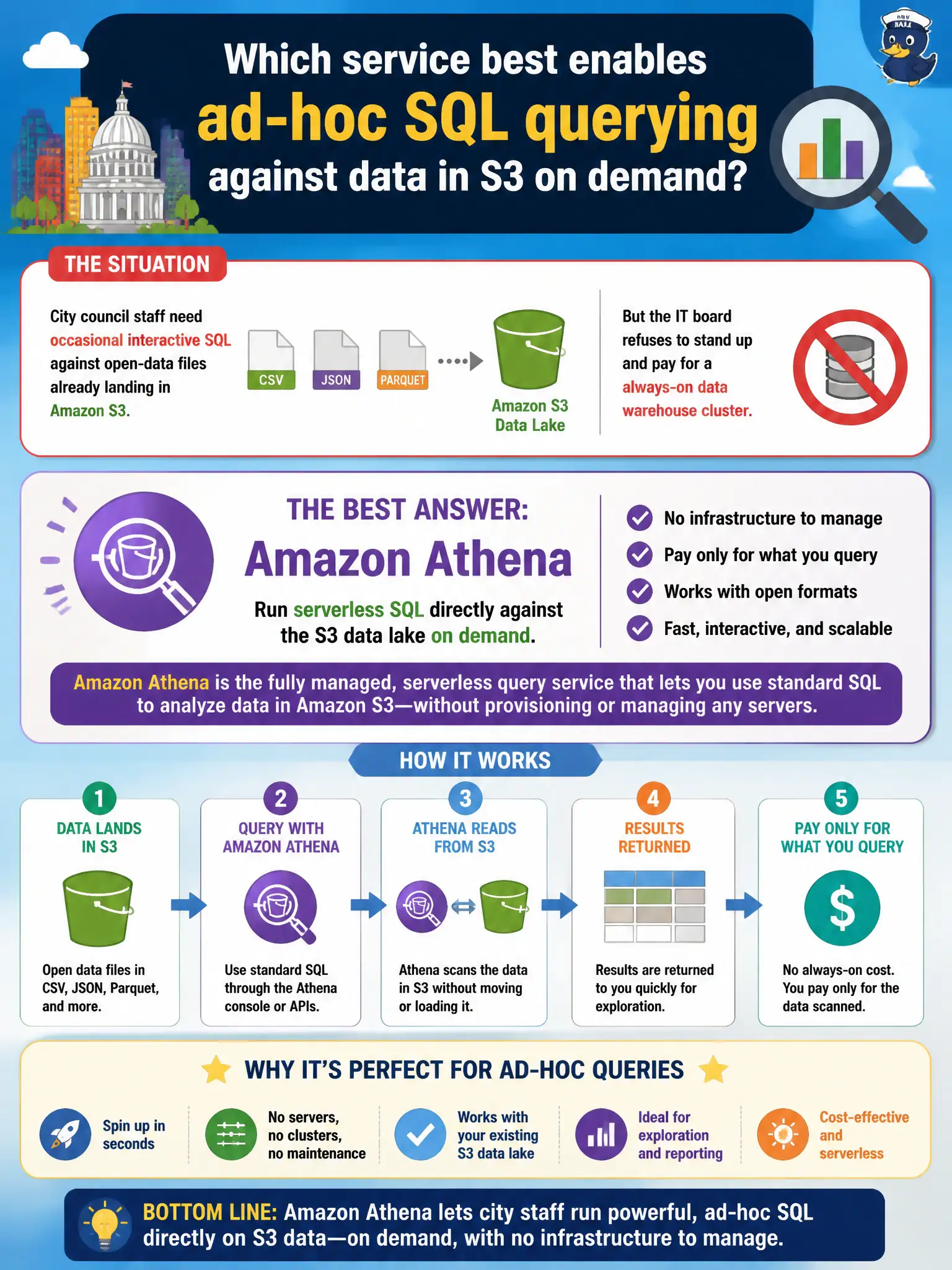
City council staff need occasional interactive SQL against open-data files already landing in Amazon S3, but the IT board refuses to stand up and pay for a always-on data warehouse cluster. Which service best enables that ad-hoc querying pattern?
Select an answer to reveal the explanation.
Short Explanation
Council questions are like pop quizzes—you don’t keep a whole classroom powered on for one pop quiz a week. Athena lets staff run SQL on S3 when they need it and shut the meter off when they don’t. Always-on RDS, DIY Hadoop, or Direct Connect-to-Excel miss the serverless lake idea.
Full Explanation
Amazon Athena is the best match for occasional interactive SQL against open-data files already in Amazon S3 when the IT board refuses an always-on warehouse cluster. Athena is serverless: council staff pay for queries they run against the lake, and there is no requirement to keep a cluster warm for rare questions. That pattern aligns cost with sporadic municipal inquiry volume. Amazon RDS for MySQL with a multi-AZ instance left running continuously for rare questions keeps compute and storage billed whether or not anyone asks a question, conflicting with the board’s cost posture. Amazon EC2 hosts running self-managed Hadoop NameNodes for every department create heavy operational and always-on cost overhead for ad-hoc SQL that a managed serverless engine already covers. AWS Direct Connect dedicated to streaming each CSV row into on-premises Excel macros is an expensive private-connectivity project that still ends in desktop analytics rather than a governed S3 lake query layer. Exam caveat: Athena performance and cost still depend on file format, compression, and partitioning; serverless does not excuse scanning giant CSV blobs. Operational check: grant least-privilege Athena/Glue/S3 access to the council analytics role, run representative open-data queries, review bytes scanned in CloudTrail/Cost Explorer, and confirm results match trusted source extracts before publishing dashboards.