
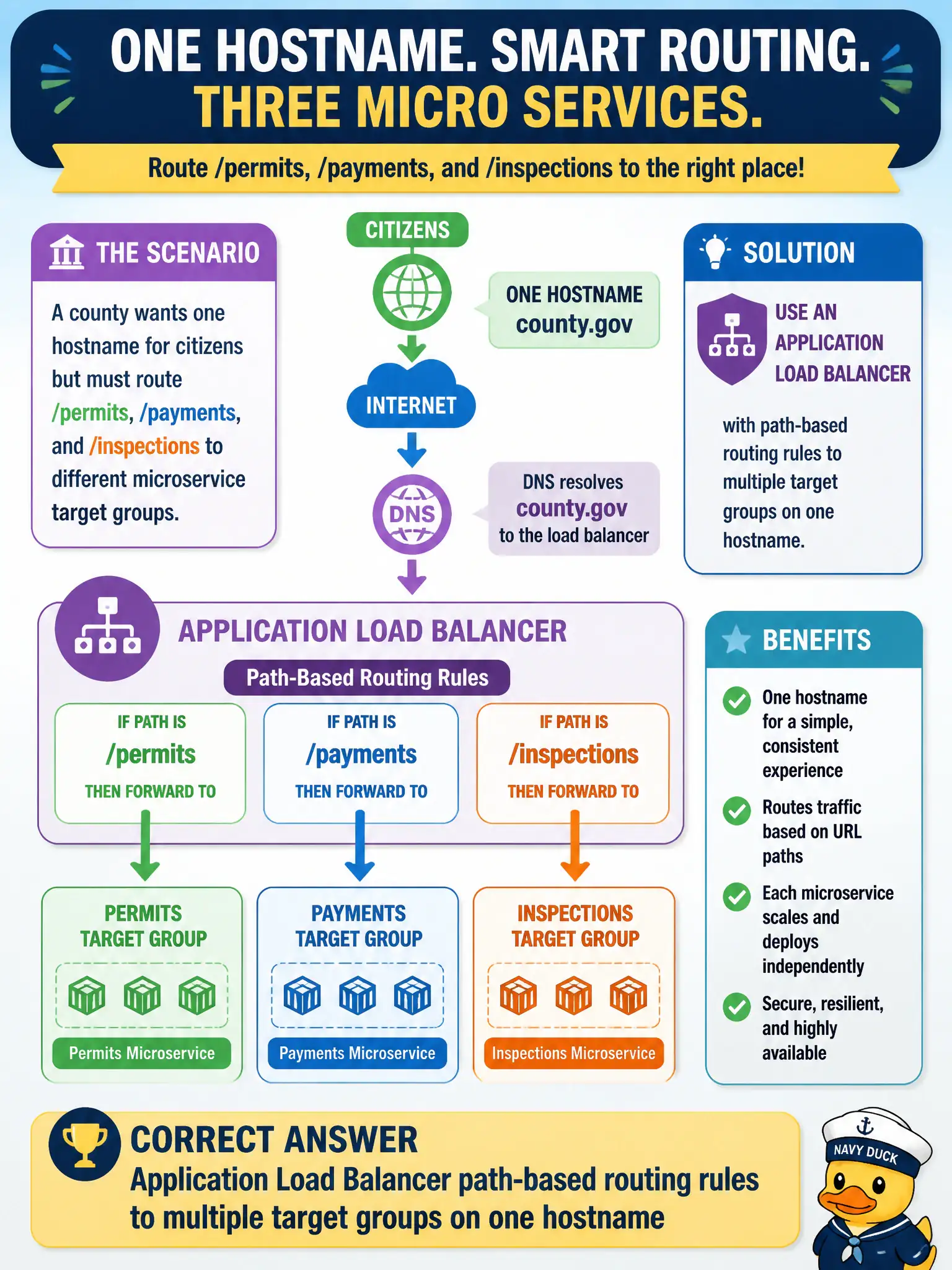
A county wants one hostname for citizens but must route /permits, /payments, and /inspections to different microservice target groups. Which load balancer capability fits?
Select an answer to reveal the explanation.
Short Explanation
One city website address, three departments behind the counter—path rules send /permits, /payments, and /inspections to the right desk. That is ALB layer-7 routing, not a random UDP hose.
Full Explanation
A county that wants one citizen-facing hostname while sending /permits, /payments, and /inspections to different microservice target groups needs Layer-7 HTTP routing. An Application Load Balancer (ALB) evaluates listener rules on path patterns (and optionally host headers) and forwards each request to the correct target group—permits service, payments service, or inspections service—behind a single DNS name. That pattern keeps the municipal portal’s public URL simple while allowing independently scaled microservices underneath.
A Classic Load Balancer with random UDP spray and no HTTP path rules cannot express path-based microservice routing for an HTTP portal. AWS Global Accelerator improves routing to Regional endpoints using anycast IPs; it does not rewrite URL paths inside packets to choose microservices the way ALB path rules do. Amazon CloudFront signed cookies control access to cached content; they are not the primary mechanism for choosing among VPC microservice target groups on one hostname.
Exam caveat: ALB path rules require HTTP/HTTPS applications. For pure TCP without HTTP semantics, Network Load Balancer or Global Accelerator patterns apply instead. Rule priority ordering matters when paths overlap (for example /payments vs /payments/receipts).
Operational check: create listener rules for each path prefix to distinct target groups; confirm health checks pass per service; hit https://portal.example.gov/permits and /payments from a test client and verify traffic lands on the intended targets; and review access logs when a new municipal microservice is onboarded.