
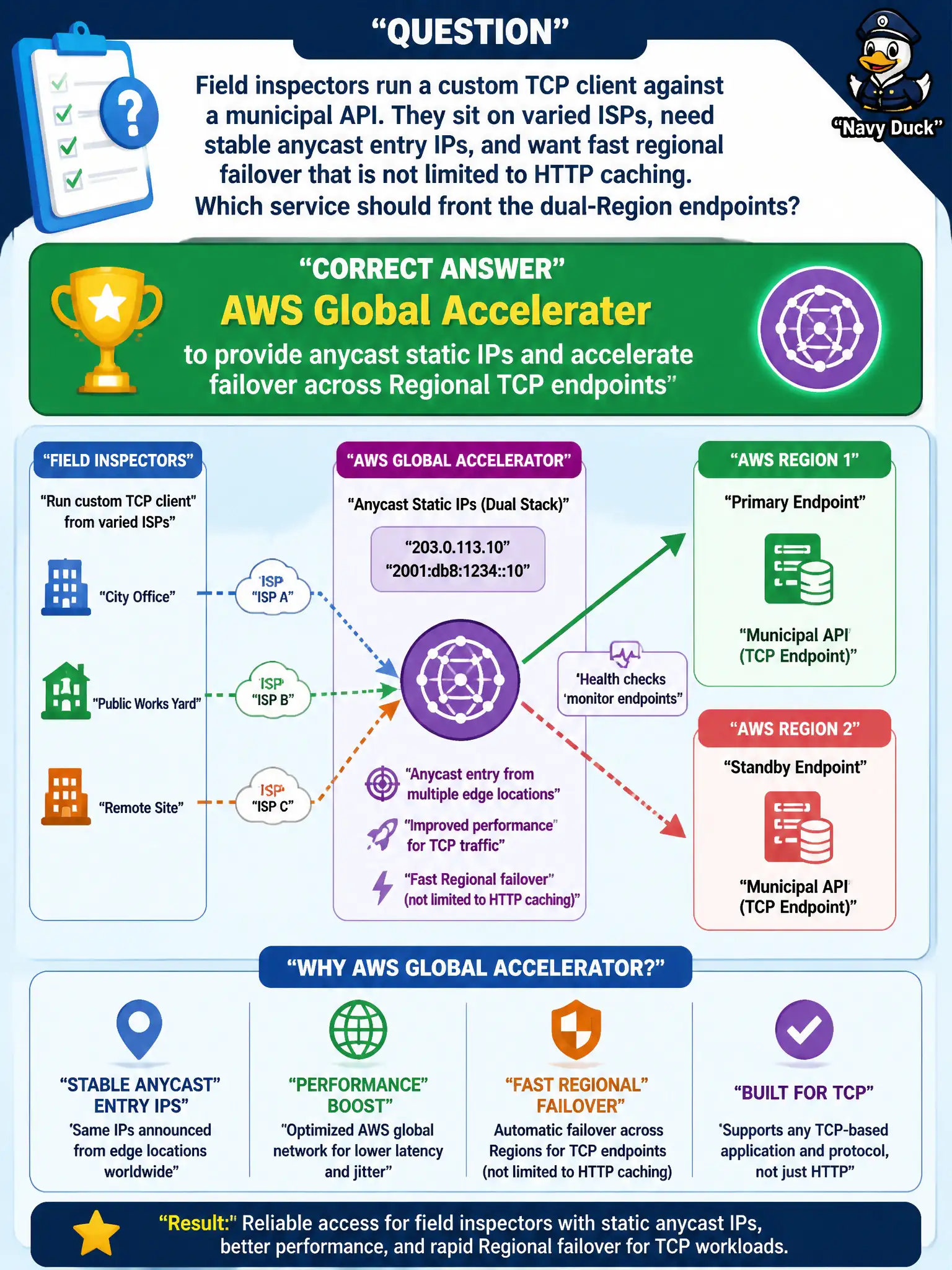
Field inspectors run a custom TCP client against a municipal API. They sit on varied ISPs, need stable anycast entry IPs, and want fast regional failover that is not limited to HTTP caching. Which service should front the dual-Region endpoints?
Select an answer to reveal the explanation.
Short Explanation
Inspectors on random cell networks need a steady front door address and a fast lane into AWS—not an HTTP-only CDN assumption. Global Accelerator gives anycast IPs and quick failover for that TCP API.
Full Explanation
Field inspectors using a custom TCP client against a municipal API need stable anycast entry IPs and fast regional failover that is not limited to HTTP caching semantics. AWS Global Accelerator provides static anycast IP addresses as a fixed entry point and uses the AWS global network to route traffic to healthy Regional endpoints, accelerating failover across dual-Region TCP targets. That fits thick TCP clients that cannot simply follow HTTP cache rules and that benefit from unchanging IPs in firewall allow lists used by field devices and partner networks.
Amazon CloudFront alone is primarily an HTTP/HTTPS content delivery and application acceleration service; it does not equally terminate all arbitrary TCP application protocols the way Global Accelerator’s TCP/UDP acceleration model targets. Amazon S3 Transfer Acceleration speeds transfers to S3 buckets—it is not a general TCP API front door for dual-Region application endpoints. Amazon SQS public queues replace request/response TCP APIs with asynchronous messaging and cannot front a live TCP inspector client protocol.
Exam caveat: Global Accelerator and CloudFront solve overlapping but different problems—edge HTTP caching versus static anycast IPs and protocol-agnostic acceleration to Regional endpoints. If the stem stresses non-HTTP TCP and stable IPs, Global Accelerator is the usual answer. Health checks and endpoint group weights still must be configured correctly for civic failover.
Operational check: allow-list the Global Accelerator static IPs on inspector networks; fail a primary Region endpoint in a drill and confirm clients reconnect via the alternate Regional endpoint without changing device configurations; and monitor accelerator health and flow metrics during peak inspection hours.