
Finance analysts need columnar scans across years of utility usage for ad-hoc reports. Cashiers still need single-row transactional updates on active accounts. Which design keeps each engine in its lane?
Select an answer to reveal the explanation.
Short Explanation
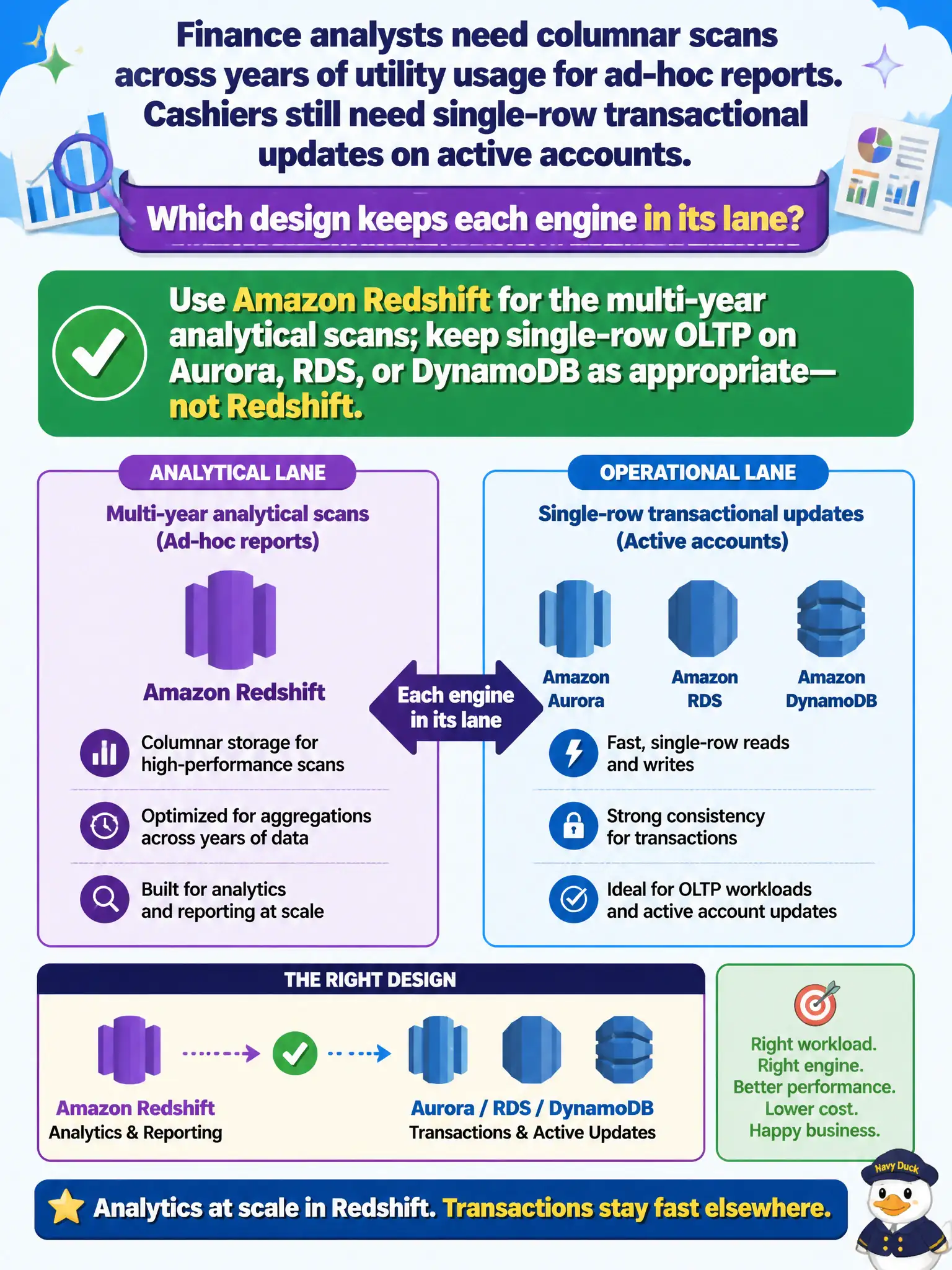
Warehouses are for leafing through years of usage history; cash registers are for one account at a time. Redshift handles the big columnar questions—leave the single-row postings on an OLTP database.
Full Explanation
Finance analysts scanning years of utility usage need columnar, scan-friendly analytics; cashiers posting payments need single-row transactional OLTP. Amazon Redshift is the warehouse lane for multi-year analytical scans and aggregations across historical usage. Active account updates—payment postings, balance corrections—belong on an OLTP system such as Amazon Aurora, Amazon RDS, or Amazon DynamoDB as the access pattern dictates. Keeping each engine in its lane prevents the city from forcing cash-register transactions through a warehouse or pretending a warehouse is a teller system.
Pointing the cashier UI at Redshift UPDATE statements for every payment posting misuses an analytical warehouse as an OLTP cashier ledger, risking concurrency and design mismatch. Storing only analytical warehouse rows in ElastiCache and deleting the OLTP database removes durable transactional storage and confuses cache with system of record. Replacing both analytics and OLTP with Amazon SQS queues holding CSV lines provides messaging, not a queryable warehouse or an account ledger.
Exam caveat: Redshift can participate in architectures with federated queries or zero-ETL integrations, but the exam still expects you to separate OLTP vs OLAP responsibilities when the stem contrasts them. Do not assume Redshift is “just another Postgres” for high-rate single-row cashier updates.
Operational check: run representative multi-year usage reports on Redshift with acceptable scan times; post sample payments on the OLTP store and confirm ACID behavior; and ensure ETL/ELT jobs move settled data to the warehouse without making cashiers wait on analytical clusters.