
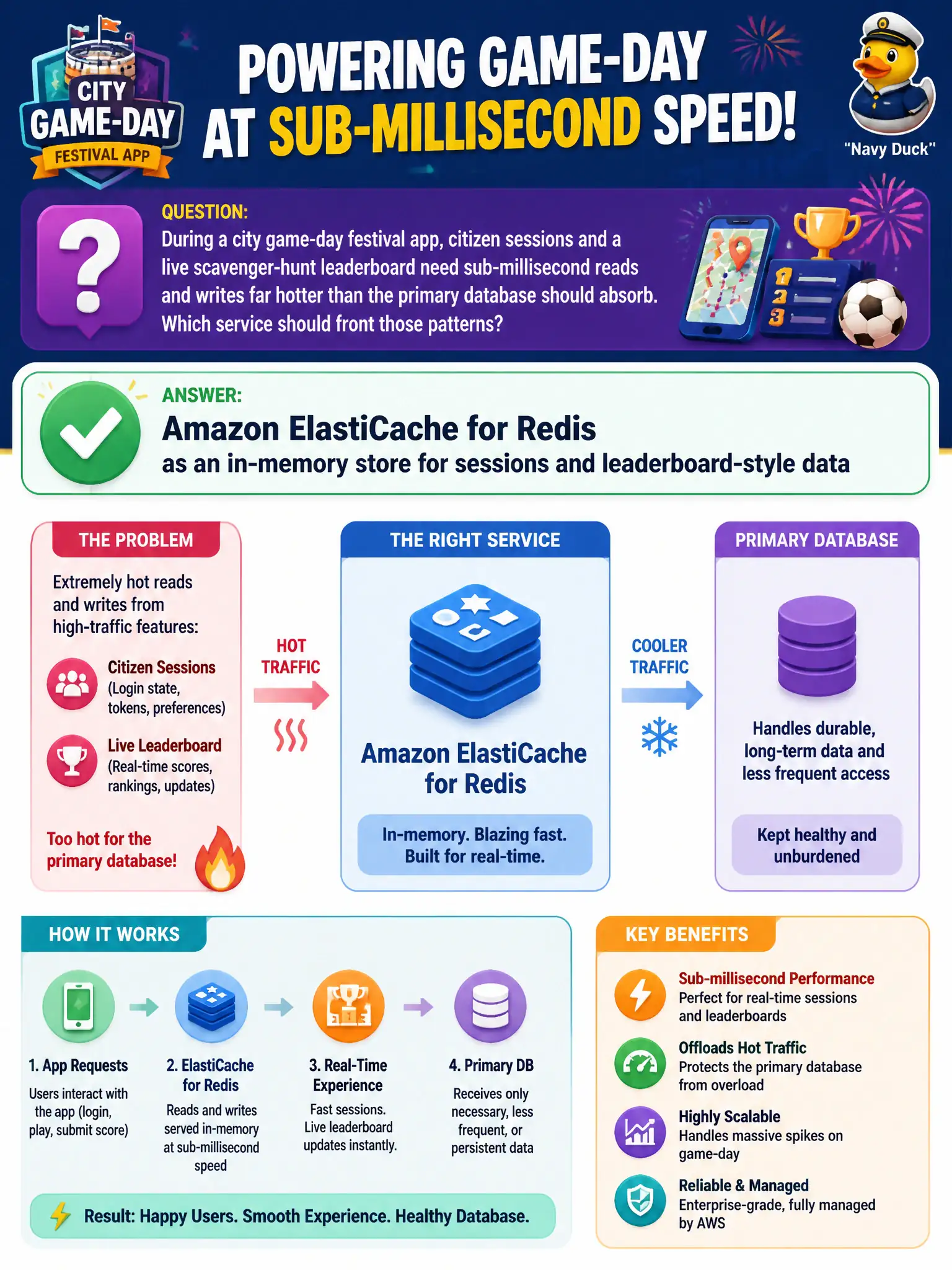
During a city game-day festival app, citizen sessions and a live scavenger-hunt leaderboard need sub-millisecond reads and writes far hotter than the primary database should absorb. Which service should front those patterns?
Select an answer to reveal the explanation.
Short Explanation
Game-day leaderboards and sticky sessions want memory speed, not a trip to cold storage or a backup vault. Park that hot scratchpad in ElastiCache Redis and leave the durable database for the quieter work.
Full Explanation
A city game-day festival app that tracks citizen sessions and a live scavenger-hunt leaderboard generates extremely hot, low-latency read/write traffic that should not hammer the primary durable database. Amazon ElastiCache for Redis is an in-memory data store with structures well suited to session state and leaderboard-style sorted sets, delivering sub-millisecond responses at festival scale. By fronting those patterns with Redis, the municipality keeps the durable system of record for quieter, authoritative writes while the hot scratchpad absorbs scoreboard chatter and sticky session lookups during peak crowd hours.
Amazon S3 Standard alone is object storage with higher latency and different consistency/semantics than an in-memory session/leaderboard engine; it is not designed as a sub-millisecond interactive scoreboard system of record. Amazon Glacier Instant Retrieval is an archival storage class aimed at infrequently accessed objects—using it for every score update contradicts both cost and latency goals for a live hunt. Querying AWS Backup vaults synchronously on each page refresh abuses backup infrastructure as an online data plane and cannot meet game-day interactive performance.
Exam caveat: ElastiCache is typically not the sole durable system of record for civic data that must survive cache node loss; persist authoritative results to a database or other durable store as the event design requires. Also distinguish Redis (rich data structures, leaderboards) from Memcached (simpler caching) when the stem mentions leaderboards.
Operational check: load-test session create/read and leaderboard increments at projected festival concurrency; enable Multi-AZ/cluster mode as required for resilience; monitor eviction and CPU; and verify that a Redis node failure does not permanently erase official contest outcomes if durability was promised to sponsors and citizens.