
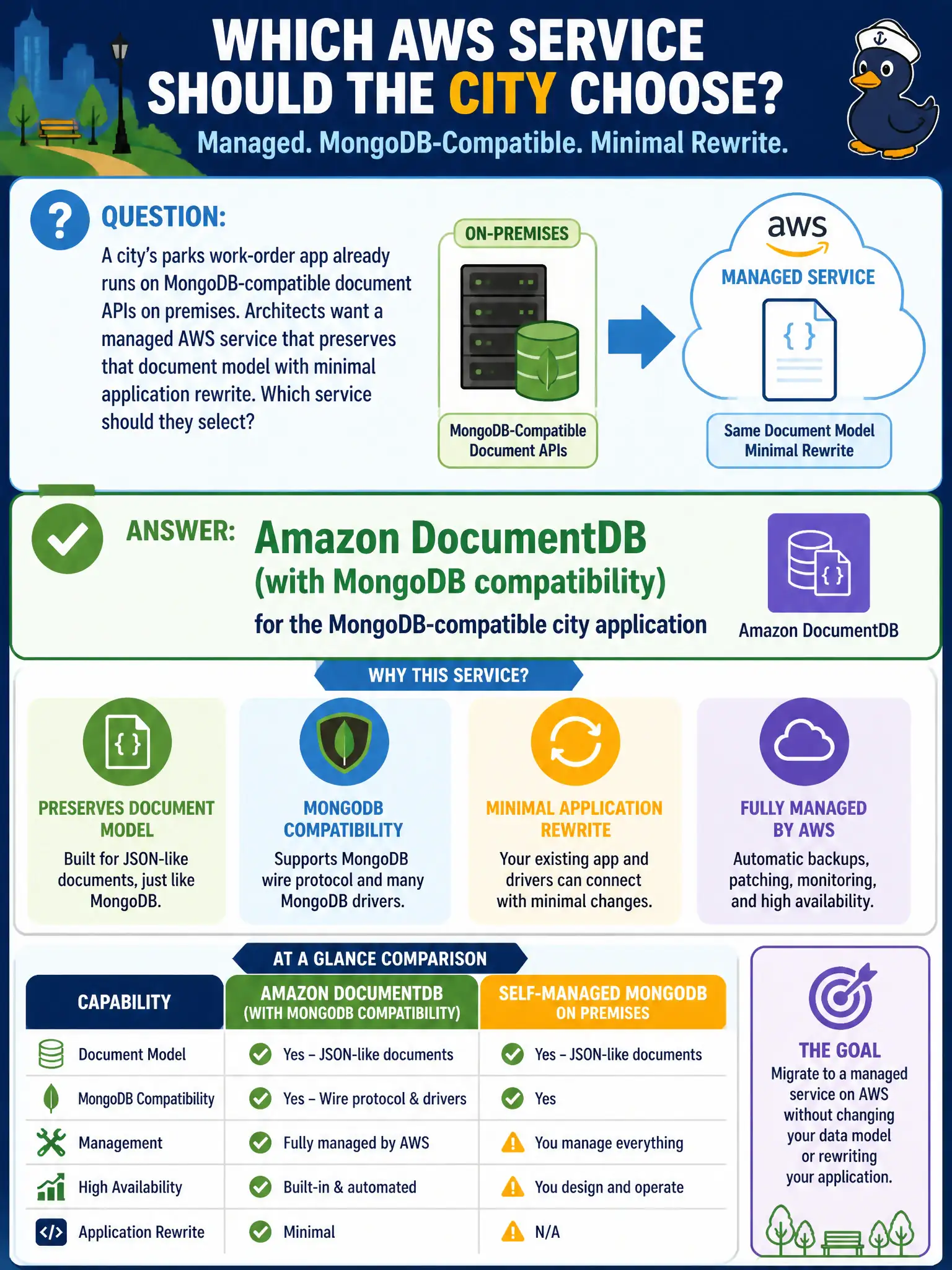
A city’s parks work-order app already runs on MongoDB-compatible document APIs on premises. Architects want a managed AWS service that preserves that document model with minimal application rewrite. Which service should they select?
Select an answer to reveal the explanation.
Short Explanation
If the app already speaks MongoDB-flavored documents, do not force it to learn Cassandra CQL or warehouse SQL overnight. DocumentDB is the managed lane that keeps the document model familiar.
Full Explanation
When a city’s parks work-order application already speaks MongoDB-compatible document APIs on premises, the lowest-friction managed path on AWS is Amazon DocumentDB (with MongoDB compatibility). DocumentDB preserves a document data model and aims to support applications written for MongoDB-compatible drivers and APIs, so parks ticket documents, nested asset attributes, and existing client libraries can move with far less rewrite than a wholesale redesign into relational SQL, wide-column CQL, or ledger APIs. For municipal teams under budget and change-control pressure, keeping the document paradigm reduces migration risk while still gaining a managed service operational model.
Amazon Keyspaces (for Apache Cassandra) is a managed wide-column store that speaks CQL, not MongoDB document APIs; choosing it would force a data-model and driver rewrite despite the stem’s explicit MongoDB compatibility requirement. Amazon Redshift is a columnar analytical warehouse—excellent for parks usage reporting over years of history, but it does not replace an operational document database for day-to-day work-order CRUD. Amazon QLDB provides an immutable ledger with cryptographic verification; unless every parks ticket truly requires ledger digests as a primary requirement (the stem does not), QLDB is the wrong abstraction and still would not preserve MongoDB-compatible APIs.
Exam caveat: “MongoDB compatibility” is not a promise of every MongoDB feature or version parity. Always check compatibility matrices and unsupported operators during assessment. Also do not confuse DocumentDB with DynamoDB document items or with Aurora PostgreSQL JSONB—those are different APIs and migration stories.
Operational check: run the parks application’s integration suite against DocumentDB using existing drivers, verify critical aggregations and indexes behave as required, plan instance sizing and replica strategy for field-season peaks, and document any unsupported MongoDB features discovered before cutover so work orders are not blocked in production.