
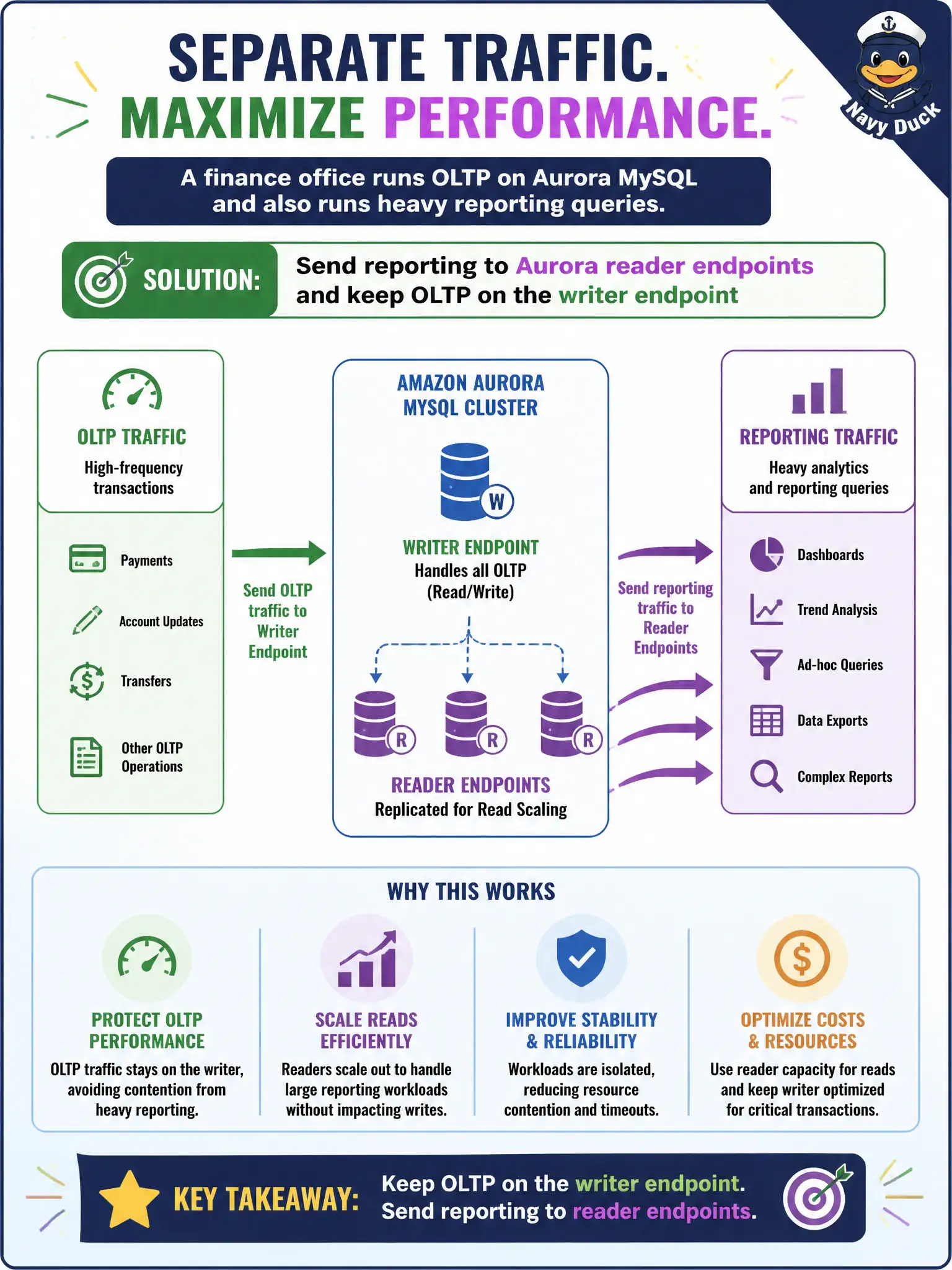
A finance office runs OLTP on Aurora MySQL and also runs heavy reporting queries. How should traffic be separated for high-performing database access?
Select an answer to reveal the explanation.
Short Explanation
Don’t let the report printers sit on the same checkout lane as cashiers. Point reporting at Aurora reader endpoints and leave OLTP on the writer. Forcing reports onto the writer, killing replicas, or copying live volumes to instance store invites contention and risk.
Full Explanation
Aurora MySQL separates writer and reader roles so OLTP and heavy reporting do not fight for the same primary resources. Sending reporting to Aurora reader endpoints while keeping OLTP on the writer endpoint protects transactional latency and scales read load across Aurora Replicas. That traffic separation is the correct Task 3.3 high-performing database design for a finance office that must run both cashiers-style transactions and report printers concurrently. Running all reporting exclusively against the writer to guarantee lock contention fails because analytical queries on the writer increase lock and CPU contention and directly threaten OLTP response times. Disabling read replicas and enlarging a single writer indefinitely for reports fails conceptually: vertical growth alone does not isolate report load, and removing replicas abandons Aurora’s read-scale pattern. Exporting the live OLTP volume to instance store before each report run fails because instance store copies are ephemeral, operationally heavy, and risk consistency and durability issues compared with using reader endpoints. Exam caveat: Aurora readers are eventually consistent with asynchronous replication lag—reports that need read-after-write of the newest transaction may still need the writer or careful lag checks. Operational check: point the reporting tool at the reader endpoint, keep the application’s mutations on the writer, measure writer CPU and lock waits during a report window, and alert if replica lag exceeds the finance office’s reporting tolerance.