
A library consortium needs common computer-vision checks on uploaded photos and wants strong performance with minimal GPU fleet operations. What should the architect prefer?
Select an answer to reveal the explanation.
Short Explanation
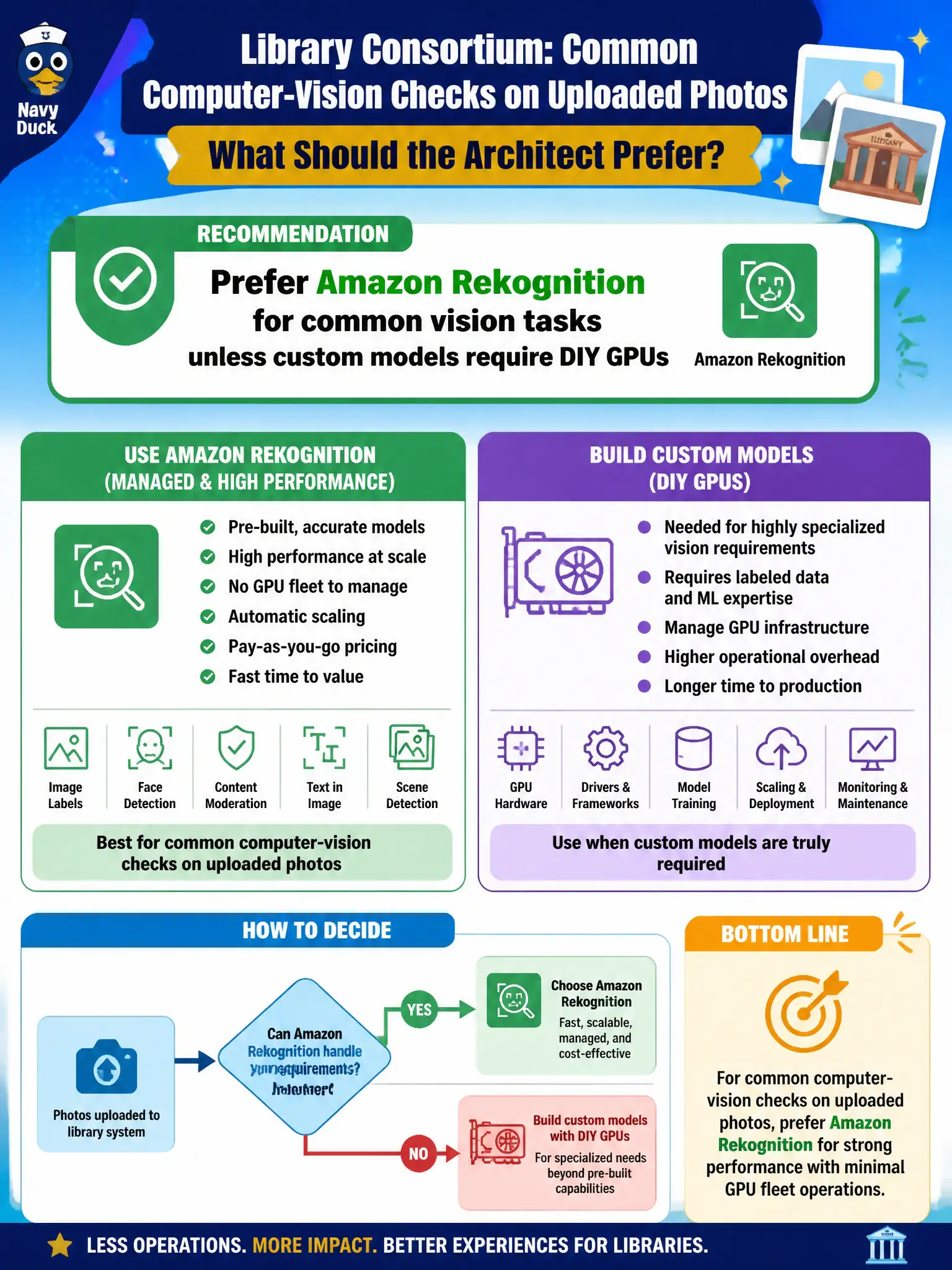
If the vision job is a common one, don’t stand up a GPU ranch—use Rekognition and save the ops. DIY GPUs wait for custom models that managed APIs can’t cover. Deep Archive yearly jobs and Config rules aren’t real-time vision engines.
Full Explanation
Common computer-vision checks on uploaded library photos should use a purpose-built AI service when the task is standard and the consortium wants strong performance without operating GPU fleets. Amazon Rekognition provides managed vision APIs so architects prefer it for common tasks and reserve self-managed GPU instances for custom models that managed APIs cannot meet. That managed-first choice is the Task 3.2 high-performing compute guidance for civic image workflows that do not require DIY accelerators. Always building a self-managed GPU EC2 fleet first, even for standard vision APIs, fails because it adds unnecessary cost and operations when Rekognition already covers common checks with managed performance. Storing images only in Glacier Deep Archive and running vision offline annually fails conceptually for any near-term moderation or cataloging need: deep archive retrieval delay and yearly batch cadence cannot meet interactive or timely upload checks. Using AWS Config rules as the image classification inference engine fails because Config evaluates resource configuration compliance; it is not a computer-vision inference service. Exam caveat: prefer Rekognition for common labels, moderation, and faces-style tasks, but custom scientific or proprietary models may still need SageMaker or GPU EC2/ECS—do not force managed APIs past their capability boundary. Operational check: call Rekognition against a representative photo set, measure latency and accuracy against library acceptance criteria, confirm IAM least privilege for the upload pipeline, and document when a request would escalate to custom GPU inference.