
Field inspectors use a mobile app that must execute light logic with ultra-low latency near users, not only from a distant Region. Which associate-level design awareness is most appropriate?
Select an answer to reveal the explanation.
Short Explanation
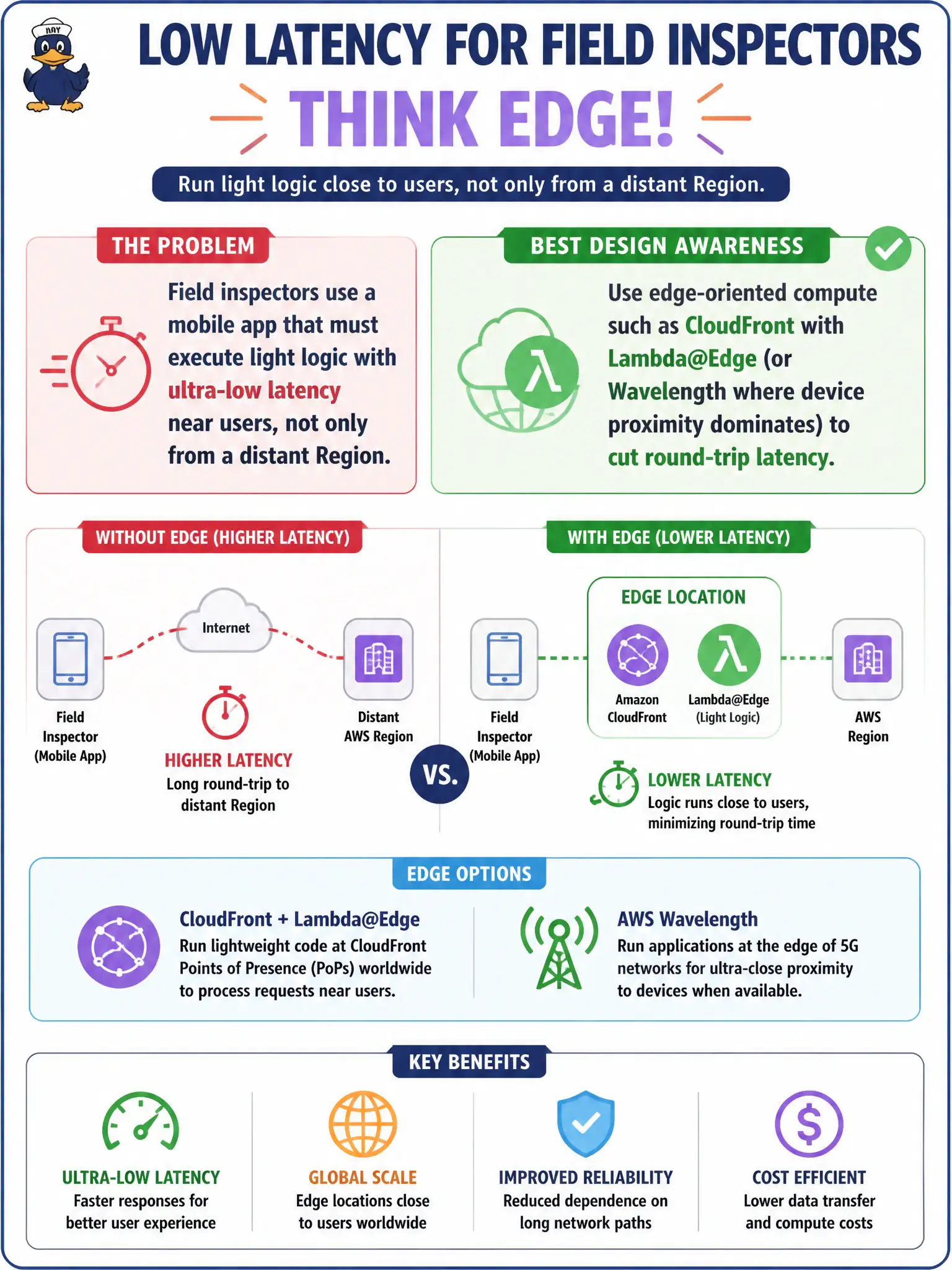
When fingers on a phone can’t wait for a cross-country hop, push work toward the edge. CloudFront plus Lambda@Edge (and Wavelength for ultra-close device cases) shrinks that round trip for field apps. Mainframe-only, VPN-to-one-box, or killing the CDN keeps latency high.
Full Explanation
Field inspector mobile apps that need ultra-low latency for light logic should push work toward the edge when Regional round trips dominate. CloudFront with Lambda@Edge can execute lightweight viewer-near logic, and AWS Wavelength addresses cases where device proximity to the carrier network is critical. Associate-level design awareness means selecting those edge-oriented options when distant Region hops violate field UX goals, rather than forcing every tap through a centralized far-away path. Placing all inspector logic exclusively in a single on-premises mainframe with no edge cache fails because it maximizes distance and single-system dependency for mobile users who need snappy local interaction. Requiring every tap to open a VPN to a one-AZ EC2 instance before any UI update fails conceptually by adding setup latency, a single-AZ failure domain, and an unnecessary choke point for simple UI logic. Disabling CDN caching so every static asset always originates from the farthest Region fails because it deliberately increases latency for assets that should be served near the inspector. Exam caveat: Lambda@Edge and Wavelength have constraints on runtime, regional presence, and use cases; heavy authoritative business logic may still belong in the Region, with the edge handling latency-sensitive slices. Operational check: measure current round-trip times from field networks, prototype edge logic or caching for the hottest mobile paths, compare latency to the SLO, and keep authoritative writes synchronized back to the municipal system of record.