
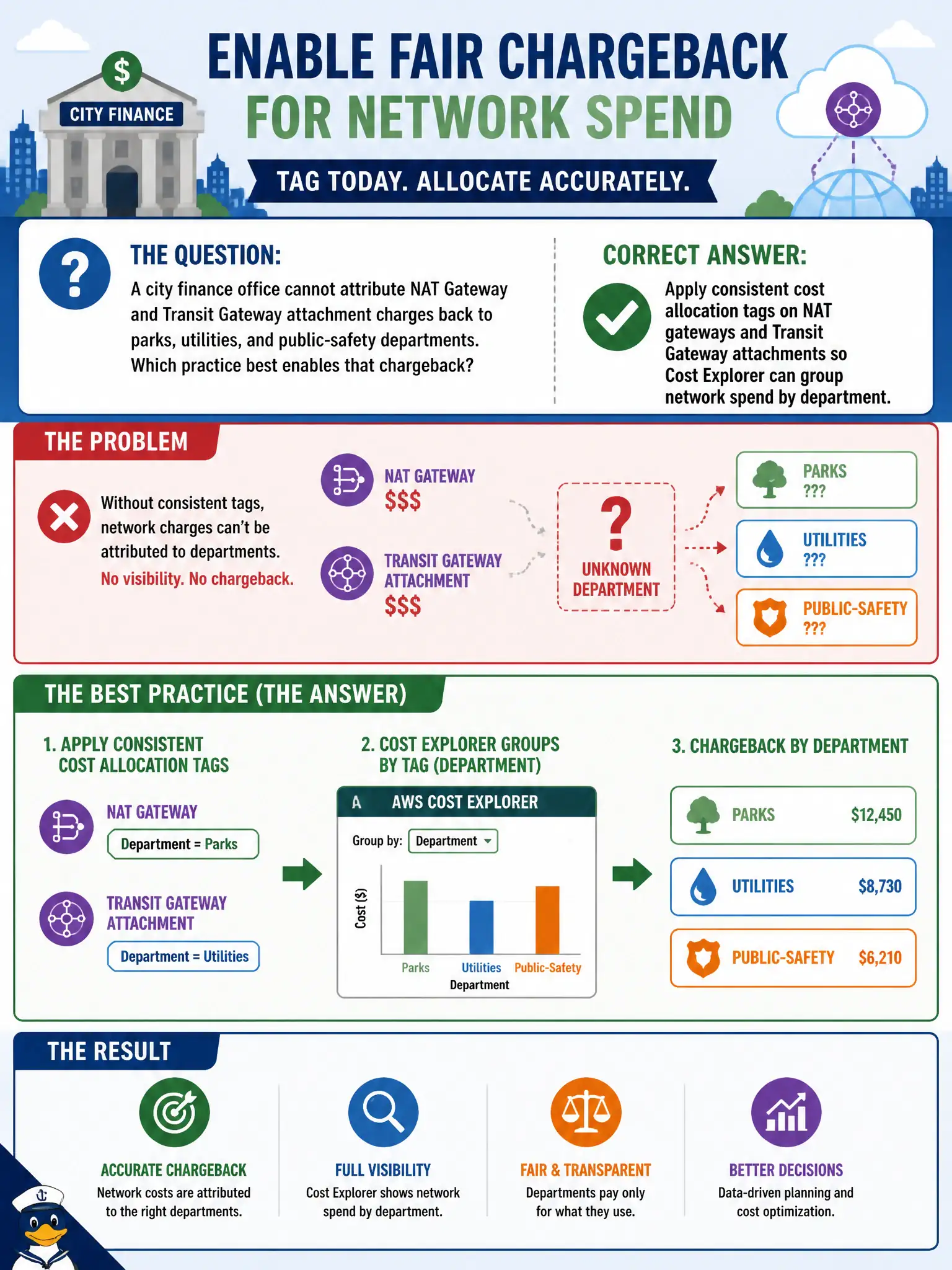
A city finance office cannot attribute NAT Gateway and Transit Gateway attachment charges back to parks, utilities, and public-safety departments. Which practice best enables that chargeback?
Select an answer to reveal the explanation.
Short Explanation
If you can't label the fire hose, you can't bill the firehouse. Tag NAT and Transit Gateway attachments so finance can show each department its network tab.
Full Explanation
City finance cannot attribute NAT Gateway and Transit Gateway attachment charges to parks, utilities, and public-safety departments without consistent metadata. Applying cost allocation tags—such as Department, CostCenter, or Program—on NAT gateways, Transit Gateway attachments, and related network resources allows Cost Explorer and the Cost and Usage Report to group data-processing and attachment spend by department for chargeback or showback. Tags turn opaque shared-network bills into actionable municipal FinOps reports.
Leaving network resources untagged and allocating costs by guessing monthly ticket volume fails by concept: guesses are not auditable chargeback. Deleting Cost Explorer and relying on verbal estimates removes the measurement system. Moving every workload into one untagged account so chargeback becomes impossible by design actively prevents financial accountability.
Exam caveat: tags must be activated for cost allocation in Billing, applied consistently (SCPs/tag policies help), and present on the resources that actually generate the charges—attachments and NAT gateways, not only EC2 instances. Shared services may still need a documented allocation rule for truly common infrastructure.
Operational check: define a mandatory Department tag policy, tag existing NAT Gateways and TGW attachments, activate the keys for cost allocation, build Cost Explorer reports grouped by that tag, share draft showback with department heads, and refine any shared-hub allocation formula after one billing cycle.