
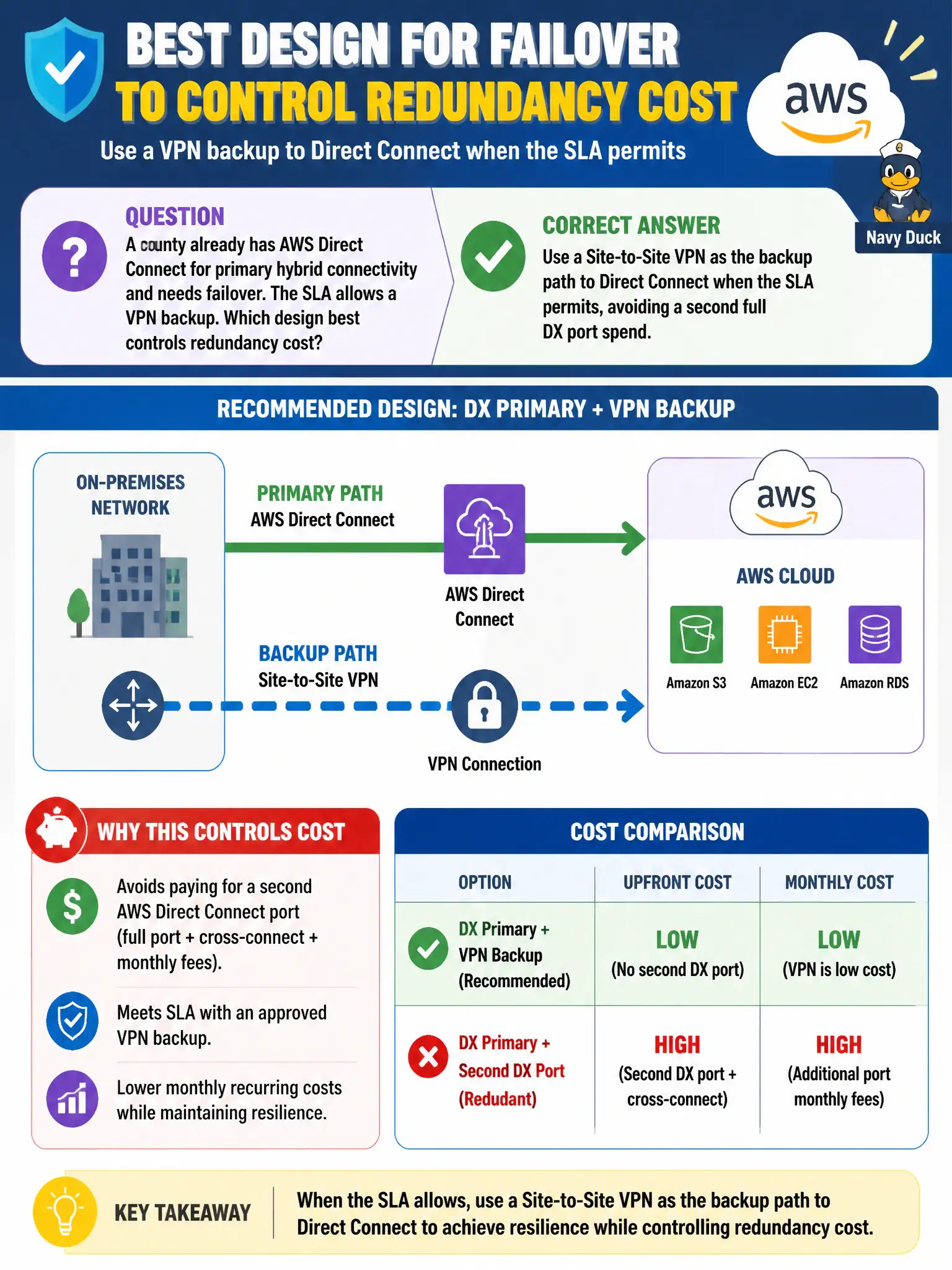
A county already has AWS Direct Connect for primary hybrid connectivity and needs failover. The SLA allows a VPN backup. Which design best controls redundancy cost?
Select an answer to reveal the explanation.
Short Explanation
Keep the highway as the main road and the side street as the detour. If the SLA allows VPN failover, you may not need to pay for two full Direct Connect ports.
Full Explanation
A county that already pays for AWS Direct Connect as primary hybrid connectivity often still needs failover. When the SLA explicitly allows VPN backup characteristics (throughput, jitter, internet dependency), a Site-to-Site VPN as the backup path avoids purchasing a second full production DX port solely for redundancy. Traffic normally prefers DX; on DX failure, VPN carries critical hybrid flows at much lower standby cost. This is a standard cost-aware hybrid redundancy pattern for municipal workloads that can tolerate VPN failover within documented RTO/RPO.
Purchasing a second full production DX port solely because VPN failover is never acceptable under any SLA contradicts the stated SLA that permits VPN backup. Disabling all failover to minimize networking invoices risks prolonged outages for tax, CAD-adjacent, or records links. Mirroring every packet to CloudFront as the private DX backup circuit misuses a CDN—it is not a private hybrid failover path.
Exam caveat: if the SLA forbids VPN failover or requires symmetric DX bandwidth for DR drills, a second DX (ideally diverse providers/locations) may be mandatory despite higher cost. Read the SLA first; cost follows requirements.
Operational check: configure VPN as backup with routing preference toward DX, test failover under change control, measure application impact against SLA timers, document that a second DX was deferred because VPN met requirements, and monitor both DX and VPN health in CloudWatch.