
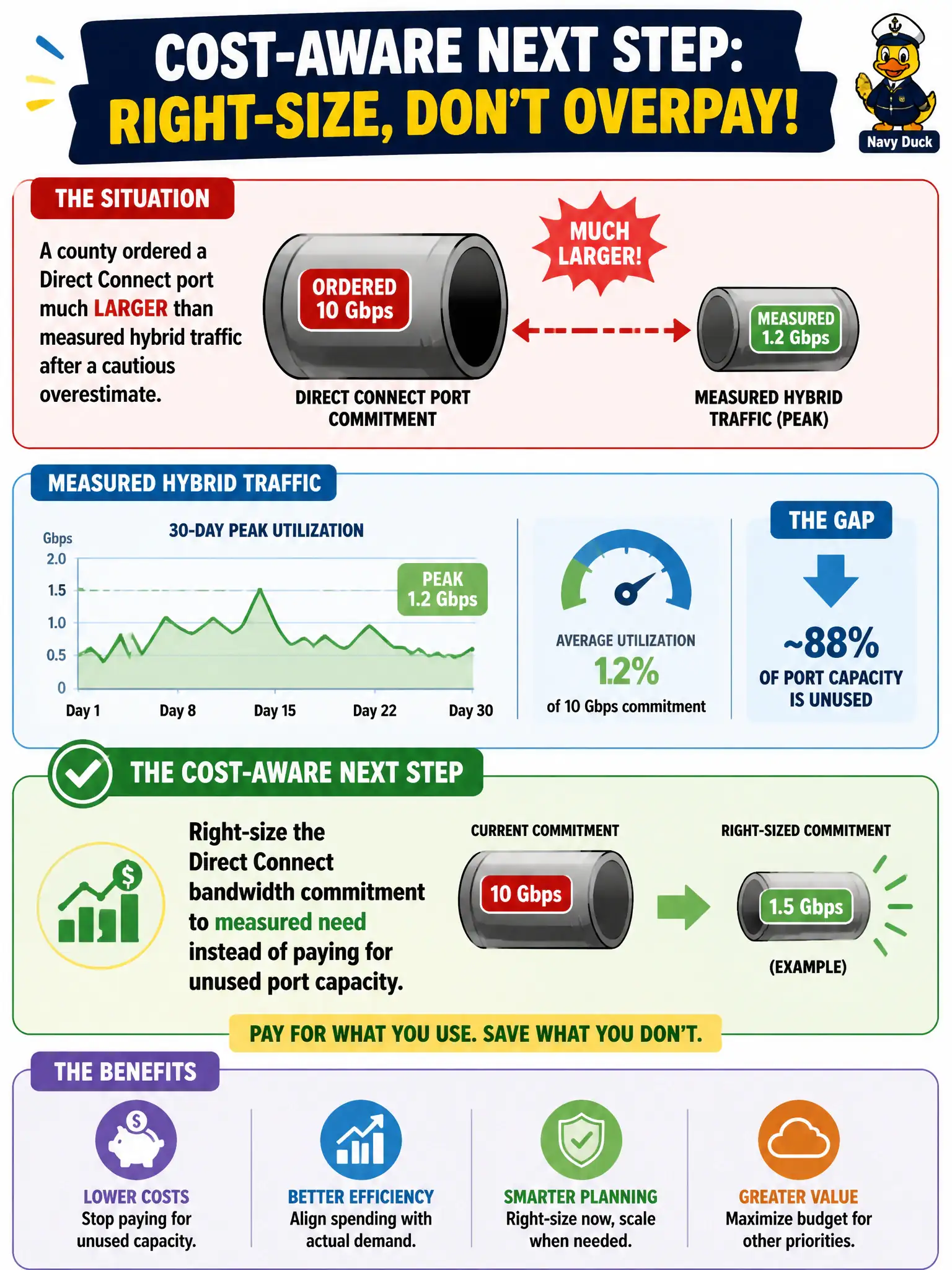
A county ordered a Direct Connect port much larger than measured hybrid traffic after a cautious overestimate. What is the cost-aware next step?
Select an answer to reveal the explanation.
Short Explanation
Don't rent a six-lane bridge for bicycle traffic. Right-size the Direct Connect port to what the meters actually show.
Full Explanation
A county that ordered a Direct Connect port much larger than measured hybrid traffic pays recurring port capacity for unused headroom. The cost-aware next step is to right-size the Direct Connect bandwidth commitment to measured need—using CloudWatch DX metrics, on-premises utilization, and growth forecasts—rather than continuing to fund an oversized circuit from a cautious overestimate. Right-sizing may mean changing port speed at renewal or migrating to a more appropriate hosted connection capacity through an approved partner, always with change control for the hybrid records path.
Keeping the oversized commitment indefinitely because unused DX bandwidth has no cost impact fails by concept: unused port capacity still incurs port-hour charges. Adding a second identical oversized port in every Region multiplies waste. Converting the Direct Connect circuit into an Amazon S3 Gateway endpoint is not a valid transformation—gateway endpoints are in-VPC AWS service paths, not substitutes for a hybrid DX circuit.
Exam caveat: leave justified burst headroom for month-end or disaster recoveries, but do not confuse comfort padding with blank-check port sizes. Also maintain failover (VPN or secondary DX) when shrinking primary capacity.
Operational check: collect 30–90 days of DX bit-rate metrics, model the minimum port that covers P95 plus agreed headroom, schedule a change window with network operations, validate application throughput after right-sizing, and confirm the DX port line item drops in the following invoice.