
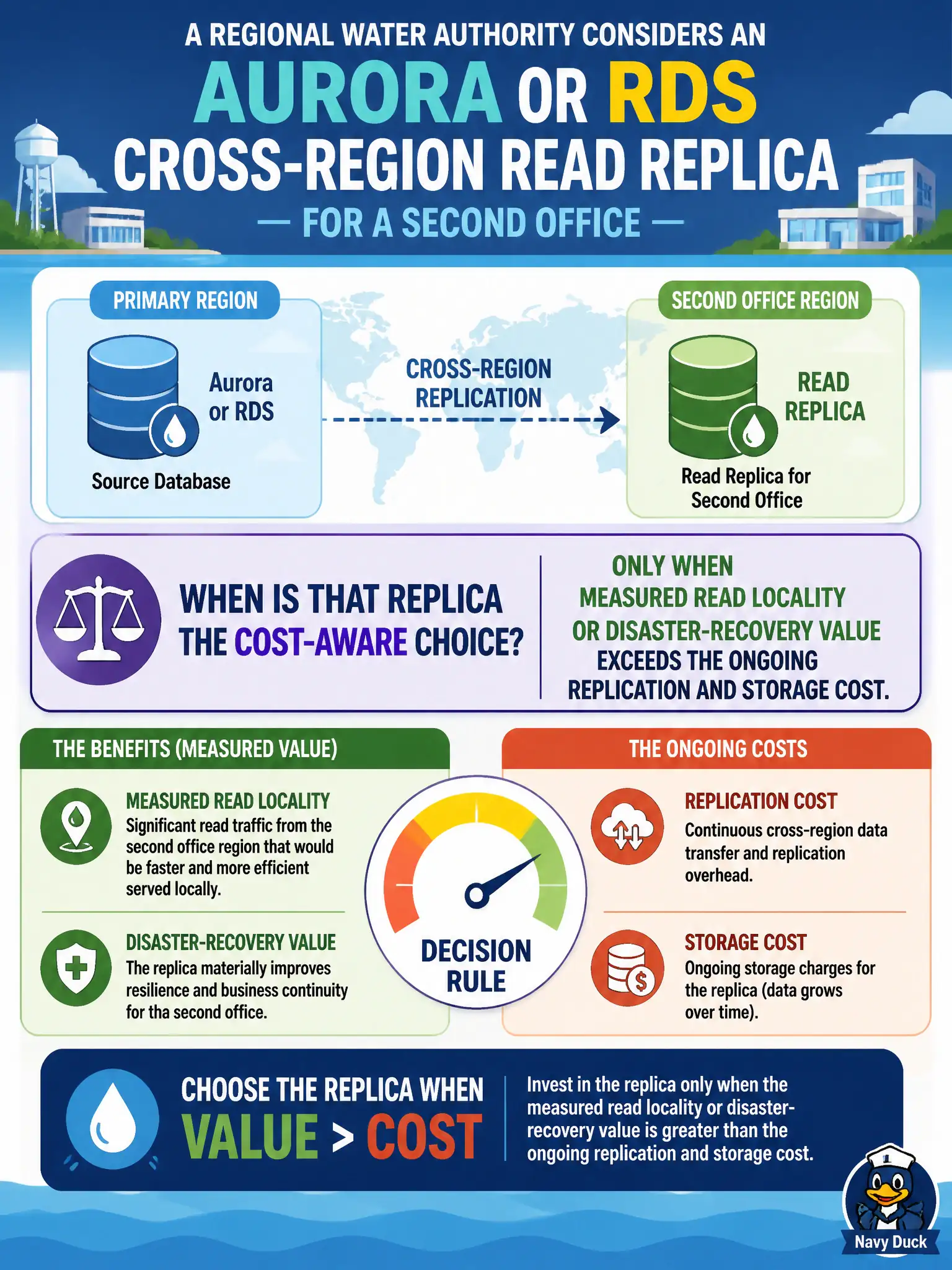
A regional water authority considers an Aurora or RDS cross-Region read replica for a second office. When is that replica the cost-aware choice?
Select an answer to reveal the explanation.
Short Explanation
A spare pipe across the state is great when the town needs water there—not when it just looks fancy on a diagram. Buy the cross-Region replica when locality or DR value beats the bill.
Full Explanation
A regional water authority weighing an Aurora or RDS cross-Region read replica for a second office must treat the replica as a paid architectural choice, not a free checkbox. Cross-Region replicas incur remote instance hours, storage, and ongoing replication data transfer. They become cost-aware when measured read locality (second-office query latency and bandwidth) or disaster-recovery value (RPO/RTO for SCADA-adjacent business systems, customer billing reads, and so on) exceeds those ongoing costs. Decision-makers should quantify second-office traffic and DR objectives before approving the replica.
Adding a cross-Region replica whenever any single report exceeds one second fails by concept: local query tuning, indexing, or a same-Region read replica may fix latency without inter-Region transfer. Assuming cross-Region replicas are free within an AWS Organization is false—organization hierarchy does not erase replication and instance charges. Deleting the primary to avoid duplicate charges destroys the source of truth and is not a HA/DR pattern.
Exam caveat: cross-Region replicas help read locality and some DR designs but are not identical to a full multi-Region active-active write architecture; understand promotion and lag characteristics for the engine in question.
Operational check: measure second-office query latency and bytes replicated in a pilot, price remote instance plus inter-Region transfer in the AWS Pricing Calculator or Cost Explorer forecasts, map DR RTO/RPO to replica promotion runbooks, and only retain the replica if locality or DR benefit clearly exceeds the monthly bill.