
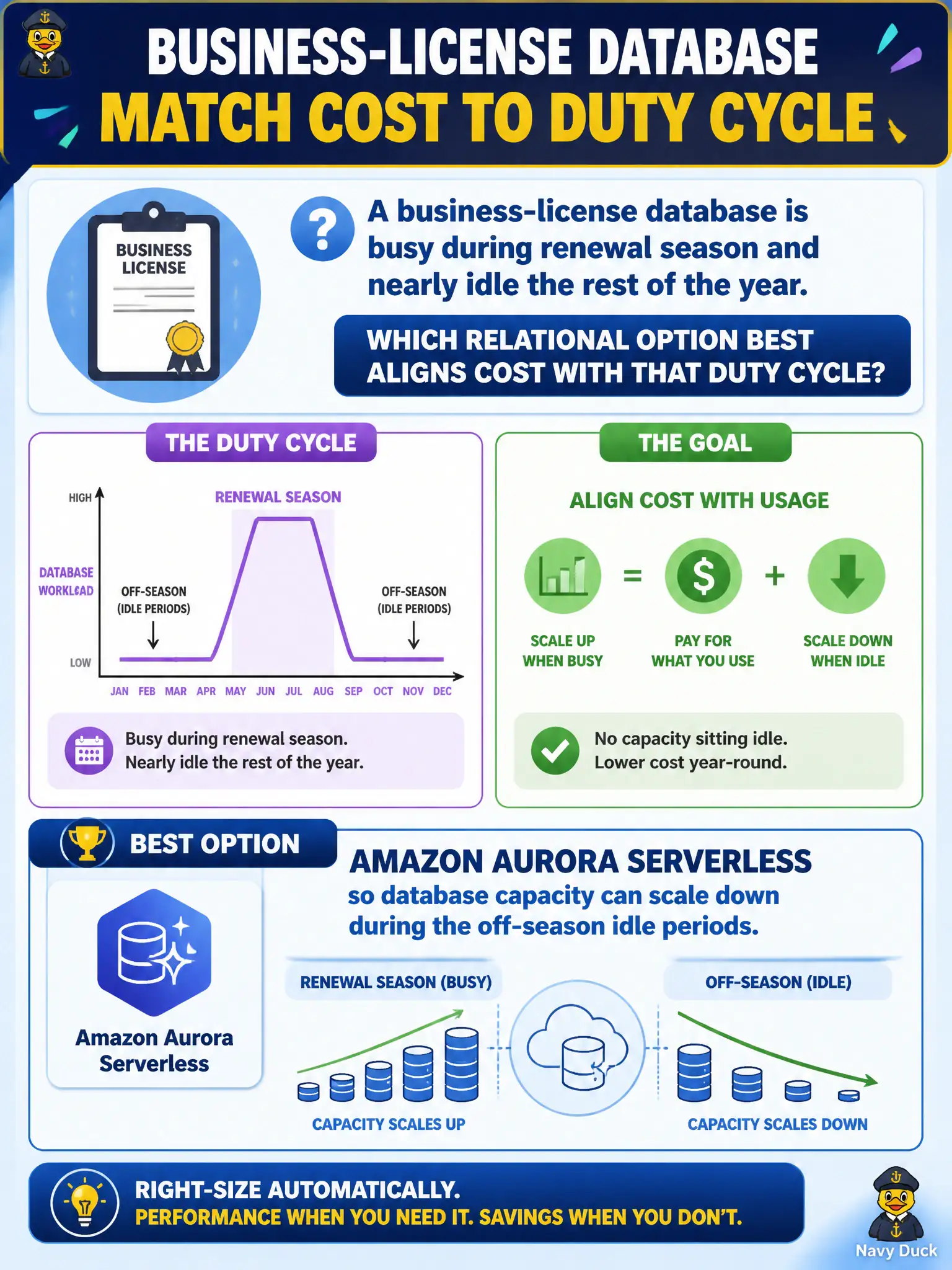
A business-license database is busy during renewal season and nearly idle the rest of the year. Which relational option best aligns cost with that duty cycle?
Select an answer to reveal the explanation.
Short Explanation
Renewal season needs a roaring database; August needs a nap. Aurora Serverless flexes with that seasonal license rush so you're not paying peak RDS all year for an empty waiting room.
Full Explanation
Amazon Aurora Serverless is the correct relational option to align cost with a business-license database that is busy during renewal season and nearly idle the rest of the year, because capacity can scale down in the off-season instead of paying continuously for peak RDS sizing. Seasonal municipal licensing is a classic intermittent database pattern. A fixed largest Amazon RDS instance running continuously at peak sizing fails by funding renewal-season horsepower through quiet months. DynamoDB global tables as a drop-in SQL replacement without schema changes fails conceptually: DynamoDB is a NoSQL service and is not a transparent SQL drop-in for relational license schemas without application redesign. Self-managed Oracle on a single EC2 with no backups to save money fails by trading managed reliability for operational burden and unacceptable recovery risk that dwarfs short-term savings. Exam caveat: Aurora Serverless for seasonal relational duty cycles; reject always-peak RDS, pretend SQL-to-DynamoDB drop-ins, and unbacked DIY databases. Operational check: migrate or create the license DB on Aurora Serverless with scaling limits matching renewal peaks; test off-season scale-down; validate renewal-season performance; enable proper backups; and compare annual database cost to the former always-peak instance.