
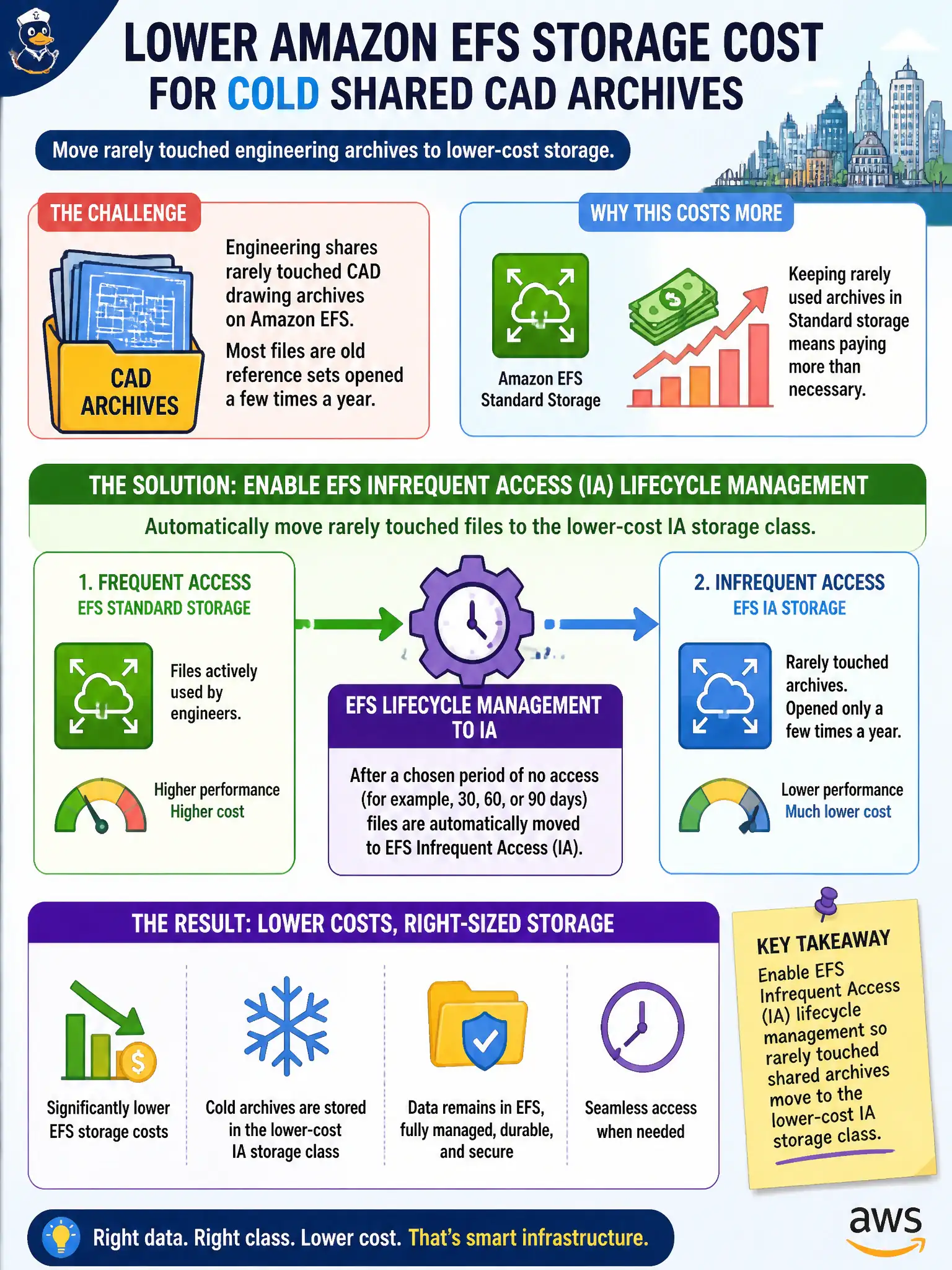
Engineering shares rarely touched CAD drawing archives on Amazon EFS. Most files are old reference sets opened a few times a year. How can the city lower EFS storage cost for that cold shared data?
Select an answer to reveal the explanation.
Short Explanation
Old drawings that gather digital dust belong on EFS Infrequent Access, not the everyday tier. Lifecycle to IA and stop paying hot-file prices for cold shared archives. Turning off encryption, hourly public S3 dumps, or a trailer laptop aren’t cost governance.
Full Explanation
Enabling Amazon EFS Infrequent Access (IA) lifecycle management moves rarely touched engineering CAD drawing archives to a lower-cost storage class while keeping the shared file system namespace intact. That is the intended cost control for cold shared files opened only a few times a year. Disabling encryption and versioning as the primary cost-control strategy weakens security and recoverability for negligible or negative real savings and is not how EFS cost optimization works. Copying the entire file system into a single unencrypted public S3 bucket each hour creates data exposure and churn cost without solving EFS tiering. Replacing EFS with local instance store on one laptop in the engineering trailer destroys shared high-availability file access and durability for a municipal engineering team. Exam caveat: IA has per-access charges—files that are cold but occasionally scanned en masse can surprise you—so set lifecycle policies based on true last-access patterns. Operational check: enable lifecycle to IA on the archive file system, review AbsoluteIOBytes/access patterns after a month, confirm engineers can still open reference sets with acceptable first-byte latency, and document restore/read expectations.