
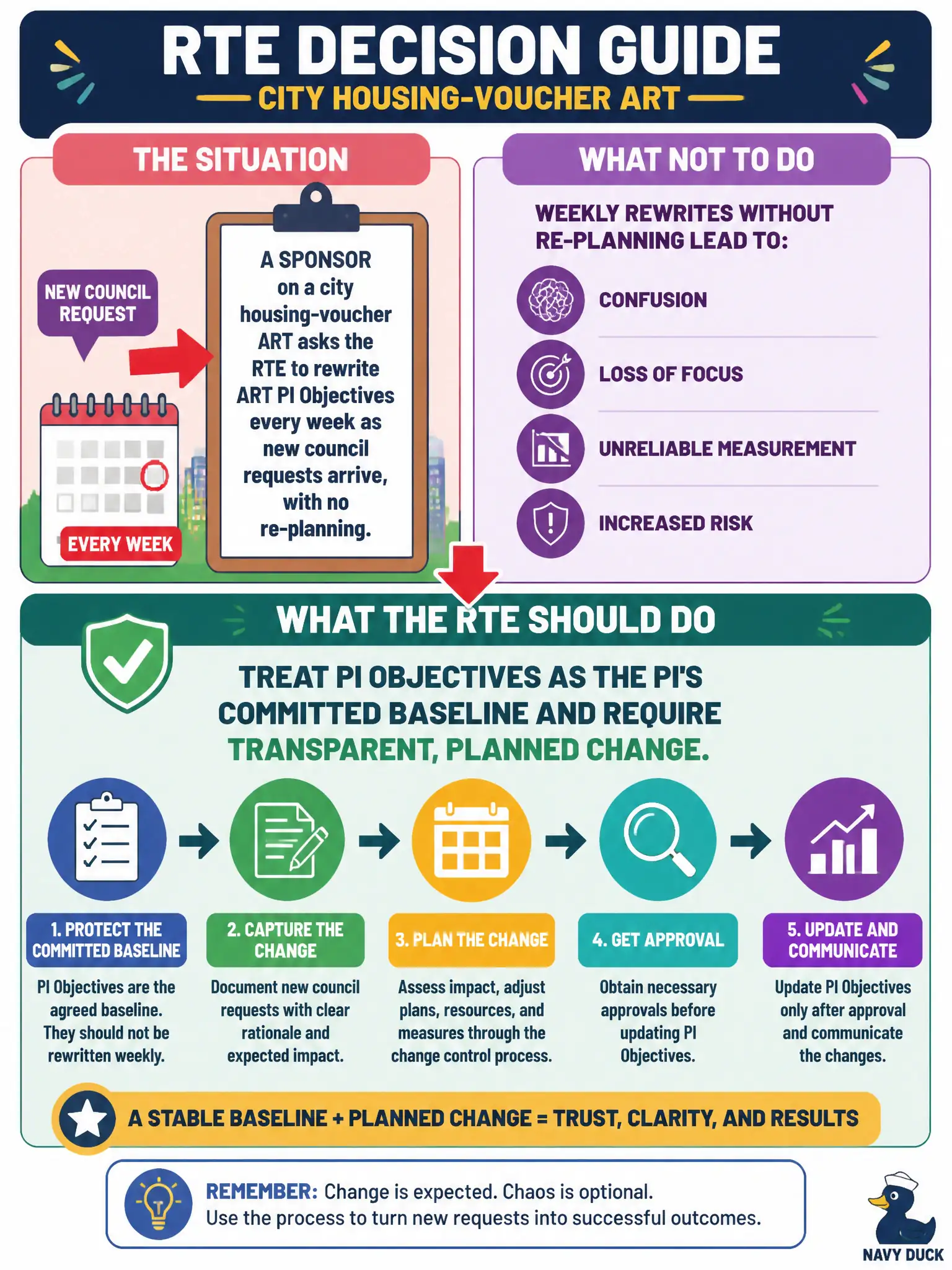
A sponsor on a city housing-voucher ART asks the RTE to rewrite ART PI Objectives every week as new council requests arrive, with no re-planning. What should the RTE do?
Select an answer to reveal the explanation.
Short Explanation
PI Objectives are the season's playbook, not a whiteboard you wipe every Monday. New council noise is real, but you do not quietly swap the scoreboard. Change the plan in the open, or it was never a plan.
Full Explanation
PI Objectives are the PI's committed baseline; changing them requires transparent, planned renegotiation with affected stakeholders—not weekly rewrites as hallway requests arrive. When a sponsor on a city housing-voucher ART asks the RTE to rewrite ART PI Objectives every week with no re-planning, the RTE should refuse silent churn and require transparent, planned change. Updating objectives each Monday to match the latest council hallway request destroys predictability and makes Inspect and Adapt meaningless. Freezing PI Objectives forever, even when a legal mandate truly invalidates a commitment, is the opposite extreme and ignores legitimate renegotiation. Deleting PI Objectives and managing the voucher ART only by incoming emails abandons SAFe planning artifacts entirely. Housing-voucher applicants and caseworkers need a stable PI forecast; weekly silent rewrites turn the ART into a rumor mill and erase Inspect and Adapt learning. Exam caveat: emergency legal or safety mandates can force change, but the change is still visible through ART syncs and updated objectives—not quiet edits. Operational check: if a sponsor requests a rewrite, place the request on the ART sync agenda, identify capacity impact, and update objectives only after the renegotiation is recorded. Document any renegotiated voucher objectives with date, requester, and capacity impact in the ART communication channel.