
Stakeholders ask who works with teams on Team PI Objectives business value during PI Planning on the open-data and civic-engagement ART. What is the correct pairing?
Select an answer to reveal the explanation.
Short Explanation
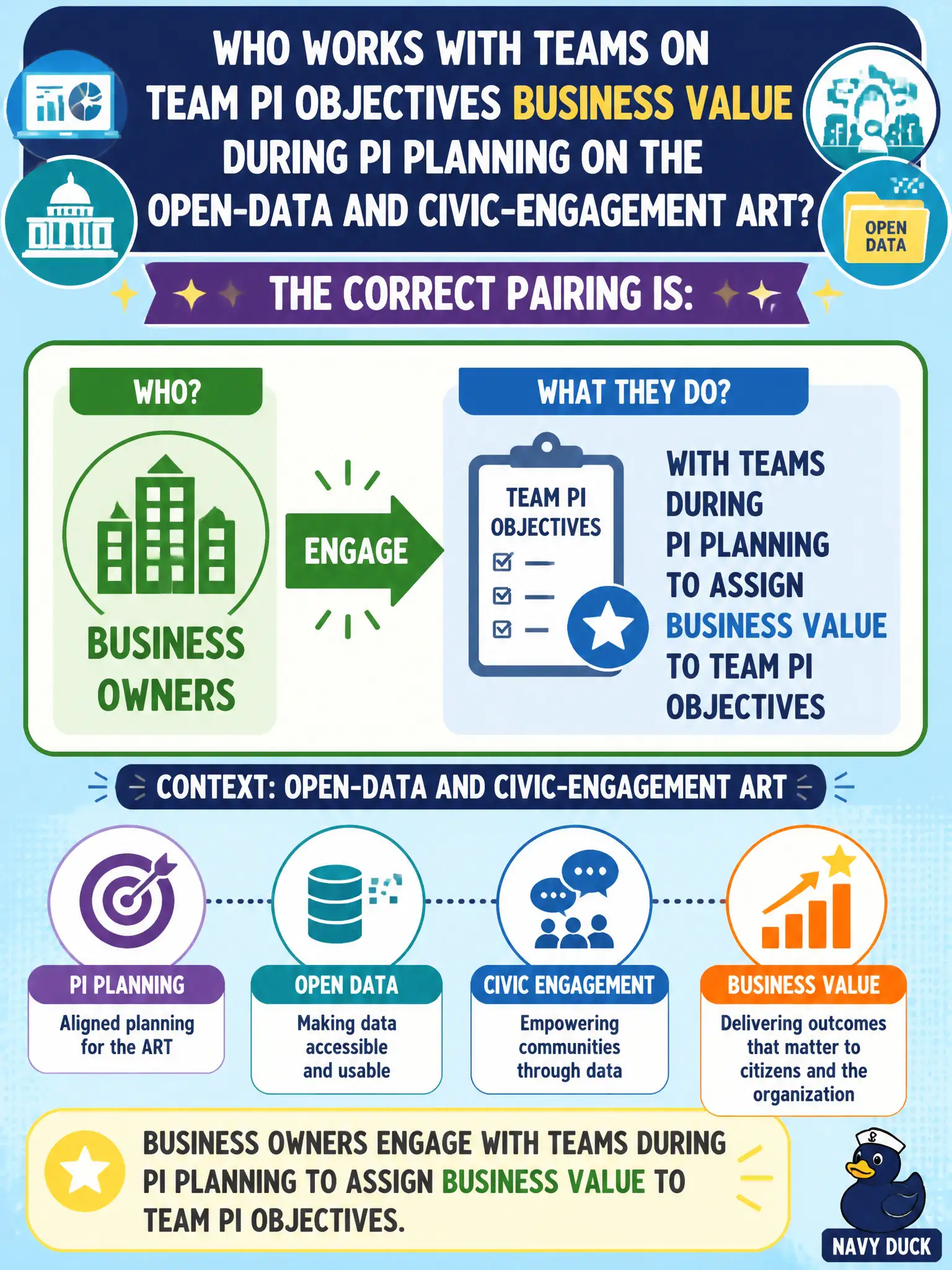
Business value is the sponsor's this-matters-to-the-city number, written with the team while they plan. Business Owners sit with teams at PI Planning and do that work. The RTE does not fill the scores in later.
Full Explanation
Business Owners engage with teams during PI Planning to assign business value to Team PI Objectives. On an open-data and civic-engagement ART, stakeholders asking who works with teams on that value assignment should hear Business Owners—not the RTE filling scores after teams leave, Scrum Masters scoring because they run team events, or System Architects scoring technical elegance. Business value is an economic sponsorship act tied to civic outcomes. The RTE facilitates the process and timeboxes; the RTE does not invent the numbers. Scrum Masters coach teams but do not replace Business Owners on value. Architects guide technical approach; elegance is not business value. Exam caveat: If a Business Owner is absent, planning should escalate or use a delegated Business Owner—not silently let facilitators invent scores. Operational check: During open-data PI Planning, verify Business Owners sit with teams for value assignment and that scores on objectives are attributable to named sponsors before the confidence vote. In municipal settings, pressure to look busy, compliant, or politically safe is constant; the RTE earns trust by holding the principle through that pressure and verifying the next cadence event shows improved civic delivery, not just a quieter meeting. Capture the before/after signal so sponsors see the operational evidence.