
Two teams on a building-permit product keep blocking each other because intake, plan-review, and payment slices are ordered independently. How should the Product Owner use ordering to reduce that thrash?
Select an answer to reveal the explanation.
Short Explanation
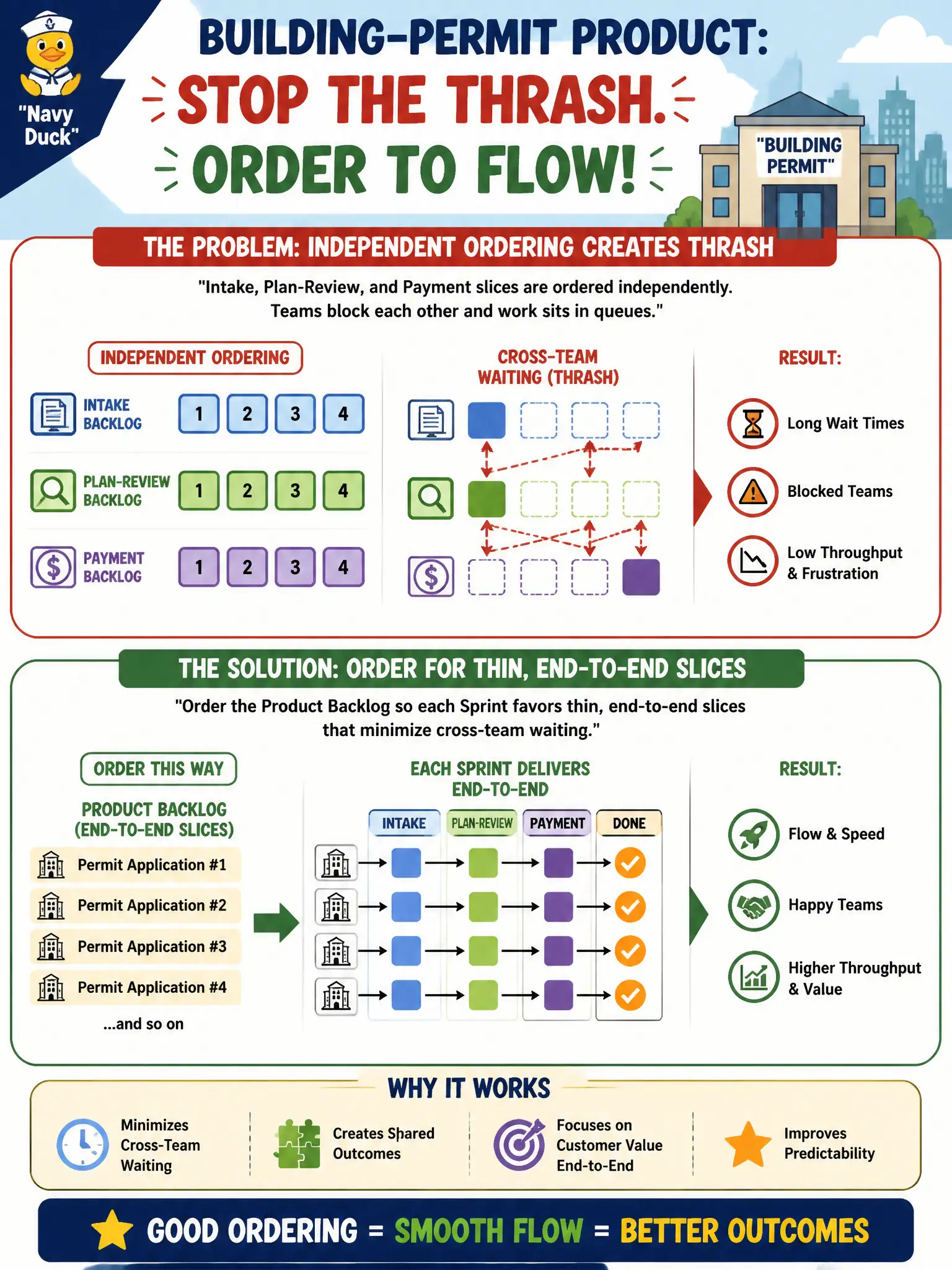
If the backlog is a pile of isolated parts, teams stand in each other's way like trucks at a one-lane bridge. Order work as thin permit journeys—intake through payment—so less waiting shows up. The Product Owner's sequence is a dependency tool, not just a wish list.
Full Explanation
At scale, Product Backlog order is one of the Product Owner's strongest levers for reducing cross-team dependencies. When two teams on a building-permit product keep blocking each other because intake, plan-review, and payment slices are ordered independently, the Product Owner should order the Product Backlog so each Sprint favors thin, end-to-end slices that minimize cross-team waiting. Sequence is a dependency tool for civic throughput, not just a wish list.
Freezing order for a quarter so teams can specialize on components without talking hardens silos and waiting. Adding a project manager to sequence tasks after the Product Backlog is set layers coordination on top of a poor order instead of fixing order. Requiring every team to pull the same number of items so load looks fair optimizes optics over coupling.
Cross-team waiting on permits is a tax on applicants; thin end-to-end ordering is how the Product Owner cuts that tax.
Exam caveat: PSPO II scaled ordering prefers thin vertical slices that reduce waiting over component specialization and equal item counts.
Operational check: reorder upcoming permit work into thin journeys (intake through payment), select slices both teams can finish together, and measure whether cross-team wait time falls next Sprint.