
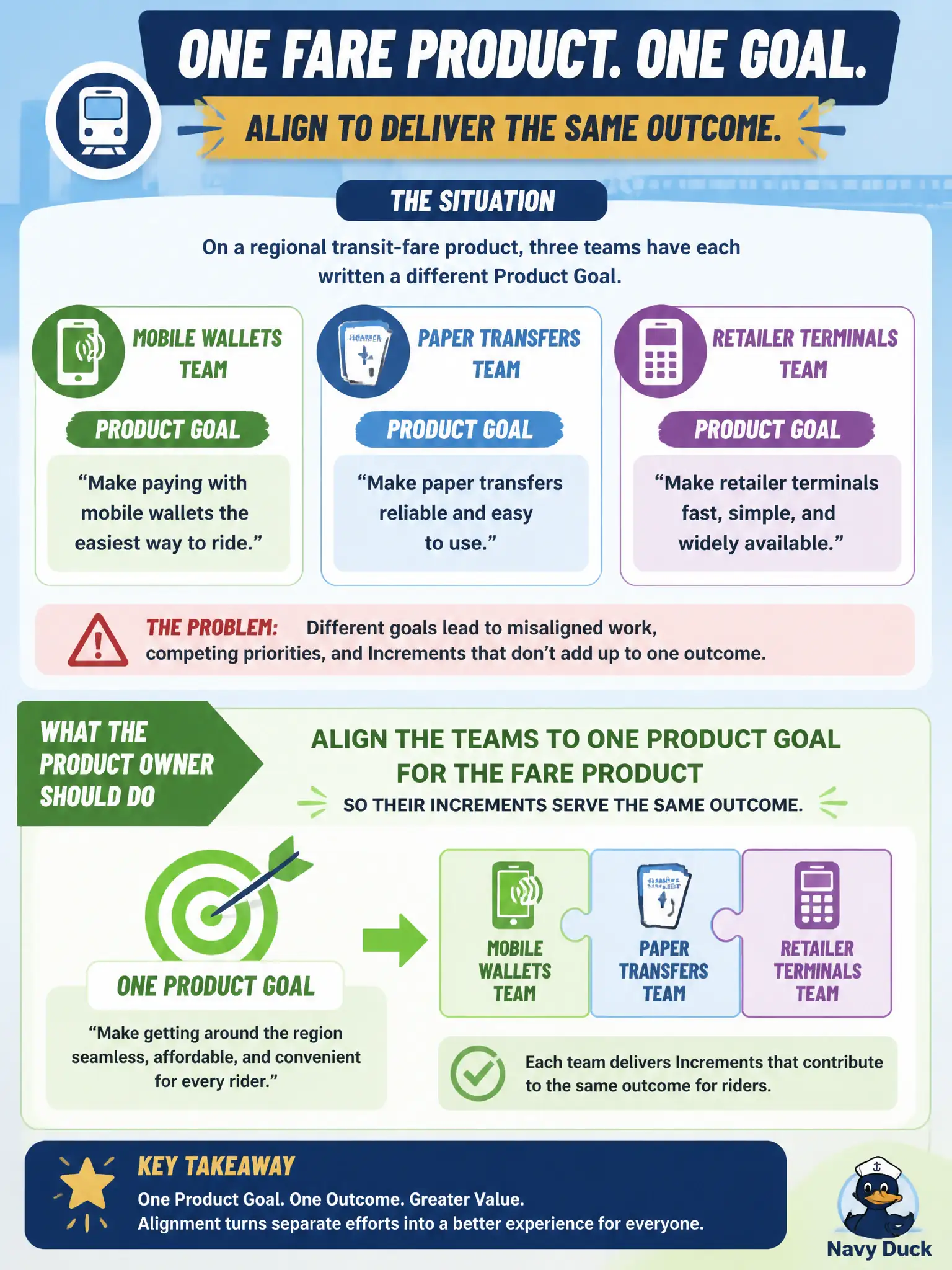
On a regional transit-fare product, three teams have each written a different Product Goal—one for mobile wallets, one for paper transfers, one for retailer terminals. What should the Product Owner do?
Select an answer to reveal the explanation.
Short Explanation
Three Product Goals on one fare product is three compasses on one bus. Pick the destination riders actually need. Team-local goals can be Sprint Goals or tactics, not competing product destinations.
Full Explanation
Scaled teams working on one product share one Product Goal—the commitment of the single Product Backlog. On a regional transit-fare product, when three teams have each written a different Product Goal for mobile wallets, paper transfers, and retailer terminals, the Product Owner should align the teams to one Product Goal for the fare product so their Increments serve the same rider outcome. Team-local aims may be Sprint Goals or tactics, not competing product destinations.
Blessing all three Product Goals so each team can stay independent guarantees incompatible Increments. Asking the Scrum Masters to negotiate a compromise goal after each Sprint postpones product-level commitment and makes facilitation own strategy. Replacing Product Goals with team OKRs that do not mention riders abandons the product commitment for internal scorecards.
Riders pay one fare experience; three Product Goals on one fare product pull the buses in three directions at once.
Exam caveat: PSPO II one-product scaling requires one Product Goal; multiple Product Goals on one fare product are an anti-pattern.
Operational check: publish one fare Product Goal focused on rider payment outcomes, retire the three competing goals, and reorder all three teams' work against that single commitment.