
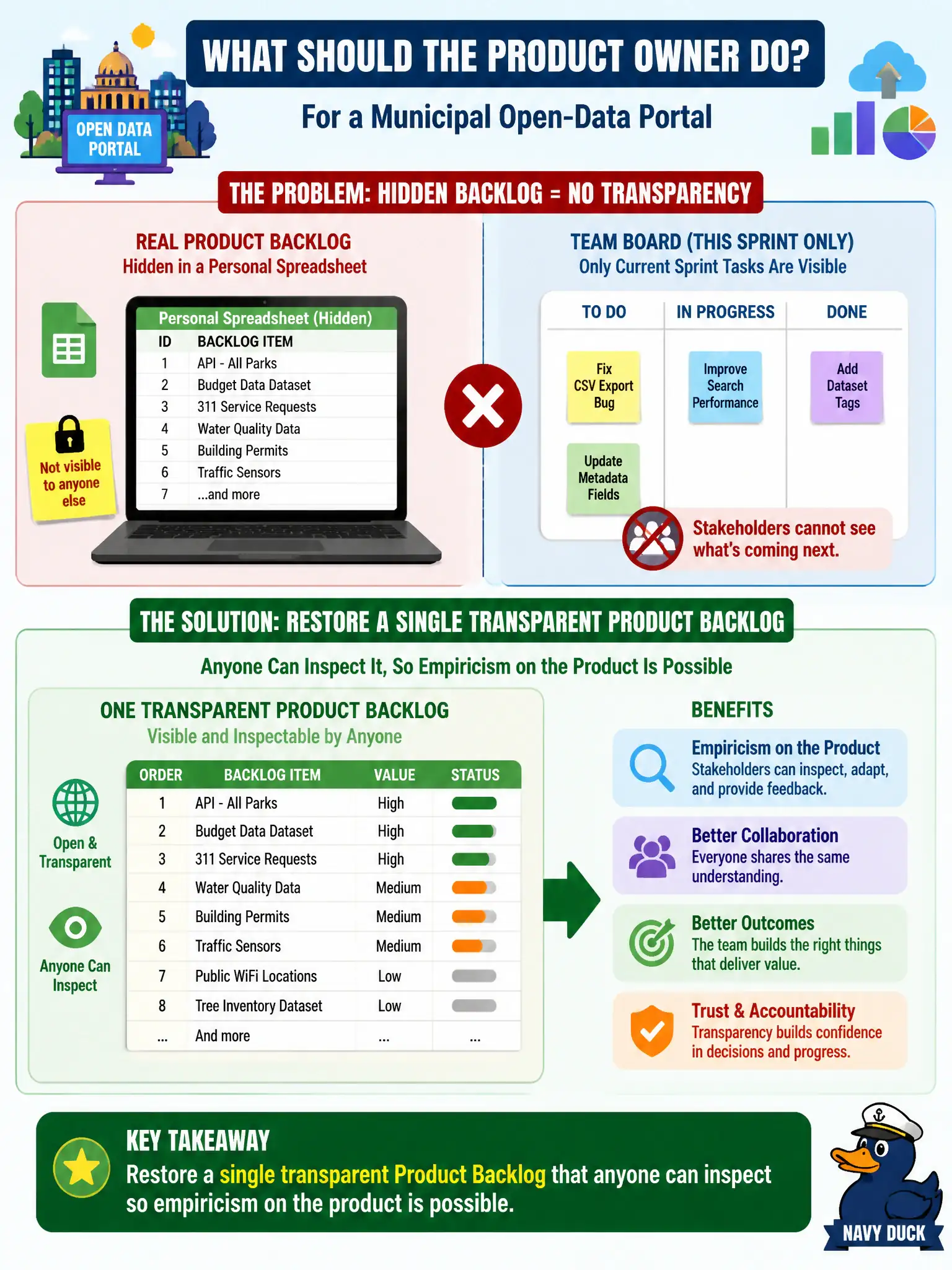
A municipal open-data portal Product Owner keeps the real Product Backlog in a hidden personal spreadsheet while the team board shows only this Sprint's tasks. Stakeholders cannot see upcoming order. What should the Product Owner do?
Select an answer to reveal the explanation.
Short Explanation
A secret spreadsheet is a menu the kitchen will not show the dining room. Nobody can inspect what open-data set comes next, so they cannot help adapt. Transparency is not niceness—it is how empiricism works.
Full Explanation
Artifact transparency is a prerequisite for inspection and adaptation. When a municipal open-data portal Product Owner keeps the real Product Backlog in a hidden personal spreadsheet while the team board shows only this Sprint's tasks, stakeholders cannot see upcoming order and empiricism on the product stalls. The Product Owner should restore a single transparent Product Backlog that anyone can inspect so civic open-data trade-offs are visible.
Keeping the hidden spreadsheet to prevent political fights over order chooses opacity over inspection and usually intensifies politics offline. Publishing only a quarterly highlight memo and leaving detailed order private is still not a Product Backlog. Asking the Scrum Master to own the Product Backlog so the Product Owner can stay strategic misplaces Product Backlog accountability.
Open-data stewardship for the public requires a backlog citizens' advocates and Developers can both inspect without a private spreadsheet.
Exam caveat: PSPO II requires one transparent Product Backlog; secret spreadsheets and memos are classic transparency failures.
Operational check: migrate the spreadsheet into the team's visible Product Backlog the same day, keep it current, and invite stakeholders to inspect order at the next Review.