
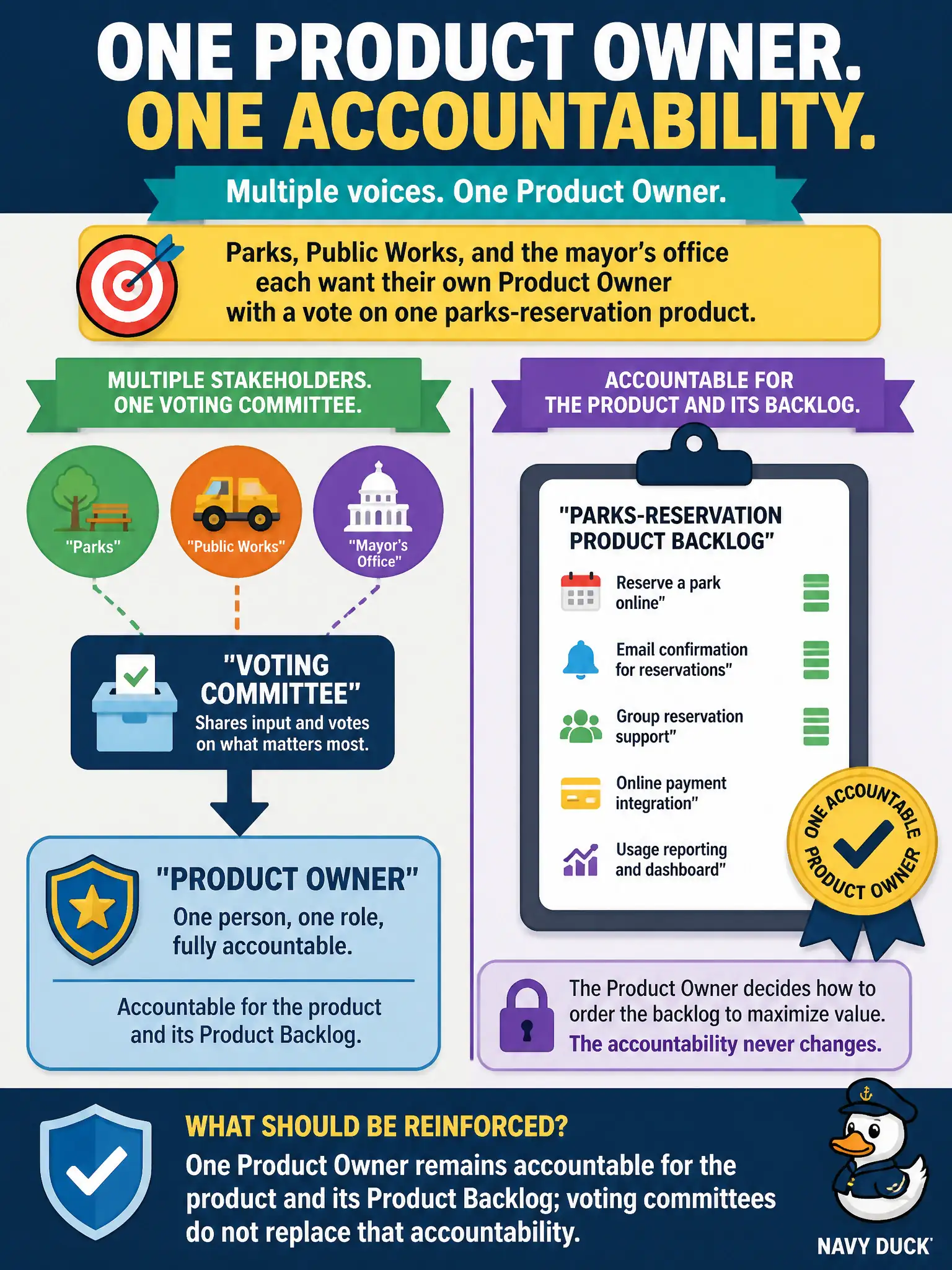
Parks, Public Works, and the mayor’s office each want their own Product Owner with a vote on one parks-reservation product. What should be reinforced?
Select an answer to reveal the explanation.
Short Explanation
Three Product Owners with votes is just a committee wearing name tags. One product gets one Product Owner who can actually order the parks-reservation backlog. Stakeholders can advise; they do not get a veto round-robin.
Full Explanation
For one product there is one Product Owner accountability and one Product Backlog. When Parks, Public Works, and the mayor's office each want their own Product Owner with a vote on one parks-reservation product, the correct reinforcement is that one Product Owner remains accountable for the product and its Product Backlog; voting committees do not replace that accountability. Stakeholders advise; they do not round-robin veto civic order.
Three Product Owners voting weekly so majority order becomes the Product Backlog diffuse authority until no one maximizes value. Separate Product Backlogs per department merged at release time hide integration conflict until too late. Letting the mayor's office Product Owner outrank others while titles multiply preserves politics under a false singular hierarchy of badges.
Municipal reservation products fail residents when three offices share a veto instead of one Product Owner carrying order.
Exam caveat: PSPO II scaling and accountability items insist on one Product Owner per product; multi-PO voting is a standing anti-pattern.
Operational check: name a single Product Owner for parks reservation, convert the other offices into stakeholder channels into that person, and keep one ordered Product Backlog visible to all three.