
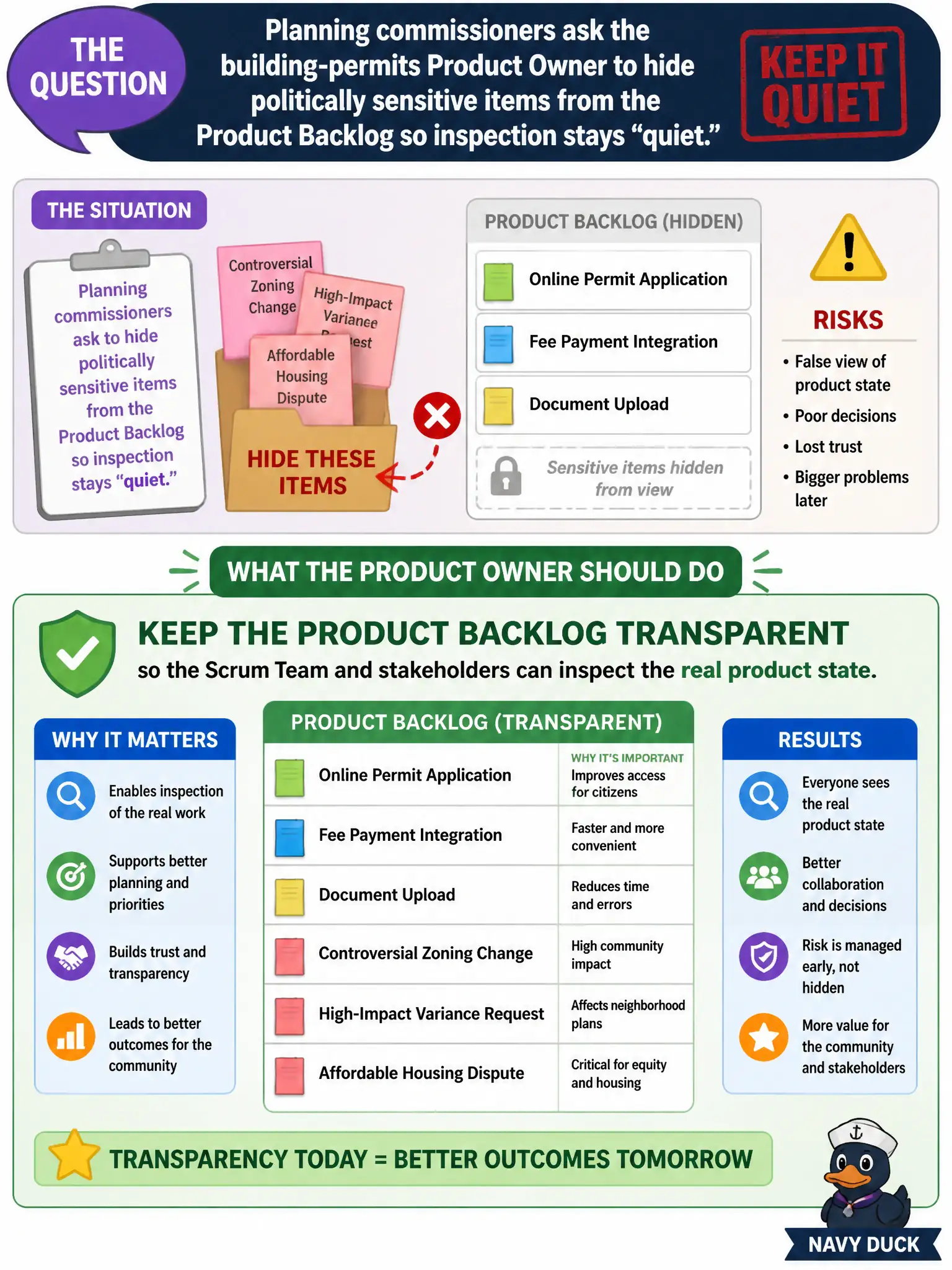
Planning commissioners ask the building-permits Product Owner to hide politically sensitive items from the Product Backlog so inspection stays “quiet.” What should the Product Owner do?
Select an answer to reveal the explanation.
Short Explanation
A backlog you cannot see is like a permit board with half the applications in a desk drawer—nobody can inspect the real work. Transparency is how empiricism even starts. Politics that prefer opacity are asking the Product Owner to turn the lights off.
Full Explanation
Transparency of the Product Backlog is a prerequisite for inspection and adaptation. When planning commissioners ask a building-permits Product Owner to hide politically sensitive items so inspection stays quiet, the Product Owner must keep the Product Backlog transparent so the Scrum Team and stakeholders can inspect the real product state. Quiet politics do not override the empiricism the Scrum framework—and civic accountability—depend on.
Moving sensitive items into a private shadow backlog that only the commission can see creates a dual truth and blocks team inspection. Deleting the items until after the next election so transparency cannot create conflict postpones reality and corrupts ordering. Asking the Scrum Master to encrypt the Product Backlog and share it only in closed session misuses facilitation to manufacture opacity.
Exam caveat: PSPO II treats Product Backlog transparency as non-negotiable; political discomfort is not a valid reason for a shadow list.
Operational check: keep every permit backlog item visible to the Scrum Team and relevant stakeholders, capture political sensitivity as a risk note on the item if needed, and refuse any request to maintain a second secret order.