
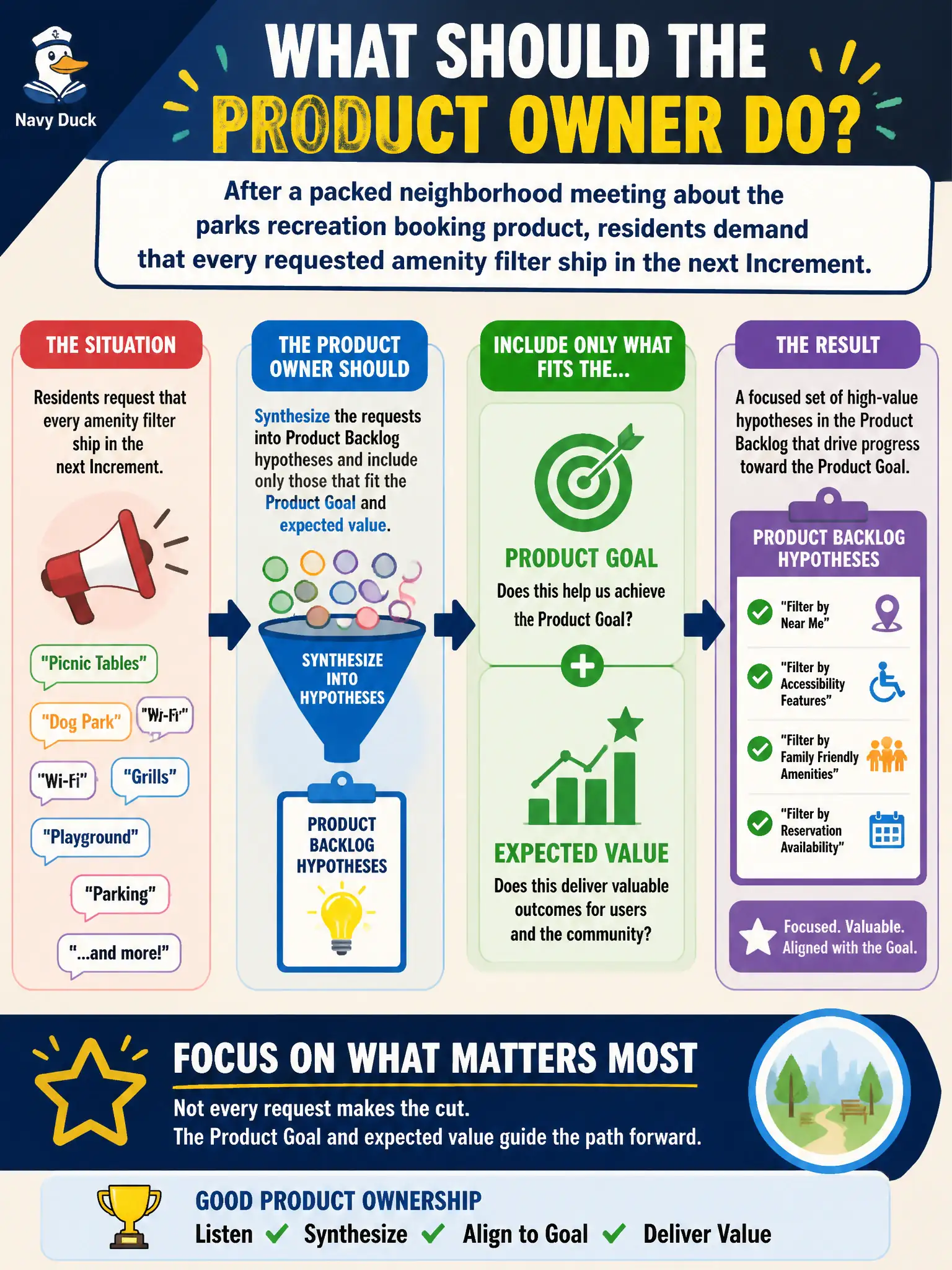
After a packed neighborhood meeting about the parks recreation booking product, residents demand that every requested amenity filter ship in the next Increment. What should the Product Owner do with that input?
Select an answer to reveal the explanation.
Short Explanation
A town hall is a gold mine of clues, not a purchase order. Treat the shouts as hypotheses about value, then keep only what serves the Product Goal. Otherwise the backlog becomes a suggestion box with a city logo.
Full Explanation
Community input from a packed neighborhood meeting is essential customer evidence for a civic parks recreation booking product, but spoken demands do not automatically become ordered Product Backlog work. The Product Owner remains accountable for maximizing value and for Product Backlog order, including whether a request supports the Product Goal and expected value. Synthesizing meeting themes into testable backlog hypotheses preserves transparency and learning while preventing a mandate-driven feature dump into the next Increment. Requests that do not fit can stay visible as later options or be declined with a clear value rationale so residents still see how their input was handled.
Treating every amenity filter as a binding top-of-backlog mandate fails because community meetings create evidence, not automatic commitments that override Product Goal fit. Asking the Scrum Master to vote which filters survive fails by concept because backlog ordering is Product Owner accountability, not a facilitation vote. Freezing the Product Goal until the parks board ratifies each spoken request fails because it turns empiricism into a formal-requirements gate and stalls adaptation.
Exam caveat: Stakeholder passion is input; only the Product Owner decides Product Backlog order against the Product Goal. Operational check: After the next parks town hall, cluster the top request themes into backlog hypotheses, map each to the Product Goal, and publish which items advanced, waited, or were declined—and why.