
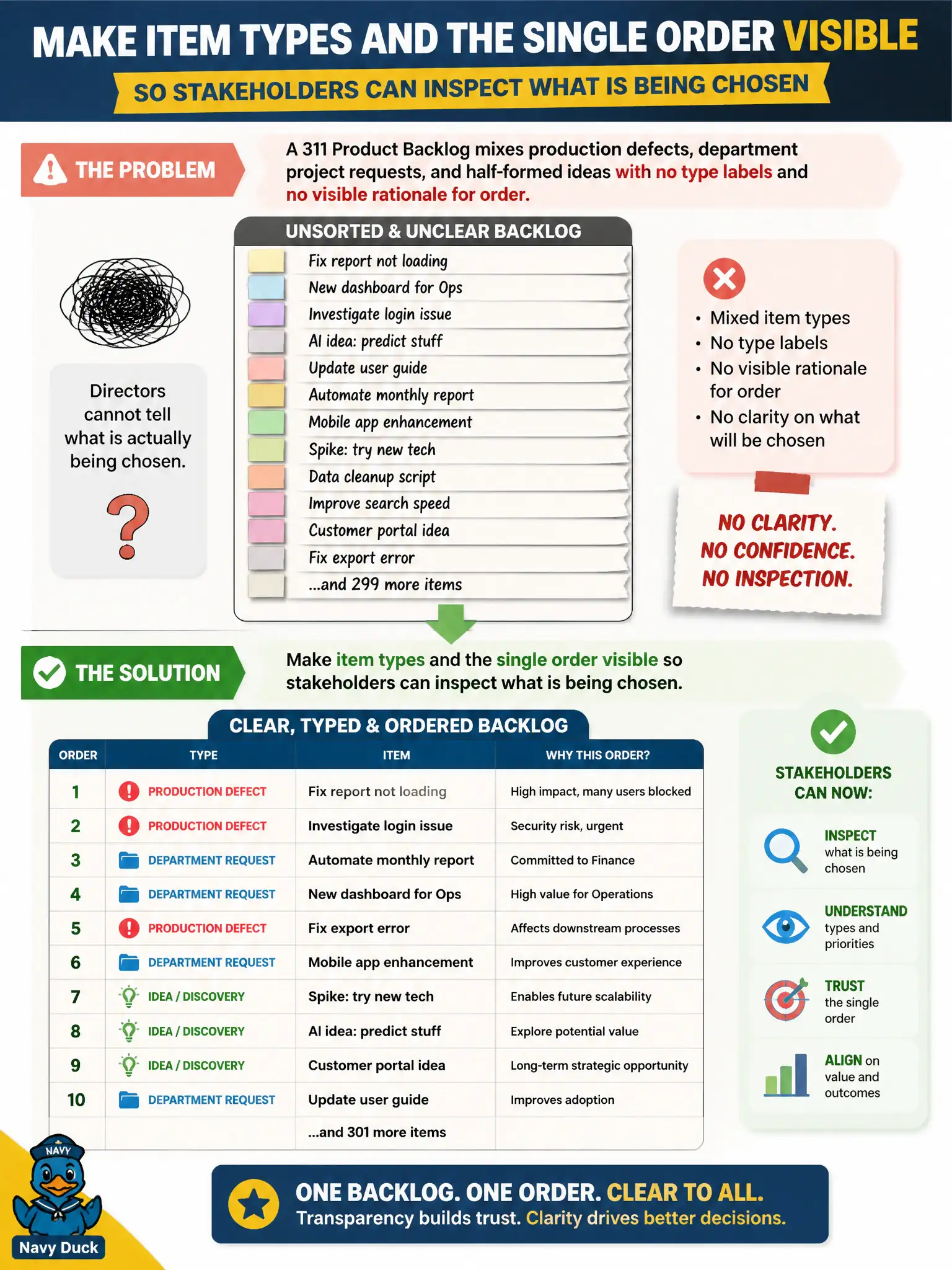
A 311 Product Backlog mixes production defects, department project requests, and half-formed ideas with no type labels and no visible rationale for order. Directors cannot tell what is actually being chosen. What should the Product Owner do?
Select an answer to reveal the explanation.
Short Explanation
A junk drawer is not a backlog. Bugs, projects, and napkin ideas can all live on one list—but people have to see what they are and where they sit. Transparency is the whole point; hiding the messy stuff just moves the mess into the shadows.
Full Explanation
Product Backlog transparency includes both content and order. When a 311 Product Backlog mixes production defects, department project requests, and half-formed ideas with no type labels and no visible rationale, directors cannot inspect what is being chosen for resident services. The Product Owner should make item types and the single order visible so stakeholders can see trade-offs without inventing separate sources of truth. Moving defects to a secret IT queue so the backlog shows only new features understates capacity competition and breaks empiricism. Publishing three unordered lists and letting each department pull independently recreates local optimization at the expense of citywide outcomes. Deleting all ideas so the backlog contains only already-funded projects may remove legitimate learning opportunities; order them rather than pretend they do not exist. Exam caveat: mixed work types are normal in a living civic product; secrecy and unordered pulls are the defect, not the mixture itself. Operational check: label types, publish ordering rationale tied to the Product Goal, keep one backlog, and use Sprint Review to inspect whether directors understand why defects, projects, and ideas sit where they do for equitable 311 service.