
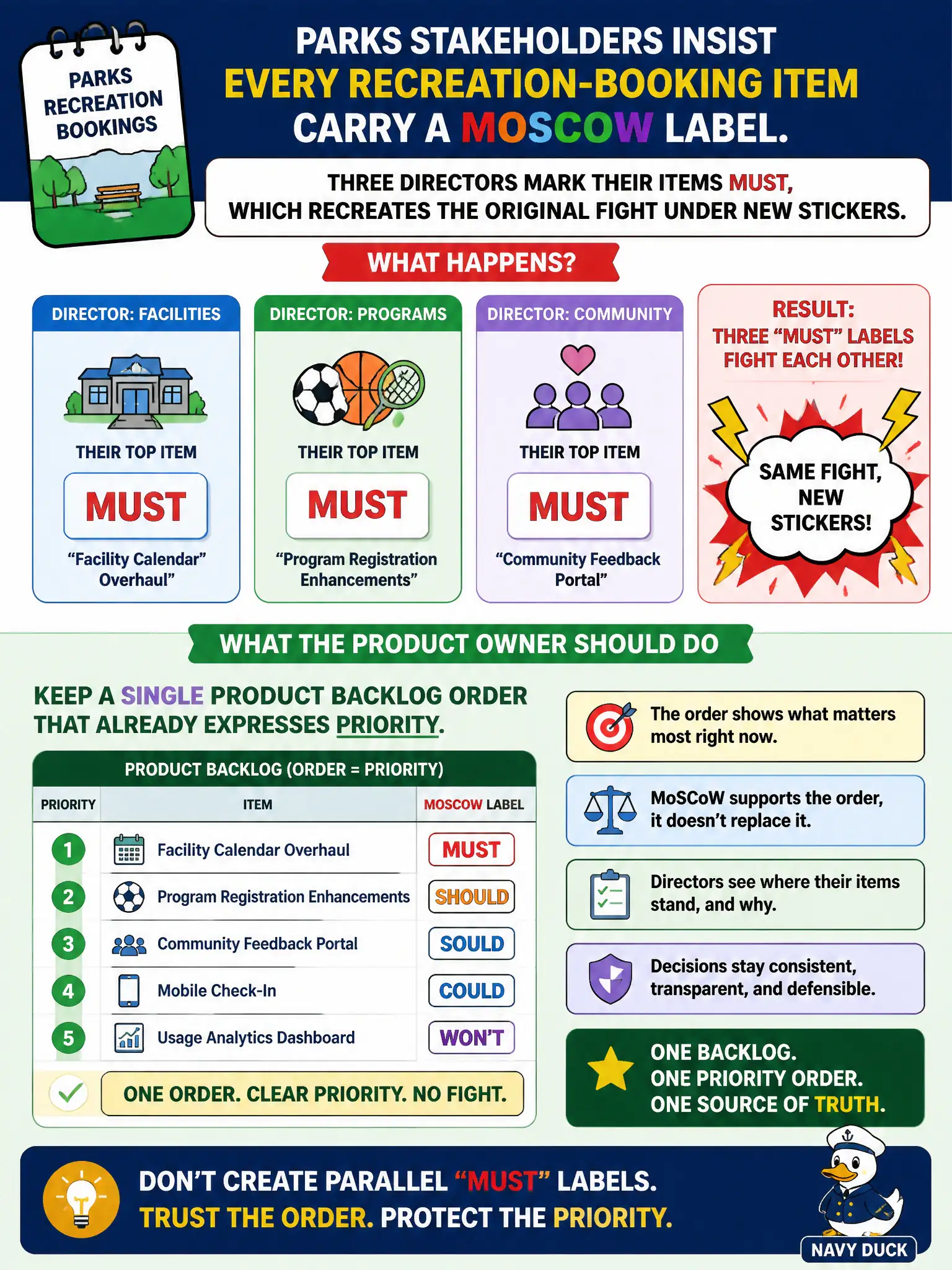
Parks stakeholders insist every recreation-booking item carry a MoSCoW label. Three directors mark their items Must, which recreates the original fight under new stickers. What should the Product Owner do?
Select an answer to reveal the explanation.
Short Explanation
When everything is a Must, nothing is. Stickers do not replace a line of items from top to bottom—the line already is the priority. The Product Owner keeps one order and declines the theater that lets three directors all win.
Full Explanation
A single ordered Product Backlog is the priority mechanism in Scrum. When parks stakeholders insist every recreation-booking item carry a MoSCoW label and three directors mark their items Must, the labels recreate the original conflict under new stickers. The Product Owner should keep a single Product Backlog order that already expresses priority instead of parallel Must labels that fight that order. Allowing unlimited Must labels so no director loses a political argument empties the label of meaning and returns the civic product to an unranked wish list. Splitting the work into four Product Backlogs, one for each MoSCoW bucket, undermines transparency about what will actually be done next for park users. Letting the Scrum Master vote on which Must items enter the Sprint misassigns ordering accountability away from the Product Owner. Exam caveat: lightweight tags can aid conversation if they never override the single ordered list; when tags become a second priority system, drop or demote them. Operational check: remove competing Must-driven sequencing, show one ordered recreation-booking backlog tied to the Product Goal, explain trade-offs in Sprint Review, and measure whether stakeholder arguments shift from stickers to outcomes for park users and clerks.