
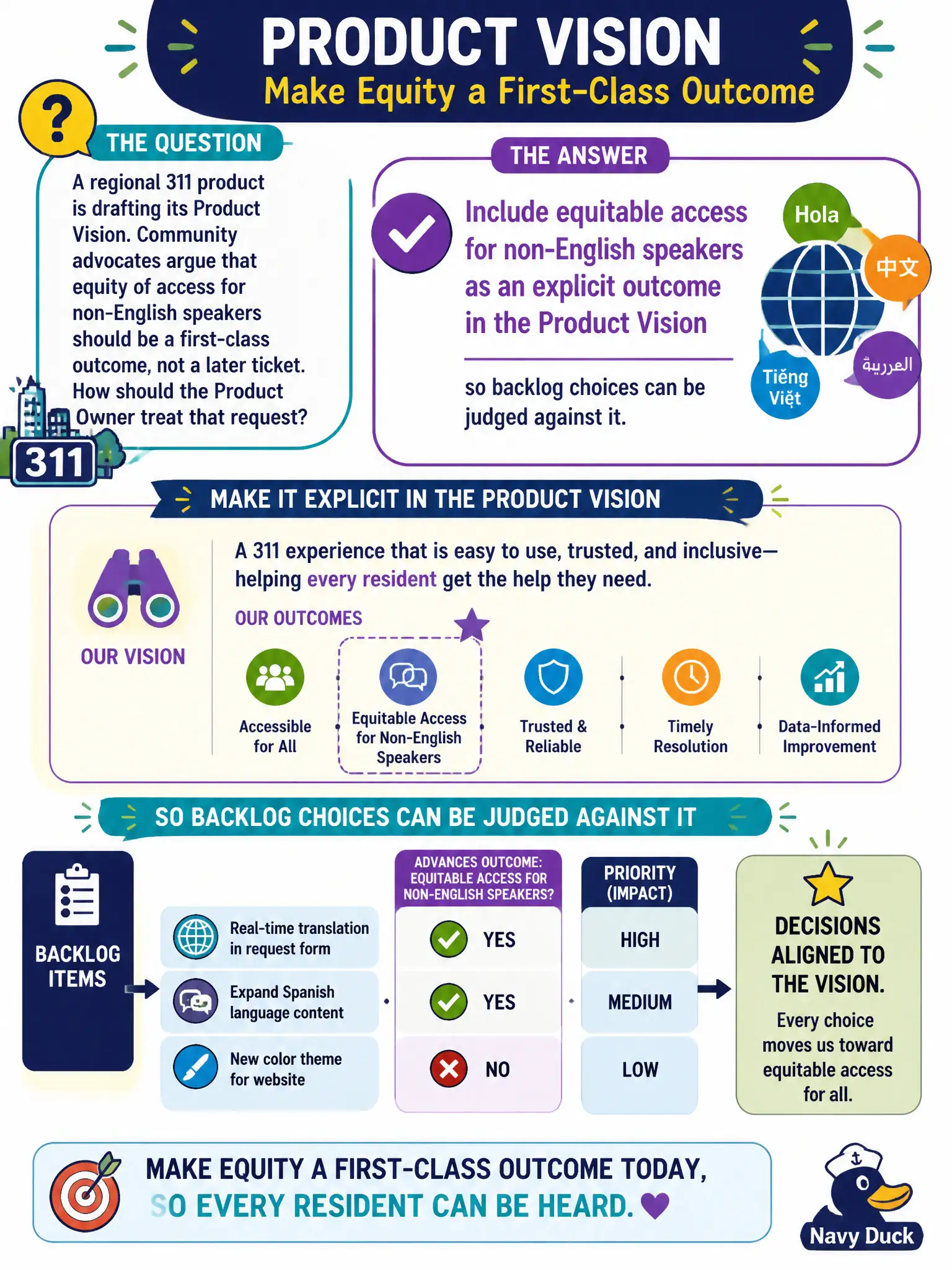
A regional 311 product is drafting its Product Vision. Community advocates argue that equity of access for non-English speakers should be a first-class outcome, not a later ticket. How should the Product Owner treat that request?
Select an answer to reveal the explanation.
Short Explanation
A vision is the north star, and civic products can put fairness right on that star. If 311 says anyone can get help, then Spanish, Vietnamese, and other language access are not leftover tickets. Write the outcome into the vision so later "why this?" talks have an answer.
Full Explanation
Equity of access for non-English speakers on a regional 311 product is a first-class citizen outcome when advocates make that case; the Product Owner should include it explicitly in the Product Vision so backlog choices can be judged against it. Keeping the vision English-only and deferring translation to a later project after the first year of releases treats equity as optional polish rather than outcome. Moving language access only into the Definition of Done as a technical constraint while omitting it from vision hides strategic intent and may reduce it to checklist compliance without prioritization clarity. Asking each language community to write its own Product Vision so the backlog serves every slogan at once fragments direction. Exam caveat: inclusive access can belong in vision as outcome, not only as a late technical ticket. Operational check: add equitable multilingual access to the vision statement, create Product Goals and measures for completion across languages, and order backlog experiments that prove access rather than promising a future translation project. Equitable multilingual access belongs in regional 311 vision when it is a first-class citizen outcome, enabling backlog judgment rather than a deferred translation project. Create measures for completion across languages and order experiments that prove access.