
A Product Owner is briefing transit leadership on when a rider-alerts Increment might be releasable. Remaining Product Backlog size is known, but several risky assumptions are still unvalidated. What should the briefing include?
Select an answer to reveal the explanation.
Short Explanation
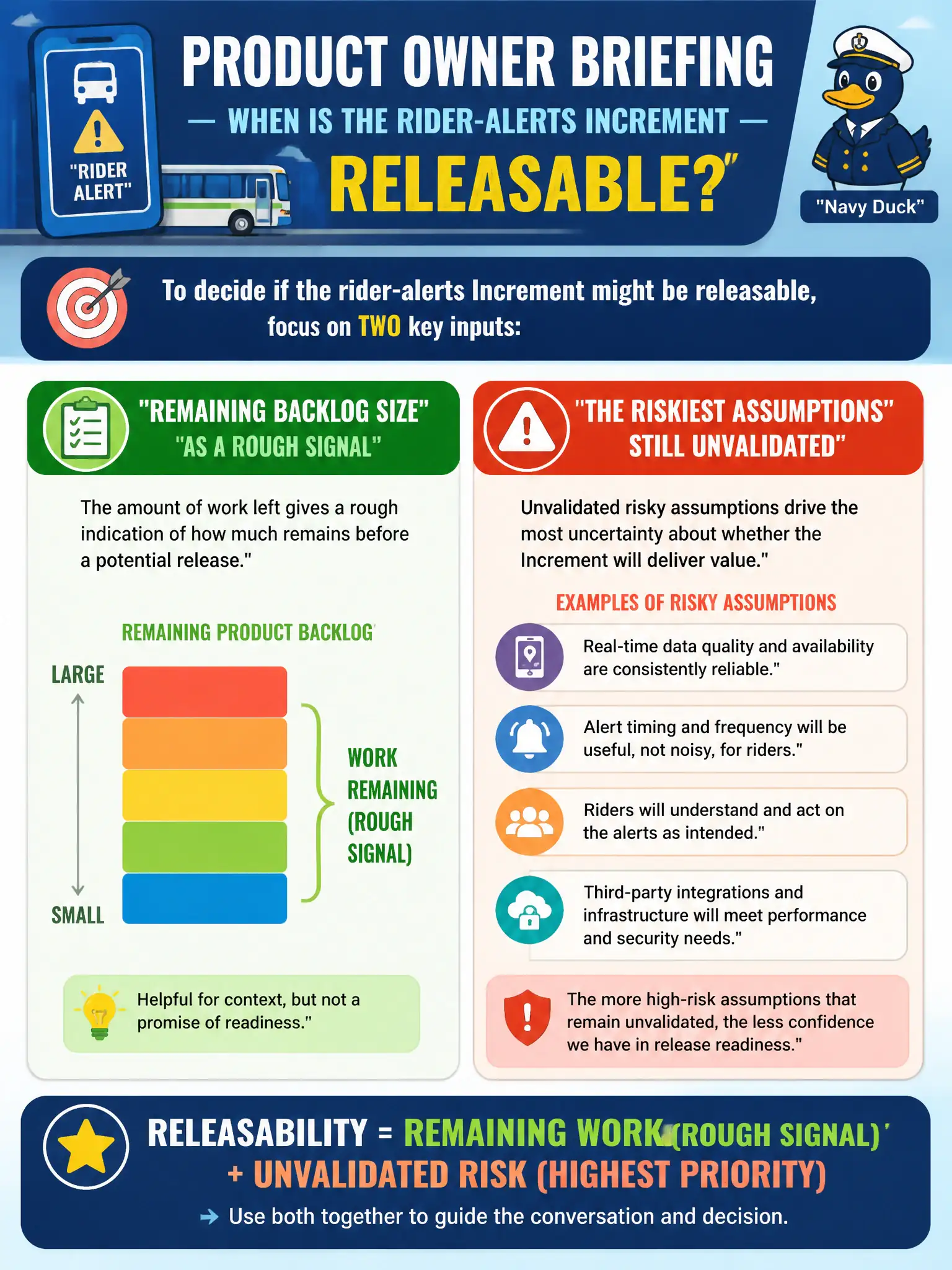
Backlog size is a pile of bricks, not a finished station. Pair the remaining work with the shaky assumptions — identity, message reach, whatever is still a guess. A guaranteed date that ignores those guesses is how rider alerts ship into a wall.
Full Explanation
When briefing transit leadership on when a rider-alerts Increment might be releasable, remaining Product Backlog size is only a rough signal; unvalidated risky assumptions can move the date more than raw item count. The Product Owner should pair remaining backlog size with the riskiest assumptions still unvalidated so leadership can inspect real uncertainty. Remaining item count alone is an insufficient forecast because it ignores whether critical hypotheses about alerting accuracy or channel reach have been tested. A single guaranteed date derived from dividing remaining points by best-case velocity compounds optimism with false precision. Omitting uncertainty so naming assumptions would not weaken political support trades short-term comfort for a later credibility failure when risks surface. Exam caveat: transparency about risk is part of forecasting, not optional soft skills, on PSPO II. Operational check: list the top unvalidated assumptions beside the size-based outlook, propose the smallest experiments that would reduce those risks, and refuse to publish a guaranteed Friday until those risks are addressed or explicitly accepted. Rider-alert forecasts that omit unvalidated assumptions look precise and fail loudly; pairing backlog size with the riskiest open hypotheses is the transparent brief. Fund the smallest experiments that would retire those risks before publishing a guaranteed date.