
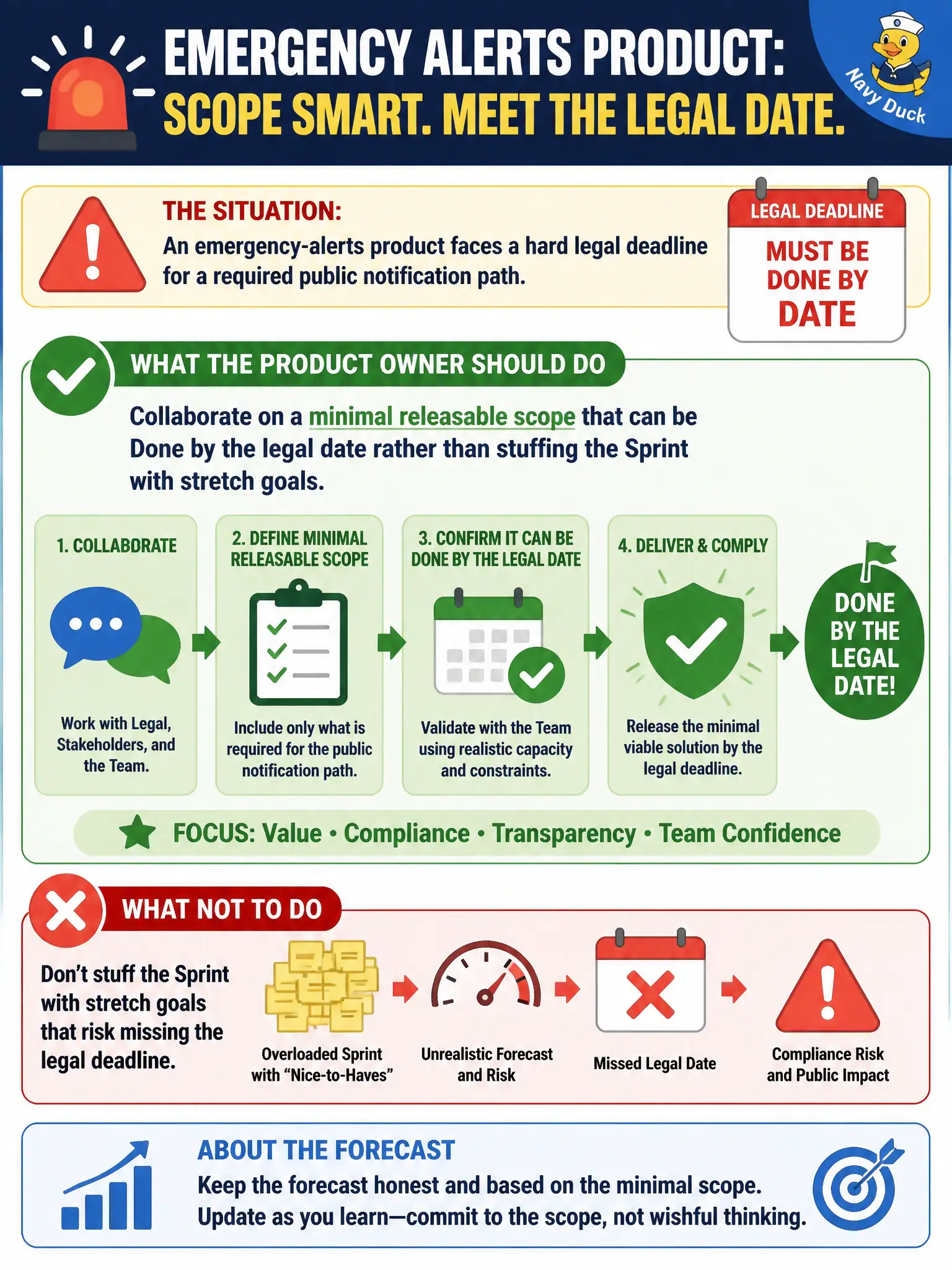
An emergency-alerts product faces a hard legal deadline for a required public notification path. What should the Product Owner do about scope and the forecast?
Select an answer to reveal the explanation.
Short Explanation
A legal siren date is real; a stuffed Sprint of extra channels is not. Cut to the smallest Done path that actually notifies the public in time. Heroics and stretch piles are how alerts miss the statute and the residents.
Full Explanation
When a public-safety notification product faces a hard legal deadline, the Product Owner should thin scope to the minimal releasable Increment that meets the law and the Definition of Done, then forecast that path honestly. Date-driven forecasting is valid in Scrum when scope flexes and quality does not; stuffing stretch goals into the same deadline is not. Scrum does not forbid acknowledging a statutory deadline, and it does not permit treating a required public-safety path as optional theater. Expanding scope with stretch features while keeping the legal date converts a compliance constraint into an overloaded commitment that will either miss the law or silently cut Done. Declaring the legal date irrelevant because Scrum teams only follow Sprint Goals ignores that Product Goals and backlog order must still deliver compliant value by the constraint. Asking Developers to skip Done so the full original feature list fits the statute date sacrifices releasability and citizen safety for calendar optics. Exam caveat: under a fixed date, flex scope and protect quality—never the reverse on PSPO II scenarios. Operational check: list the smallest legally required notification capabilities, confirm each can meet Done before the deadline, and move nonessential enhancements after the compliant Increment ships.