
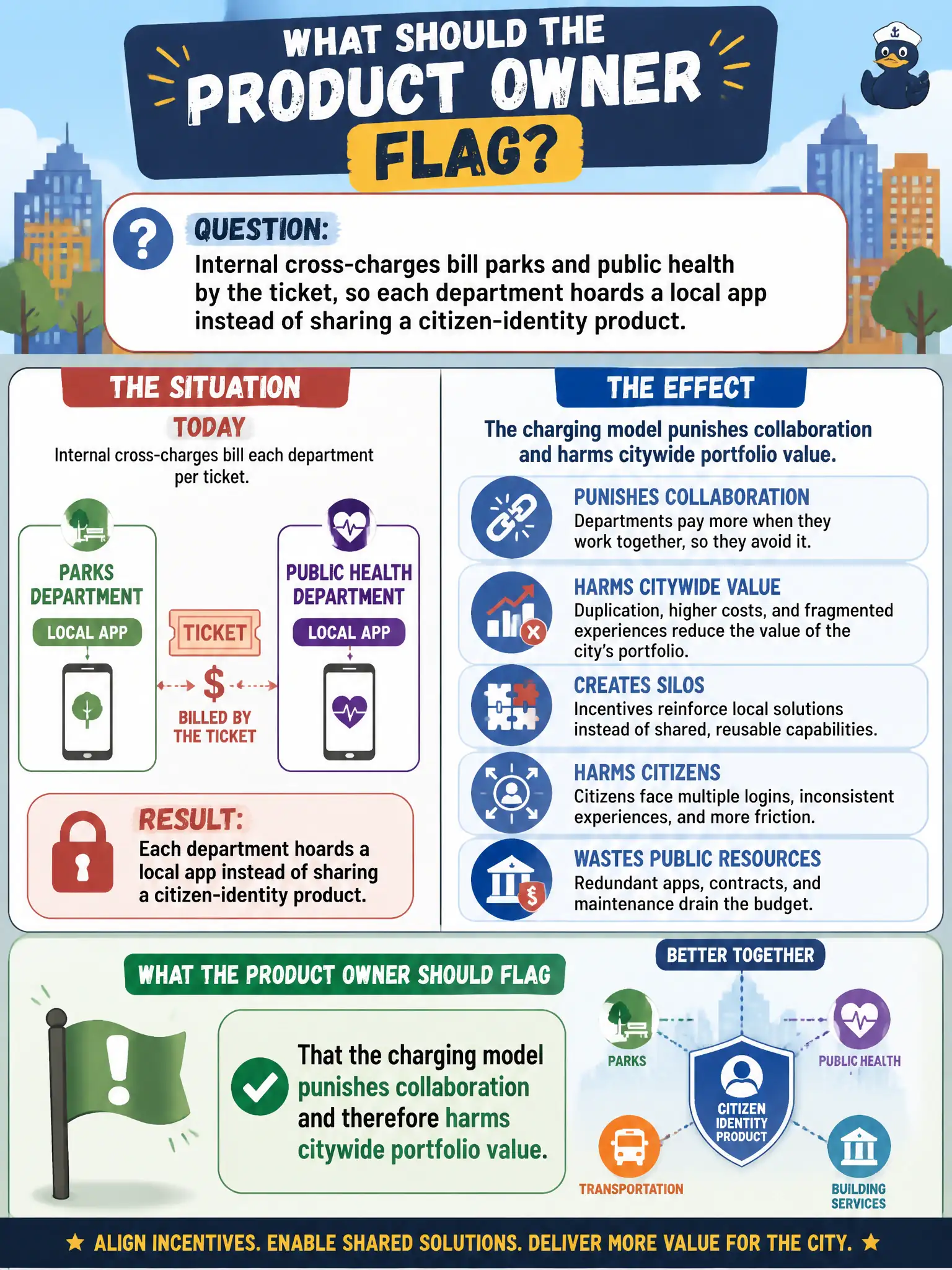
Internal cross-charges bill parks and public health by the ticket, so each department hoards a local app instead of sharing a citizen-identity product. What should the Product Owner flag?
Select an answer to reveal the explanation.
Short Explanation
If every kitchen gets billed every time it borrows salt, nobody shares salt and the city buys three shakers. Cross-charging that punishes a shared identity product is an incentive bug. Flag it as a portfolio problem, not as a reason to hide work in a drawer.
Full Explanation
Incentives are part of portfolio design. When internal cross-charges bill parks and public health by the ticket, each department hoards a local app instead of sharing a citizen-identity product because collaboration looks expensive. The Product Owner should flag that the charging model punishes collaboration and therefore harms citywide portfolio value. Secret builds and extra Product Owners for invoice fights do not fix the system. Making the misalignment transparent lets finance and leadership change the incentive or accept the local-optimization tax with eyes open.
Adding a markup so the hoarding at least funds more teams fails by amplifying a bad incentive. Asking Scrum Teams to ignore finance and build the shared product in secret fails by hiding work and risk. Giving each department its own Product Owner solely to contest invoices fails by weaponizing roles around billing instead of shared value.
Exam caveat: Flag charging models that punish shared civic platforms as portfolio design bugs. Operational check: Show finance the duplicate identity apps driven by per-ticket cross-charges, propose a shared-platform funding model that does not penalize reuse, and stop secret builds as the workaround.