
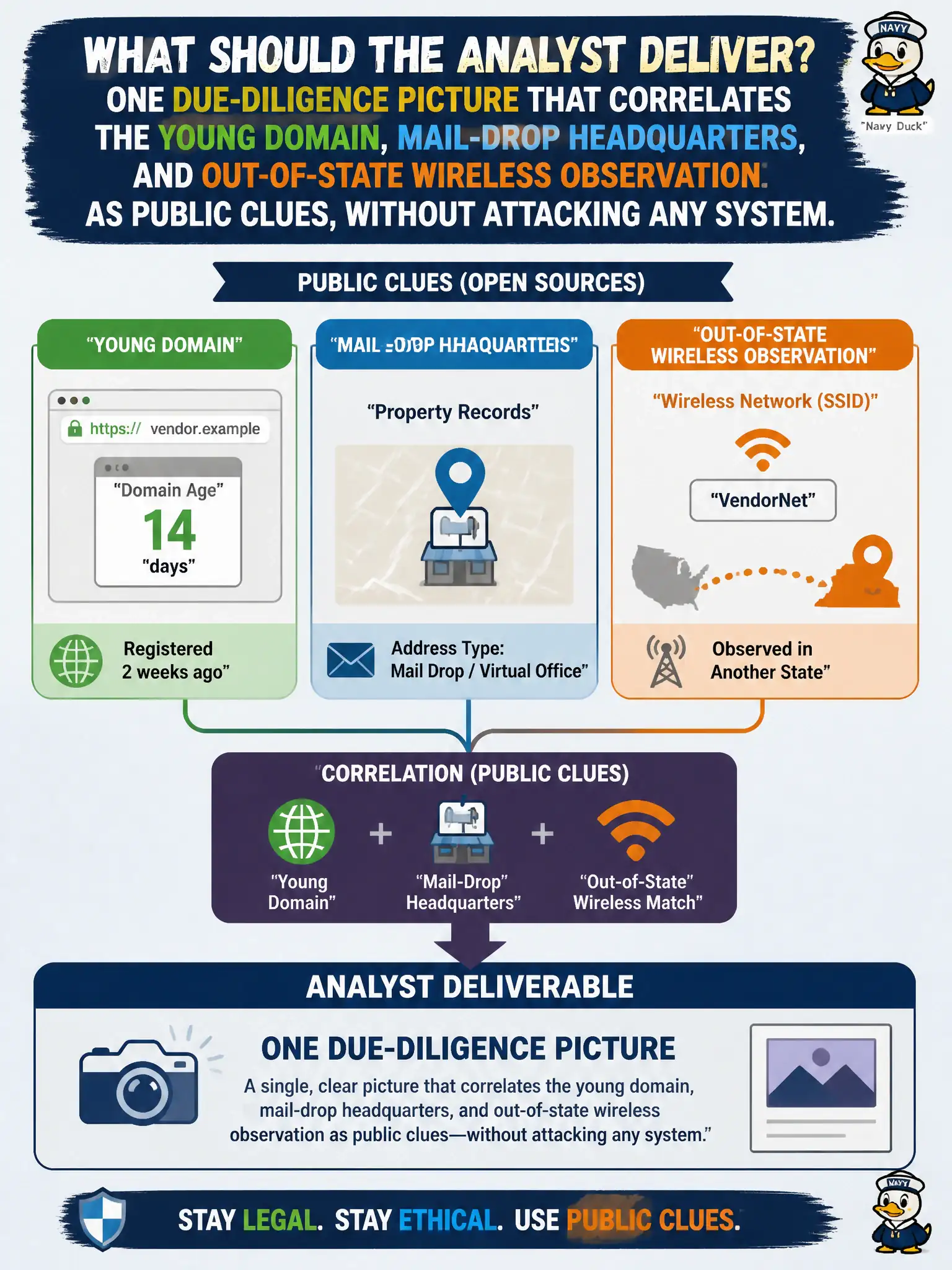
A “local” vendor’s public surfaces show a two-week-old domain, a mail-drop headquarters in property records, and a matching SSID observed only in another state. What should the analyst deliver?
Select an answer to reveal the explanation.
Short Explanation
Three public breadcrumbs tell a better story together than apart: a brand-new domain, a mailbox HQ, and Wi-Fi that only shows up in another state. Glue them into one due-diligence picture. That is research, not a pentest and not a spy novel.
Full Explanation
PORP-style analysis joins website, business-records, and observational wireless clues into one sourced due-diligence picture. When a 'local' vendor shows a two-week-old domain, a mail-drop headquarters in property records, and a matching SSID observed only in another state, the analyst should deliver one correlated public-clue package with URLs, dates, and caveats—without attacking any system and without leaping to intelligence-front conclusions from three artifacts alone.
Leaving three disconnected notes because those disciplines must never be joined wastes the analytical value of correlation that civic procurement needs. Using the out-of-state SSID as a pentest foothold against the vendor office converts OSINT into intrusion. Concluding the vendor is definitely a foreign intelligence front over-attributes thin public clues into a national-security finding.
Exam caveat: young domains, mail drops, and out-of-state SSIDs weaken a local-presence claim but do not by themselves prove nationality, intent, or covert affiliation; keep language at correlated due-diligence risk.
Operational check: build one memo that cites domain age, occupancy/mail-drop records, and wireless map vintage/location together; deliver to procurement; and stop short of exploitation or spy-novel certainty.