
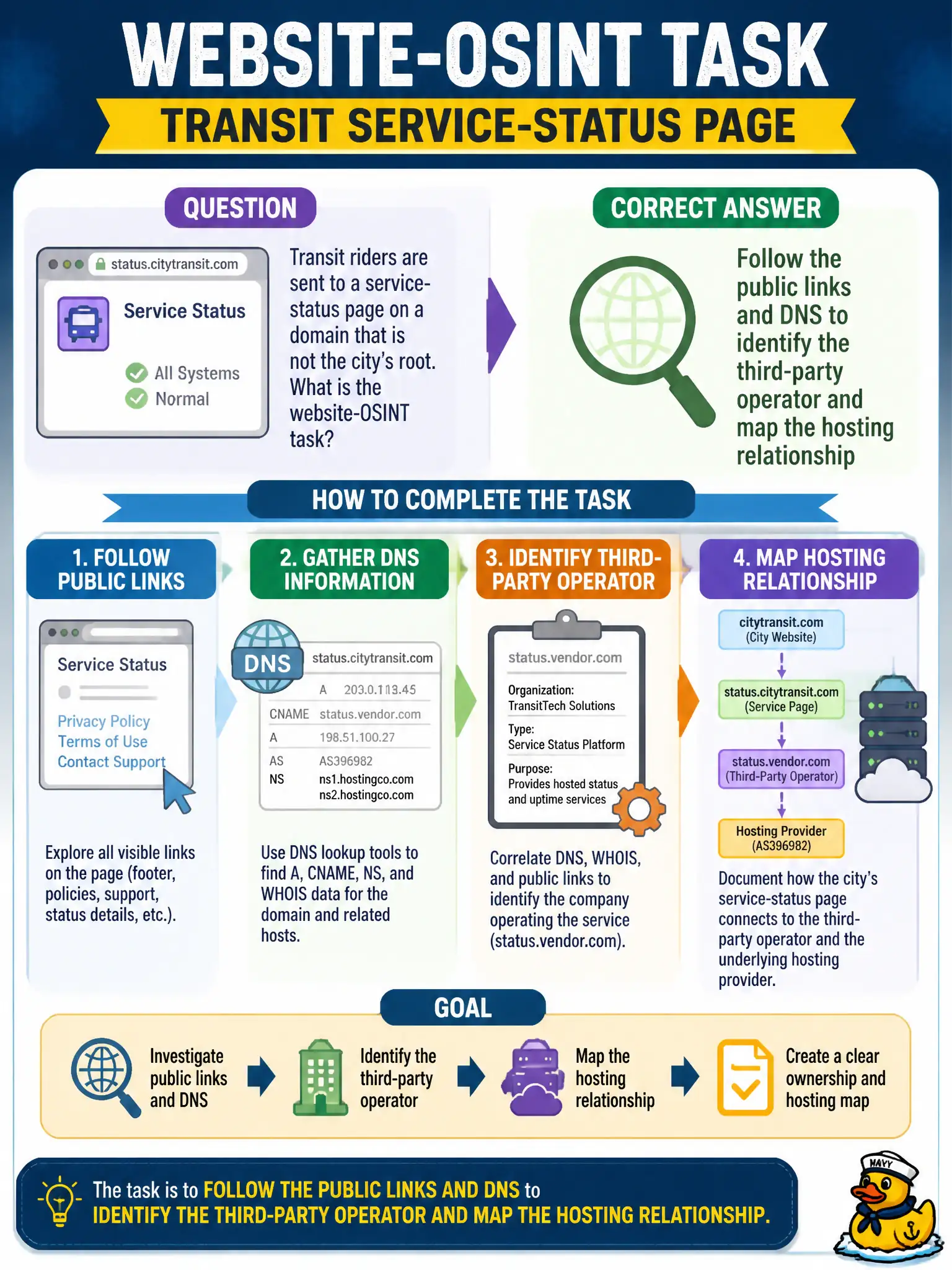
Transit riders are sent to a service-status page on a domain that is not the city's root. What is the website-OSINT task?
Select an answer to reveal the explanation.
Short Explanation
City services often sit on someone else's lot with a city sign out front. Follow the public links and DNS to see who actually hosts the status page. Do not assume the city root owns every microsite, and do not scan or hijack the vendor domain.
Full Explanation
If transit riders are sent to a service-status page on a domain that is not the city’s root, the website-OSINT task is to follow the public links and DNS to identify the third-party operator and map the hosting relationship. Civic services often live on vendor microsites; mapping that relationship supports outage and authenticity communications. Assuming every transit page must live on the city root and treating the status page as fake without checking fails by skipping DNS and link analysis that may show an authorized vendor. Hijacking the vendor domain’s DNS so the status page points at city servers fails as unauthorized DNS interference. Port-scanning the vendor status page to prove the city still owns the service fails as intrusive scanning outside Fundamentals OSINT. Exam caveat: third-party hosting can be legitimate—document the operator rather than assuming fraud. Operational check: trace public links, CNAME/DNS, and TLS/subject clues; name the operator in the transit OSINT note; confirm with IT whether the relationship is contracted. In municipal practice, record the rationale in the case file so future staff know which control was chosen and which failure modes the rejected options would create for city services.