
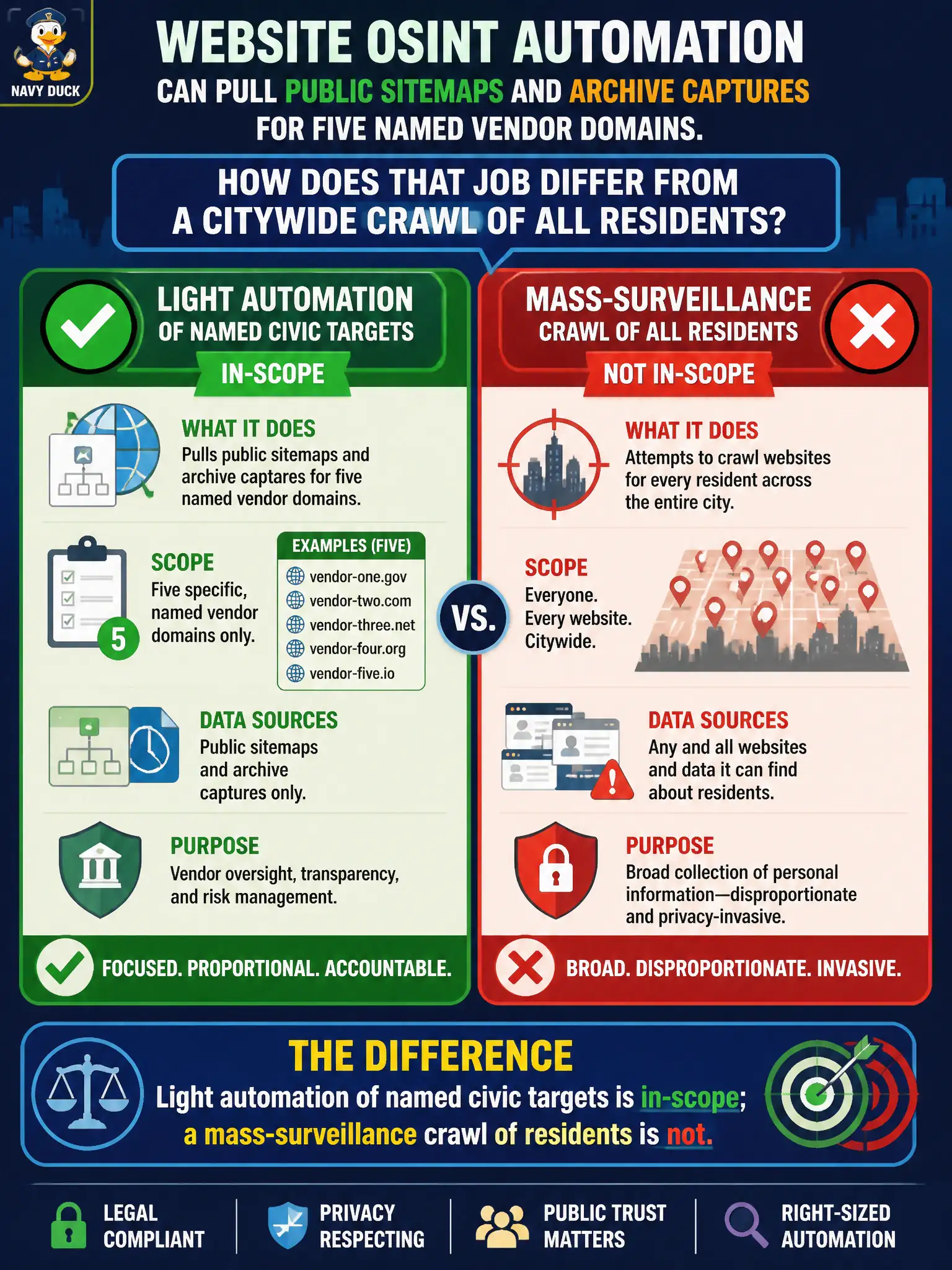
Website OSINT automation can pull public sitemaps and archive captures for five named vendor domains. How does that job differ from a citywide crawl of all residents?
Select an answer to reveal the explanation.
Short Explanation
Five named vendor sites is a grocery list; crawling every resident is a dragnet. Bounded website OSINT automation is in-scope. Mass surveillance of the public is not the method.
Full Explanation
OSINT Automation Foundations support light, named-target website work such as sitemaps and archive captures for a short vendor list. When website OSINT automation can pull public sitemaps and archive captures for five named vendor domains, that job differs from a citywide crawl of all residents because light automation of named civic targets is in-scope, while a mass-surveillance crawl of residents is not. Bounded, attributable collection tied to a procurement or due-diligence question is the professional civic pattern.
Treating both jobs as equivalent dragnets that are required for PORP erases the distinction between scoped vendor research and population surveillance. Claiming the five-name job is out of scope while only mass resident crawls count inverts the ethics of the course. Restricting automation to staff home networks targets the wrong class of systems and personalizes collection inappropriately.
Exam caveat: even named-vendor automation must stay polite, public, and stop when scoped evidence is captured; 'named' does not authorize unlimited depth against every path on those domains.
Operational check: list the five vendor domains, run bounded sitemap/archive pulls with rate limits, cite captures with dates, and refuse any citywide resident crawl framed as PORP automation.