
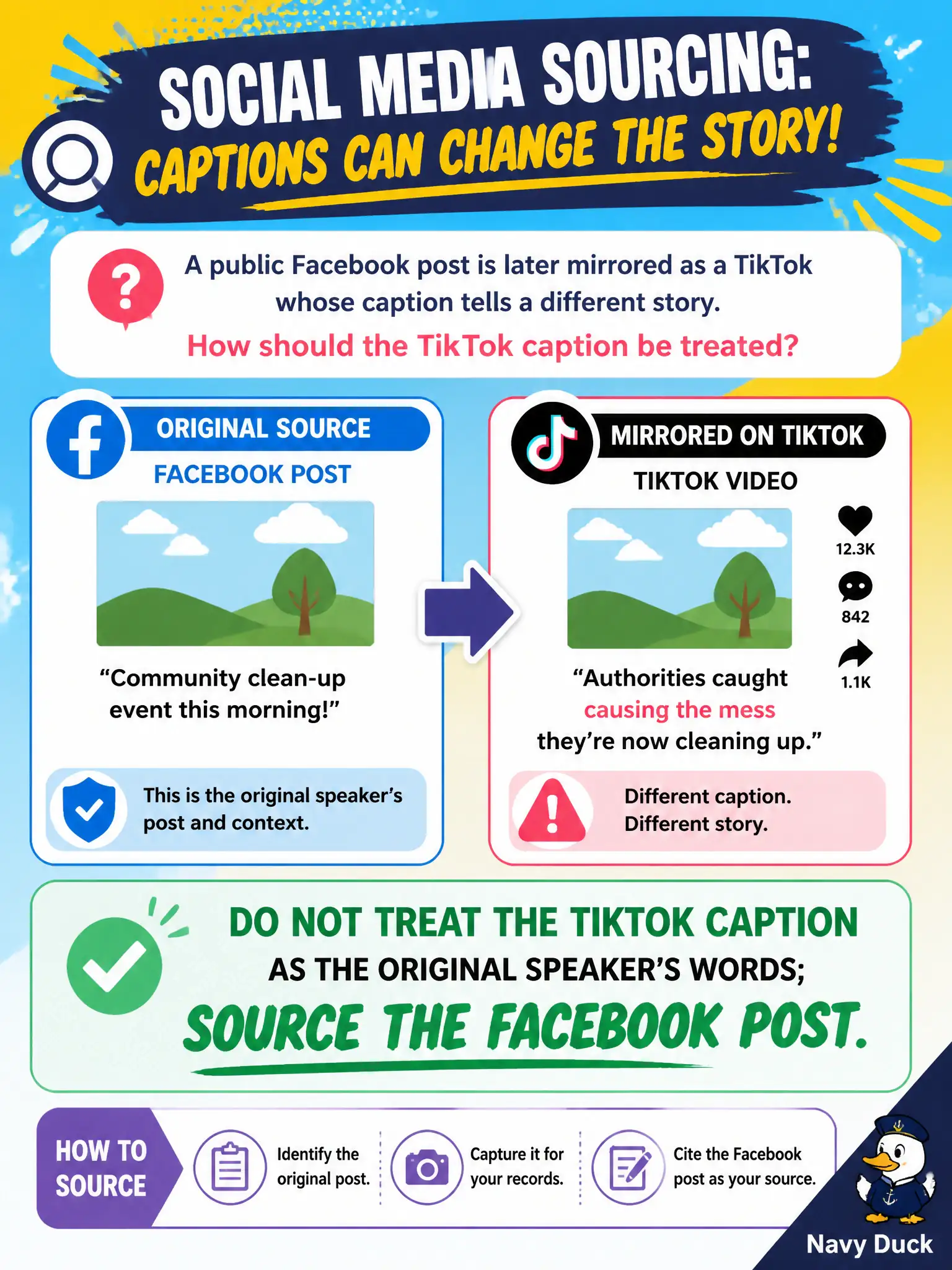
A public Facebook post is later mirrored as a TikTok whose caption tells a different story. How should the TikTok caption be treated?
Select an answer to reveal the explanation.
Short Explanation
Recaptioning is like putting a new headline on someone else's photo. The TikTok text is the remixer's line, not the original speaker's. Go back to the Facebook post for the words that were actually published there.
Full Explanation
If a public Facebook post is later mirrored as a TikTok whose caption tells a different story, the TikTok caption must not be treated as the original speaker’s words; source the Facebook post. Recaptioning is a remix layer that can mislead municipal briefings about who said what regarding a civic issue. Preferring the TikTok caption because video platforms are more accurate than Facebook fails; accuracy follows the primary utterance, not platform fashion. Merging both captions into one quote attributed to the original speaker fails by fabricating a composite quote nobody published as a single statement. Ignoring Facebook because recaptioning proves the first post was fake fails; a new caption does not falsify the earlier public post. Exam caveat: both artifacts remain collectible—the remix caption is the remixer’s speech, and the Facebook text is the earlier speaker’s if authorship there is otherwise sound. Operational check: capture both URLs with retrieval dates; quote Facebook text as original-layer speech and TikTok caption as remixer speech; brief the PIO with separated attribution so corrections target the right layer. In municipal practice, record the rationale in the case file so future staff know which control was chosen and which failure modes the rejected options would create for city services.