
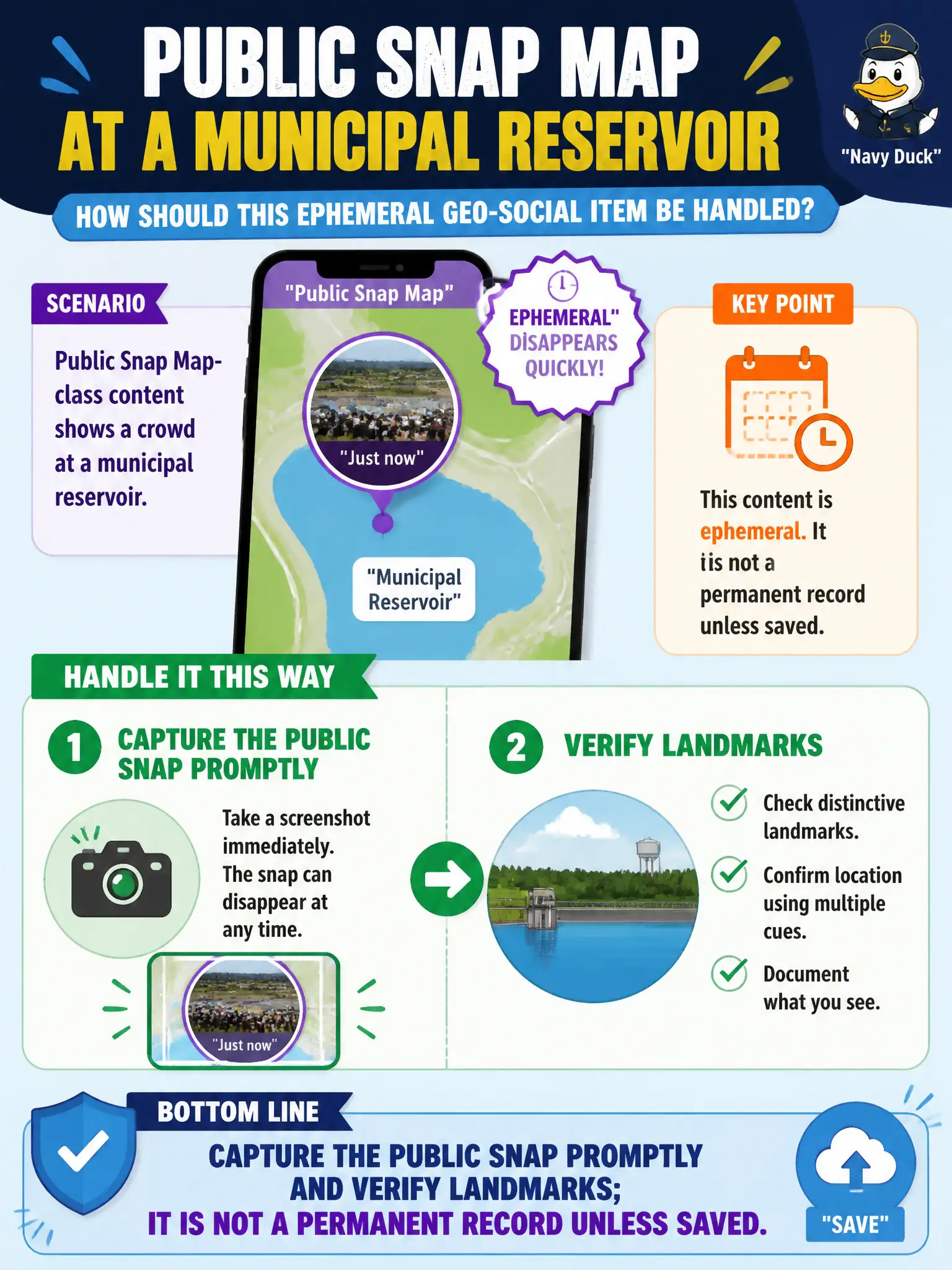
Public Snap Map-class content shows a crowd at a municipal reservoir. How should that ephemeral geo-social item be handled?
Select an answer to reveal the explanation.
Short Explanation
A public snap on a map is a weather balloon—useful right now, gone in a hurry. Save it while it is public and check the landmarks in the frame. The pin is a hint, not a survey monument, and it is not a reason to contact kids.
Full Explanation
When public Snap Map-class content shows a crowd at a municipal reservoir, that ephemeral geo-social item should be captured promptly and landmarks verified; it is not a permanent record unless saved. Ephemeral maps help civic safety and facilities awareness only while the content remains public, so delay loses the primary. Assuming Snapchat stores the snap forever as an official public record fails; ephemerality is the product design and municipal files need their own capture under records practice. Treating the map pin as surveyed coordinates without checking visible landmarks fails because pins are approximate and user-mediated. Messaging nearby minors whose snaps appear on the map to confirm crowd size fails as inappropriate contact with children and outside OSINT ethics. Exam caveat: even adult public snaps require landmark verification before operational decisions about reservoir access or public-safety posture. Operational check: capture while public; identify landmarks against reservoir maps; record retrieval time; avoid contacting minors; escalate verified crowd concerns through normal public-safety channels rather than social messaging. In municipal practice, record the rationale in the case file so future staff know which control was chosen and which failure modes the rejected options would create for city services.