
Public-works researchers argue that sock-puppet accounts are always illegal, so they plan to log in as a named city official to reach private vendor portals instead. What distinction should they apply?
Select an answer to reveal the explanation.
Short Explanation
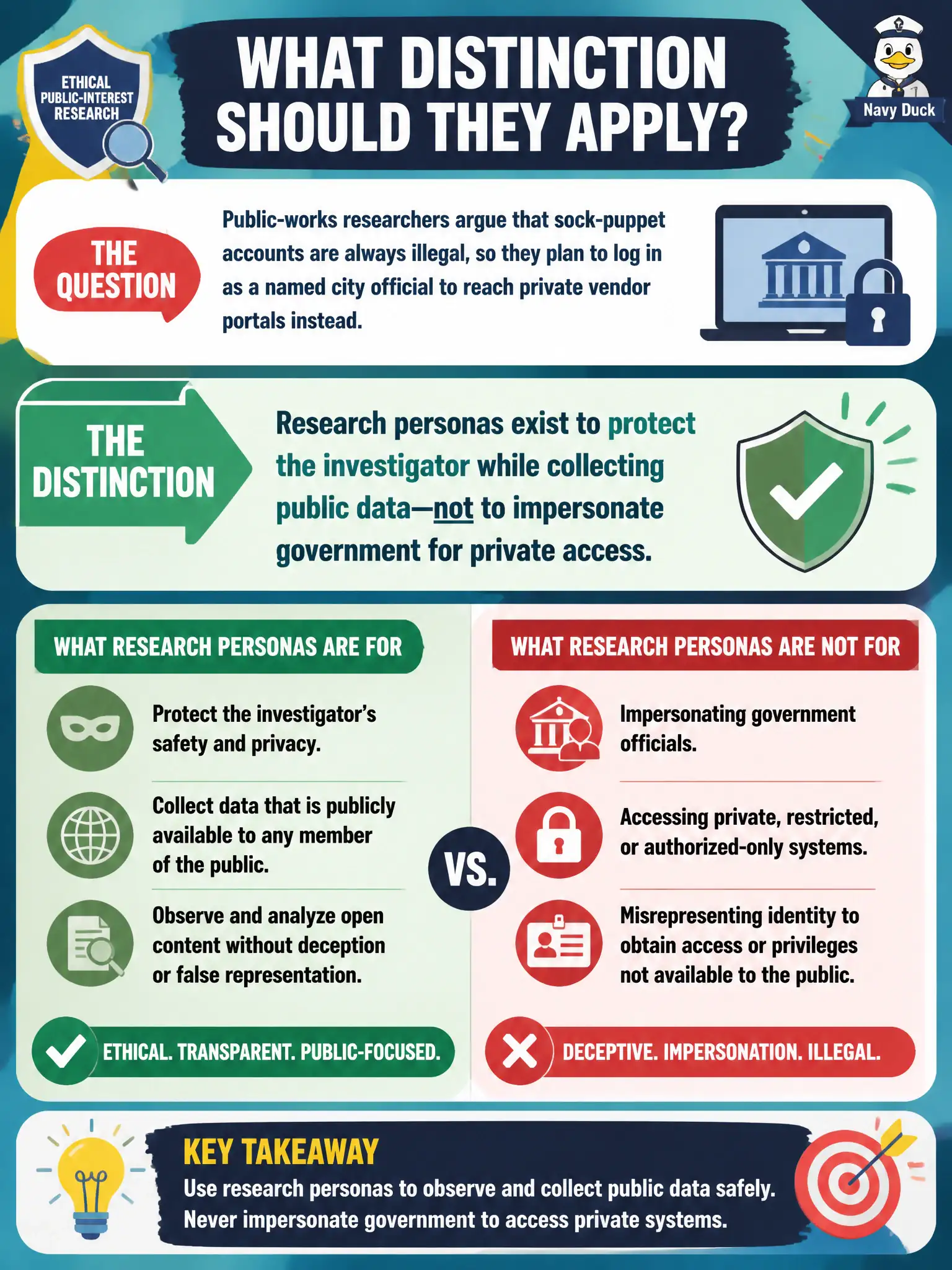
A sock puppet is a pair of sunglasses for looking at the public street, not a stolen city badge for walking through a locked door. Viewing public pages under a research persona is OPSEC. Pretending to be a city official to reach private data is a different—and out-of-bounds—move.
Full Explanation
Research personas exist to protect the investigator while collecting public data—not to impersonate government officials to reach private vendor portals. Public-works staff who reject all sock puppets as illegal and then plan to log in as a named city official for private access choose the more dangerous path. Claiming sock puppets are always illegal so official impersonation is the only lawful option misstates both concepts. Asserting that impersonating a director is required OPSEC because vendors ignore unnamed accounts confuses access negotiation with public-source research. Declaring any account that is not the analyst's real name a crime, including isolated lab browsers, overcriminalizes ordinary research hygiene. Exam caveat: authorized official accounts may access vendor portals under real authority; that is not sock-puppet OSINT and must not be framed as a persona trick. Operational check: if the needed portal is private, use a real authorized civic identity through proper channels—or stay outside—rather than fabricating either a deceptive official or an out-of-scope private login under an OSINT label. Keep the civic purpose, method limits, and exhibit labels aligned so reviewers can see what was public-source work versus other authorities.