
A billing team stores card numbers in spreadsheets and wants data findings for those values without a flood of unrelated patterns. Which classification choice fits?
Select an answer to reveal the explanation.
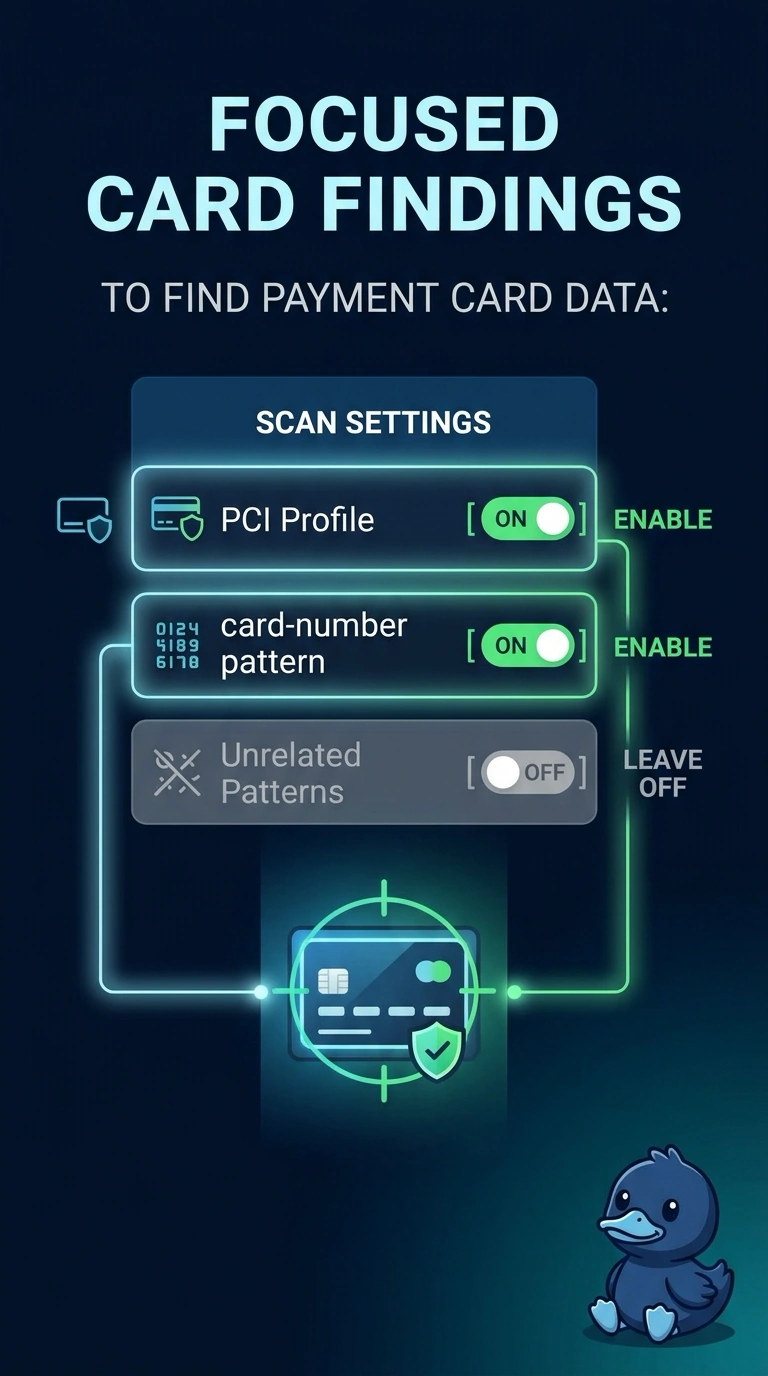
Short Explanation
You do not turn on every alarm in the building to catch one door. Card numbers in spreadsheets belong on the PCI profile, with the card pattern enabled and unrelated patterns left off. The trap is enabling every profile, or turning OCR off, and calling the noise a tuning choice.
Full Explanation
Data-classification profiles shipped in the product are Developer Secrets, Financial, PCI, PHI, PII, and Sensitive. Patterns such as card numbers can be enabled or disabled on their own. Card numbers in billing spreadsheets are a PCI classification, so the PCI profile and the card-number pattern are the match, and unrelated patterns stay off so the team is not flooded. Enabling every shipped profile and every pattern does the opposite. It classifies far more than card data and hides the billing hits in noise. OCR is global and on by default. Turning it off skips text inside images for every module. It does not limit classification to photographs in one billing store, and spreadsheets are not images, so that switch misses the stated goal. A Kubernetes connector control evaluates kind, metadata, and spec. Mapping spreadsheets to a connector rule does not classify card numbers in a data store. Exam caveat: API sensitive-data findings populate the existing sensitive-data field only for enabled profiles; enabling a profile does not create a new table column, so a disabled PCI profile stays blank even when the files contain cards. Operational check: enable PCI and the card pattern, scan one known spreadsheet, and confirm the finding is a card pattern with unrelated patterns absent from that object.