
After an authorized municipal rogue-AP test window ends, what engagement hygiene is required?
Select an answer to reveal the explanation.
Short Explanation
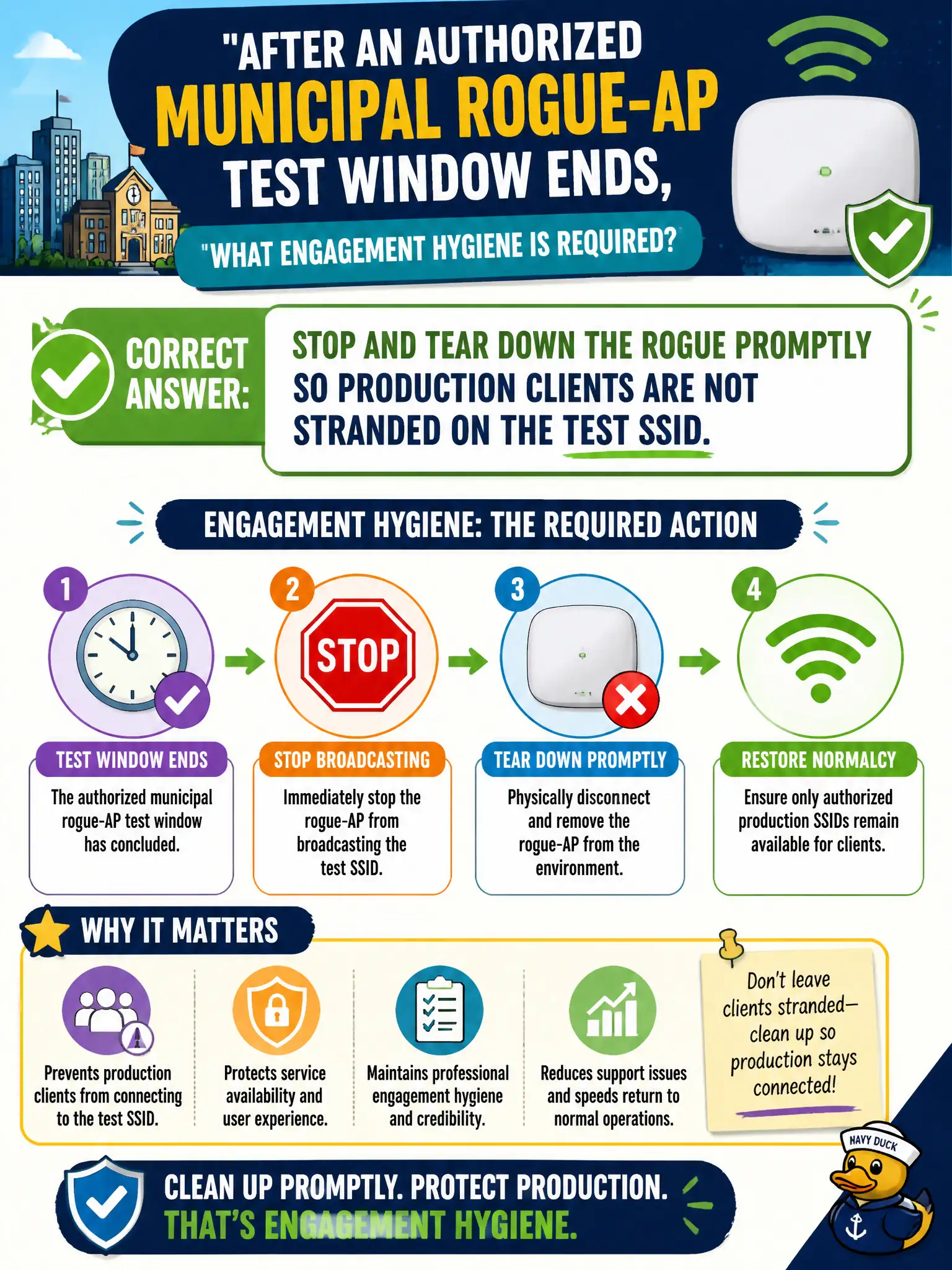
When the clock hits zero, kill the fake AP. Leaving it up is how library laptops marry your lab SSID and call you at midnight. Teardown is part of the job, not optional flair.
Full Explanation
After an authorized municipal rogue-AP test window ends, engagement hygiene requires stopping and tearing down the rogue promptly so production or bystander clients are not left associated to a non-production SSID, DHCP domain, or portal path. Evidence collection belongs inside the approved window; extending the rogue overnight to gather more screenshots violates time-boxing and increases unintended association risk for staff and visitors. Increasing transmit power after the window to stress neighboring agencies expands scope and can create harmful interference beyond the engagement. Handing rogue SSID credentials to visitors for unsupervised continuation abandons ownership and RoE accountability. Exam caveat: teardown includes RF advertisement cessation, DHCP, DNS, and portal services, plus verification that clients rejoin production networks. Operational check: use a checklist with named owner, confirm the rogue BSSID disappears from a survey, spot-check civic clients for correct SSID association, and record teardown time in the engagement log. For municipal and campus engagements, keep the finding language tied to authorized scope, name the building or SSID class affected, and state the residual risk to residents or staff if the rejected option had been chosen. Re-validate after the next change window that the selected control still matches inventory, monitoring, and RoE abort criteria used by the city wireless program.