
A county training session discusses Karma-style responses to client probe requests. At awareness depth, what does that Karma-class behavior do?
Select an answer to reveal the explanation.
Short Explanation
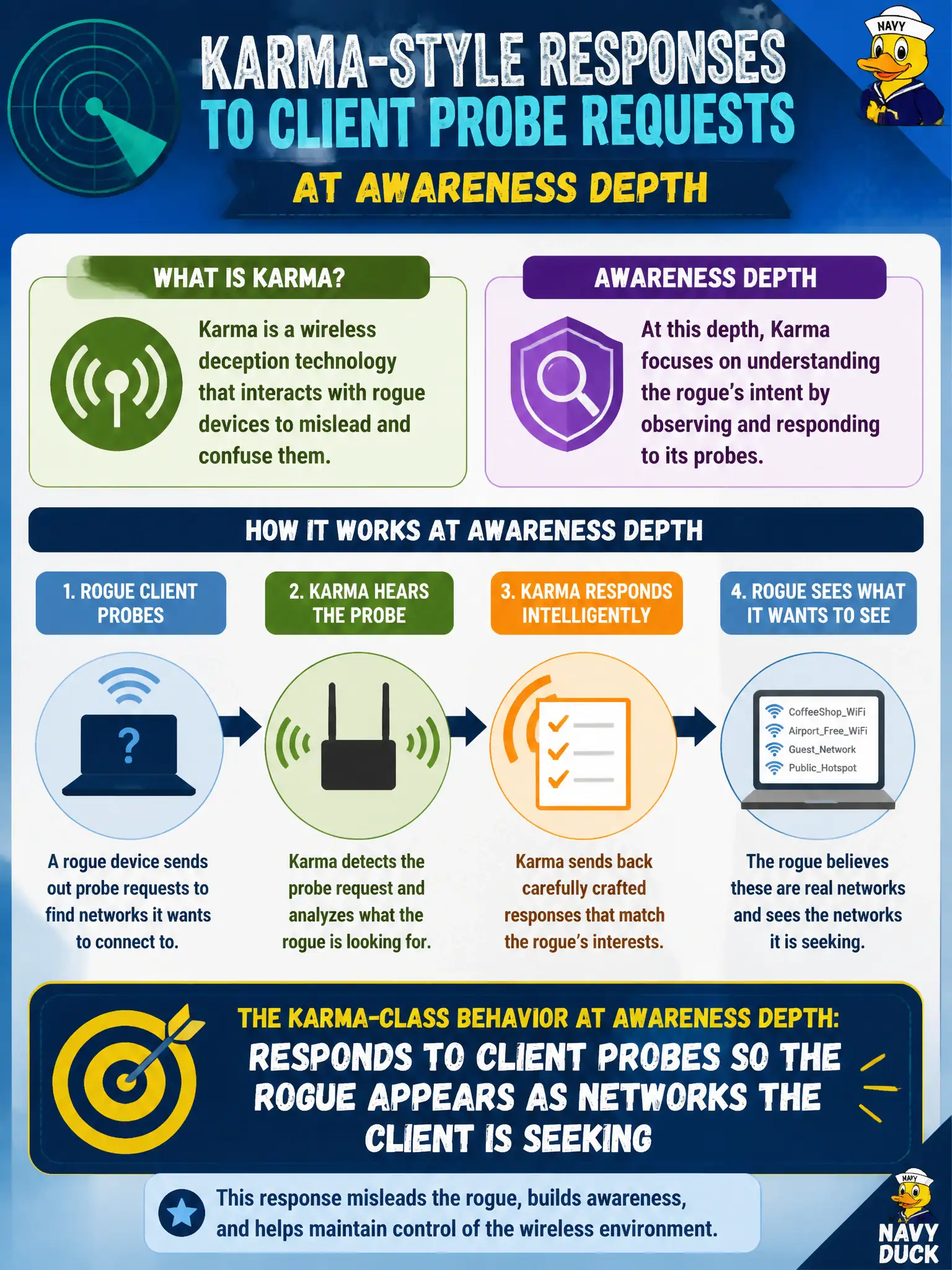
Karma is the trick where the rogue listens to probe requests and answers, 'Yep, I'm that café you miss.' The laptop thinks it found a familiar SSID and walks right in. It is not wiping PNLs, turning WPS on everywhere, or sprinkling WEP on management frames.
Full Explanation
Karma-style responses to client probe requests, at awareness depth, respond to client probes so the rogue appears as networks the client is seeking. That attraction class helps explain why laptops with noisy Preferred Network Lists are vulnerable to lookalike or unexpected SSIDs in a civic lobby. Municipal awareness training should cover probe leakage without providing illegal targeting advice.
'Deletes all Preferred Network Lists so laptops can never roam again' fails because Karma-class behavior does not delete all Preferred Network Lists so laptops can never roam again. 'Forces every AP in the county to enable WPS PIN mode permanently' fails because it does not force every AP in the county to enable WPS PIN mode permanently. 'Encrypts management frames with a citywide static WEP key' fails because it does not encrypt management frames with a citywide static WEP key.
Exam caveat: understanding Karma-class attraction is literacy—deployment still requires authorization. Operational check: in an authorized city lab, show probe responses attracting a test client, then remediate with user PNL hygiene guidance and rogue detection. Never run Karma-class responses against production populations outside RoE. In municipal wireless operations, record the rationale in the engagement notes so future assessors know which control or technique class was chosen and which failure modes the rejected options would create for city services.